The little girl forgot everything the moment she saw the photograph.
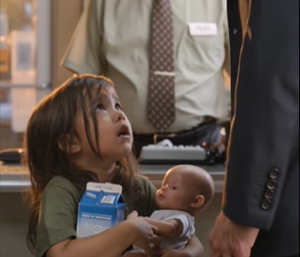
The store around her disappeared. The humming refrigerators, the tired clerk behind the counter, even the milk carton growing cold in her hands no longer mattered. For one frozen second, she forgot how to breathe.
Her arms tightened around the baby instinctively, so hard that the infant squirmed and let out a tiny cry of discomfort. But she didn’t loosen her grip. She couldn’t.
Because the woman in the photograph was her mother.
Younger than she remembered. Thinner too. Her face looked frightened in a way the little girl had never seen before. And wrapped in her mother’s arms was a newborn baby covered in the exact same blue-and-white blanket the child she carried had been sleeping in for weeks.
The stranger standing across from her noticed the fear immediately.
Then he noticed the anger.
“That’s my brother,” the girl whispered.
The man didn’t answer right away.
Something about the silence made him more frightening than shouting ever could. Maybe it was because calm people were harder to predict. Or maybe it was because grief had already hollowed him out long before he walked into that little store.
Behind the register, the elderly clerk shifted uncomfortably but stayed quiet. He seemed to understand this was the kind of moment where one wrong move could destroy everything.
The girl swallowed hard and tried again.
“Who are you?”
The man looked down at the baby before answering.
“My sister’s son disappeared from the hospital three months ago,” he said quietly. “Your mother’s picture was found with the nurse who vanished the same night.”
The child’s face immediately crumbled.
“No,” she said, shaking her head fast. “My mom didn’t steal him.”
It wasn’t the answer of someone trained to lie.
It was the answer of a daughter defending the only person she had left in the world.
The man noticed that too.
The baby began fussing again, tiny hands curling against the blanket. Without thinking, the girl gently rocked him against her chest with the awkward skill of someone who had learned responsibility much too early in life. There was nothing natural about a child carrying another child through city streets at night, yet she held him with practiced care.
The stranger watched every movement carefully.
Then he asked the question that changed everything.
“Where is your mother now?”
The girl opened her mouth, but no words came out.
That silence told him enough.
The old clerk lowered his eyes toward the counter.
And suddenly the man’s expression shifted. The suspicion faded first. Then the anger. What remained looked dangerously close to heartbreak.
The little girl blinked quickly, fighting tears.
“She told me to buy milk first,” she whispered. “And she said if she wasn’t back before the streetlights came on, I had to keep walking. She told me not to tell anyone his real name.”
The store became completely silent.
Even the refrigerators seemed quieter now.
The man stared at the baby. Then at the frightened little girl holding him. Then finally back at the photograph in his hand.
And in that terrible moment, he realized something worse than kidnapping.
The woman hadn’t been running away with the baby.
She had been running to protect him.
The girl tightened her fingers around the milk carton until it nearly slipped from her hands.
“My mom said people would come looking for him,” she whispered. “She said some of them would claim he belonged to them. But only one side actually wanted him alive.”
The stranger froze completely.
Behind the counter, the old clerk’s expression darkened with recognition.
This wasn’t just about a missing child anymore.
This was about family money. Family power. Maybe even inheritance. The kind of secrets wealthy people buried behind lawyers, security guards, and polished smiles.
And suddenly the frightened child standing in that tiny convenience store wasn’t holding a kidnapped baby.
She was holding evidence.
The man slowly sat down in the chair near the window as though his legs could no longer support him. He rubbed one hand across his face, exhausted in a way that looked older than his years.
“What did your mother tell you about my family?” he asked quietly.
The girl hesitated.
“She said your last name was dangerous.”
The words hit him hard.
“She said rich people can make bad things disappear,” the child continued softly. “She said if they found him too early, he’d never get the chance to grow up.”
The man stared at the floor for several seconds before finally speaking again.
“My father owns hospitals,” he admitted. “My brother died last year. My nephew is the last person connected to our family name.”
The girl frowned slightly, confused.
“Then why would anybody want him gone?”
The man looked at her with painful honesty.
“Because sometimes money changes people,” he said. “And sometimes a child becomes worth more dead than alive.”
The little girl instinctively held the baby closer.
For the first time since entering the store, the man looked ashamed of the name he carried.
The old clerk finally spoke, his voice rough with age.
“I saw her here three nights ago,” he said carefully. “Your mother looked terrified. She kept checking the windows like someone was following her.”
The girl’s breathing quickened.
“She promised she’d come back.”
Nobody answered.
Because deep down, all three of them already understood the truth.
If the mother had truly intended to return, she would have.
The man slowly reached into his coat pocket and pulled out a folded piece of paper. He placed it gently on the counter without taking his eyes off the baby.
“There was a car accident outside the city this morning,” he said quietly. “Police found a woman with no identification.”
The little girl stopped breathing.
“But she was holding this.”
He unfolded the paper carefully.
It was a handwritten note.
Three words were written across it in shaky ink:
“Protect him first.”
Tears filled the child’s eyes instantly, but she refused to cry. Her mother had taught her better than that. Crying slowed you down. Crying made people notice you.
The stranger looked at her differently now.
Not as a suspect.
Not as a thief.
But as a child carrying a burden no little girl should ever have to carry alone.
Then she asked the question that finally broke the calm expression on his face.
“If he really belongs to your family,” she whispered, “why did my mom beg me to never let your last name find him?”