The shout shattered the peaceful atmosphere of the elegant garden restaurant so suddenly that every conversation stopped mid-sentence.
“HEY! GET HIM OUT OF HERE!”
Crystal glasses trembled lightly against white linen tablecloths as heads turned toward the entrance. The soft music drifting through hidden speakers faded beneath the weight of growing whispers. Wealthy guests sitting beneath hanging lights and flowering vines stared in confusion at the tiny figure standing near the center walkway.
It was just a little boy.
He looked no older than five years old.
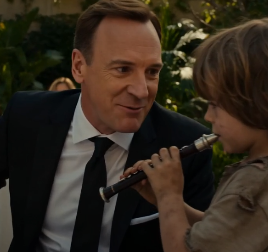
His clothes were dirty and worn thin from too many nights outside. His small sneakers were scuffed almost completely gray with dust, and his dark hair fell messily across his forehead as if nobody had brushed it in days. In his trembling hands, he held an old silver flute so tightly it almost looked painful.
But what unsettled people most was not his appearance.
It was his expression.
He wasn’t crying.
He wasn’t panicking.
His eyes looked strangely calm for a child standing alone in a place where he clearly did not belong.
A waiter moved toward him nervously. Several guests looked irritated already, uncomfortable with the interruption to their expensive evening. One woman quietly turned her chair away as though refusing to even acknowledge the boy’s presence.
Then the child spoke.
“Please… I need money,” he said softly. “My mom is sick.”
His voice was barely above a whisper, yet somehow everyone heard it.
For a moment, silence spread through the restaurant like a cold breeze moving through the trees overhead. A few people exchanged uneasy glances. Others quickly looked back down at their meals, pretending not to notice.
At the largest table near the center fountain sat a wealthy man in a dark tailored suit. He leaned back slowly in his chair, studying the child with visible amusement. A half-finished glass of wine rested loosely in his hand.
Unlike the others, he looked entertained.
A slow smirk crossed his face.
“Oh yeah?” he asked casually.
The boy nodded once.
The man leaned forward slightly now, his tone colder than before.
“Then earn it.”
Several guests shifted awkwardly in their seats.
“Surprise us,” the man continued. “And maybe I’ll give you something.”
The challenge hung in the air.
For a second, nobody moved.
The breeze stirred softly through the garden leaves. Golden evening sunlight reflected across polished glasses and silverware. Somewhere in the distance, water trickled gently from the marble fountain.
The little boy lowered his eyes to the flute in his hands.
His fingers shook visibly.
Then slowly, carefully, he raised the instrument to his lips.
And he began to play.
The first notes were soft.
Fragile.
Almost uncertain.
But within seconds, something changed.
The melody deepened into something hauntingly beautiful, rich with emotion no child his age should have understood. It drifted through the restaurant with a sadness so pure and honest that conversations died instantly.
Forks froze halfway to mouths.
A server stopped walking beside the fountain.
Even the man in the suit lost the smile on his face.
The music wrapped around the garden like memory itself.
Some guests stared openly now, unable to look away. Others lowered their eyes as if the melody had touched something painful inside them. One older woman near the roses pressed trembling fingers against her lips, tears already gathering in her eyes.
The little boy continued playing.
Every note sounded filled with longing.
With grief.
With love.
It was not the kind of performance people expected from a frightened child asking for money. It sounded like something much older. Something lived through.
Something remembered.
The restaurant no longer felt elegant.
The expensive wine, the polished marble, the designer clothing—none of it seemed important anymore. For those few moments, the music stripped away every layer of wealth and status until all that remained was silence and feeling.
And then suddenly, the song ended.
The final note faded softly into the evening air.
No one moved.
The silence afterward felt even heavier than the music itself.
The boy slowly lowered the flute.
His breathing was shallow but steady.
Then, without speaking, he reached into his pocket.
From inside, he carefully pulled out a small photograph. The edges were bent and worn from age, as though someone had carried it for years.
He walked toward the wealthy man’s table.
Every eye followed him.
The man frowned slightly now, no longer amused. Something uncertain had entered his expression.
The boy held out the photograph silently.
For a brief second, the man hesitated before taking it.
Then he looked down.
And everything changed.
The color drained from his face instantly.
His confident posture disappeared so quickly it almost frightened the guests around him. The hand holding the photograph tightened visibly around the edges while his eyes locked onto the image like he had seen a ghost.
Confusion flickered across his face first.
Then shock.
Then something much deeper.
Something real.
The entire table fell silent as they watched him stare at the photograph without blinking.
“…Where did you get this?” he asked quietly.
His voice no longer sounded powerful.
It barely sounded steady.
The little boy met his eyes without fear.
“My mom said…” he answered softly, “…you would recognize me.”
The wealthy man inhaled sharply.
For a second, nobody in the restaurant understood what they were witnessing. But everyone could feel it.
Something inside the man had cracked open.
His eyes remained fixed on the photograph while memories he had buried long ago seemed to rush back all at once.
Because he did recognize it.
The picture showed a much younger version of himself standing beside a woman beneath an old oak tree. She was smiling brightly, one hand resting gently against her stomach while he stood beside her with his arm around her shoulders.
The date printed faintly in the corner was from six years earlier.
Before his fortune exploded.
Before his name appeared in magazines.
Before he abandoned the small town where he once promised someone he would never leave.
His breathing became uneven.
The little boy stood motionless beside the table, waiting.
Around them, the restaurant remained frozen in complete silence.
Finally, the man looked up slowly.
“What… is your mother’s name?” he asked.
The child answered immediately.
And the moment the name left his lips, the wealthy man closed his eyes like the truth had physically struck him.
Several guests exchanged stunned glances.
The arrogant confidence that once surrounded him had vanished completely. In its place stood a man overwhelmed by regret he could no longer hide behind money or status.
The little boy tightened his grip on the flute.
“She’s very sick,” he whispered. “She told me if I found you… you would help us.”
The man swallowed hard.
For years he had convinced himself that part of his life no longer existed. Success had buried the memories beneath business deals, luxury vacations, and crowded social events. But standing before him now was proof that the past had never disappeared.
It had simply waited.
The child looked exactly like him.
Not just in the eyes.
Not just in the shape of his face.
But in the quiet sadness he tried so hard to hide.
The wealthy man slowly stood from his chair.
Nobody spoke.
Nobody dared interrupt.
Then, for the first time that night, his voice softened completely.
“Take me to her.”
The little boy stared at him carefully, as if trying to decide whether he could trust him.
Then finally, he nodded once.
And in the middle of the luxurious restaurant where everyone once looked at the child with discomfort and pity, the wealthy man followed the small boy toward the exit—leaving behind untouched wine, expensive meals, and a silence none of the guests would ever forget.