The sound came first.
Not loud. Somehow worse than loud.
Smooth. Perfect. The kind of engine that belonged behind gated mansions and luxury hotels—not on a forgotten corner where broken sidewalks collected rainwater and old storefronts leaned under faded signs.
One engine purred softly through the cold morning air.
Then another.
Then a third.
People turned before they even realized they were looking. Heads lifted from paper cups of coffee. Conversations stopped halfway through sentences. A man carrying grocery bags froze beside the bus stop.
Because nothing like that ever came to this street.
Not here.
Not where the smell of cheap food drifted through winter air while exhausted people counted coins in their pockets.
Then the cars appeared.
One white.
One black.
Another white.
Three shining Rolls-Royces moved slowly down the narrow street like they were floating above the cracked pavement. The polished bodies reflected the gray morning sky while steam rose from sewer grates beneath them.
And then they stopped.
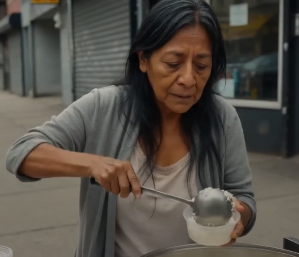
Right in front of Shiomara Reyes’s food cart.
Shiomara froze instantly.
The metal ladle stayed suspended in mid-air while steam from a pot of rice brushed gently against her face. Warm. Familiar. Real. It was the only thing that still felt real.
For one strange second, she thought maybe there was a wedding nearby. Or a movie being filmed. Something glamorous meant for people who never worried about rent or overdue bills.
People like that never stopped at her cart.
They especially never looked at her.
But then the engines went silent.
The doors opened slowly.
Three people stepped out.
Two men.
One woman.
Everything about them looked expensive without trying to. Tailored coats. Clean shoes untouched by dirt. Watches that probably cost more than Shiomara had earned in years.
They looked like people who had never gone to bed hungry.
Like people the world welcomed automatically.
Yet none of them looked at the buildings around them.
None of them noticed the crowd gathering nearby.
They looked only at Shiomara.
And at her cart.
Suddenly the street felt strangely quiet. The wind disappeared. The cold faded into the background. Even the traffic farther down the avenue seemed distant.
All Shiomara could hear was her own heartbeat.
And one painful thought repeating quietly inside her mind.
What did I do wrong?
The three strangers stepped closer.
Too close.
The younger man on the left tried to smile, but his expression trembled before it fully formed.
The taller man in the middle swallowed hard like he was struggling to hold something inside himself together.
The woman, older now with silver streaks in her dark hair, pressed one hand against her chest as though steadying her breathing.
Shiomara opened her mouth.
“Good morning—”
Nothing came out except weak air.
The woman stepped forward again.
Closer.
Closer.
Her eyes stayed locked onto Shiomara’s face with an intensity that felt almost unbearable. Searching. Remembering. Breaking apart.
Then finally, in a shaking voice barely above a whisper, she spoke.
“You fed us.”
Shiomara blinked in confusion.
The man in the blue suit stepped beside the woman.
“We were the kids,” he said softly. “Under the bridge.”
Everything stopped.
Not just the street.
Not just the crowd.
Something deeper stopped inside Shiomara herself.
Cold nights flashed through her memory.
Rain soaking through cardboard.
Three tiny children curled together beneath a highway bridge while passing cars thundered overhead.
Triplets.
Always together.
Always hungry.
She remembered their eyes most of all.
The way they tried to act brave while staring at the food she carried.
Back then Shiomara had almost nothing herself. Some days she barely earned enough to buy rice for the next morning. Her cart was old. The wheels squeaked. Winter winds slipped through holes in her jacket.
But every few nights she saw those children huddled under that bridge.
And every time she stopped.
Every time.
Even when logic told her not to.
Even when she herself was hungry.
The third man finally spoke quietly.
“You used to tell us something,” he said.
Shiomara’s hands began trembling.
The man smiled sadly.
“You said, ‘Eat first. The world can wait.’”
The words hit her like a wave crashing into stone.
Her knees nearly weakened.
“No…” she whispered softly. “It can’t be…”
The silver-haired woman moved closer until she stood only inches away. Tears slid freely down her face now.
“You saved us,” she said.
Silence settled over the street.
Heavy.
Absolute.
Even the people watching nearby seemed afraid to move.
Then the man in the center reached carefully into his coat pocket and removed a thick sealed envelope.
He placed it gently on top of Shiomara’s cart.
Steam curled around the envelope while morning light reflected softly across its surface.
Like time itself had folded backward.
“We searched for you for years,” the younger man admitted quietly.
His voice cracked near the end of the sentence.
The woman finished it for him.
“We promised each other,” she whispered, “that if we ever escaped that life… if we ever made something of ourselves… we would come back for you.”
Shiomara could barely breathe.
Her chest tightened painfully while emotions she hadn’t touched in years rose all at once.
Confusion.
Fear.
Hope.
Grief.
The kind of grief carried by people who spent too much of life surviving to stop and feel anything.
The taller man nodded gently toward the envelope.
“Open it.”
Her trembling fingers reached slowly for it.
The paper felt heavier than it should have.
Carefully she opened the seal.
Inside rested an old photograph.
Worn at the corners.
Faded by time.
Three small children sat cross-legged on the sidewalk holding paper plates filled with rice and beans.
Behind them stood Shiomara.
Younger.
Exhausted.
Her clothes were worn and her eyes looked tired beyond words.
But she was smiling.
Not because life was easy.
Not because she had enough.
But because for one moment, three children were no longer hungry.
Tears instantly blurred her vision.
Then she noticed something underneath the photograph.
A document.
Official.
Stamped.
Her name printed clearly across the top.
Her hands shook harder.
“What… what is this?” she whispered.
The younger man looked directly into her eyes.
And in his expression was something even stronger than gratitude.
Love.
The kind born only from remembering who helped you when nobody else cared enough to stop.
“It belongs to you,” he said softly.
Shiomara stared at him without understanding.
The woman wiped tears from her cheeks and smiled through them.
“You fed us when we had nothing,” she said.
The taller man drew in a slow breath before continuing.
“And now,” he said carefully, “you will never be hungry again.”
The crowd nearby watched in stunned silence as Shiomara lowered her eyes back toward the document.
It was ownership paperwork.
A fully paid home.
A small restaurant property nearby.
And a savings account established in her name.
Enough money to change the rest of her life forever.
Shiomara covered her mouth with trembling fingers.
“No…” she whispered again, tears falling freely now. “This is too much.”
The silver-haired woman shook her head immediately.
“No,” she said firmly. “It still isn’t enough.”
People standing nearby quietly wiped their own eyes.
Because deep down, everyone understood what they were witnessing.
Not charity.
Not pity.
Something far more powerful.
A debt of kindness finally returning home.
Years earlier, one exhausted woman with almost nothing had chosen compassion over survival instinct. She had fed three starving children when nobody would have blamed her for walking away.
And those children never forgot it.
Success had changed their clothes.
Their cars.
Their lives.
But it had not erased the memory of hunger.
Or the memory of the woman who looked at them and still saw human beings worth saving.
The wind moved gently down the street again.
Steam continued rising from Shiomara’s cart.
For the first time in years, her tired shoulders slowly relaxed.
And standing there between three Rolls-Royces and a crowd of silent strangers, Shiomara Reyes finally understood something beautiful:
The smallest acts of kindness are sometimes the ones that echo the longest.
Because the world may forget what people say.
It may even forget what people achieve.
But it never truly forgets who fed someone when they were starving.