Anna looked exhausted the moment she stepped into my clinic. I had seen tired pet owners before, of course. Animals get sick at inconvenient times, and many people lose sleep worrying about them. But this was different. The woman standing in front of me looked like someone who had not truly rested in months.
I’m a veterinarian, and my phone rings at all hours of the day and night. People assume that if you work with animals, you should have answers for everything immediately. I’ve gotten calls about coughing dogs, nervous parrots, rabbits refusing to eat, and cats that suddenly stopped using the litter box. But when Anna called earlier that afternoon, something in her voice stayed with me.
“Hello, is this the clinic?” she asked quietly. “My name is Anna. I have an appointment with you. I need help with my cat. She won’t let me sleep.”
Usually, when someone says that, they mean the cat is loud or restless. Maybe it scratches furniture at night or races around the house knocking things over. But Anna didn’t sound irritated. She sounded frightened and deeply worn down.
When she arrived, she looked carefully put together despite her exhaustion. She appeared to be around fifty-five years old, with a neat haircut and a long gray coat that matched her boots perfectly. She held the cat carrier gently in both hands, as though she were carrying something fragile.
“This is Luna,” she said softly after sitting down. “My husband picked the name. During the day she’s sweet and calm. But at night…” Anna paused and sighed. “At night she becomes impossible.”
Inside the carrier sat a large gray cat with thick fur and striking eyes. Luna looked calm, alert, and completely healthy. There was no sign of aggression or nervousness.
“So what exactly happens?” I asked.
Anna folded her hands together tightly before answering.
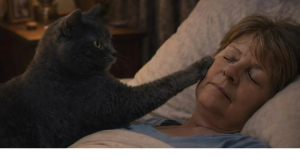
“Every night, always around three or four in the morning, Luna wakes me up. At first she gently taps my cheek with her paw. If I ignore her, she starts hitting harder. Sometimes she bites my hand. She pulls on the blanket until I get up. She refuses to stop until I leave the bedroom completely.”
“And then what happens?” I asked.
“As soon as I go sleep on the couch in the living room, she climbs onto my pillow and falls asleep peacefully. Every single time.”
“How long has this been going on?”
“About three months,” Anna replied. “At first I thought she was bored or acting out. Then I thought maybe something was wrong with me. My doctor said stress could cause insomnia, so he prescribed sleeping pills. But nothing changed because Luna always wakes me before dawn.”
As she spoke, Luna sat beside her quietly without making a sound. The cat kept watching Anna carefully, almost protectively.
I performed a full examination. Luna’s breathing was clear, her heartbeat steady, her weight healthy. Her eyes were bright, and her reflexes were normal. There were no signs of illness or neurological problems. She was one of the healthiest cats I had seen that week.
But as I stood there listening to Anna describe the nightly routine, an uneasy feeling settled in my stomach.
Animals sometimes notice things humans miss. Cats are especially sensitive to changes in smell, movement, and behavior. Over the years, I had heard countless stories from owners whose pets reacted strangely before a medical emergency. Dogs waking owners before seizures. Cats refusing to leave someone’s side before a stroke. Animals often recognize danger long before humans do.
“Anna,” I said carefully, “have you had any medical tests recently?”
She blinked in surprise. “Medical tests? Why?”
“Because I don’t think Luna is trying to torment you,” I replied slowly. “I think she may be trying to move you out of that room.”
Anna stared at me in confusion.
That was when she mentioned something she had not considered important before.
“For the past few months,” she admitted, “I’ve been waking up with headaches. Sometimes I feel dizzy in the mornings. I thought it was stress or poor sleep.”
A cold feeling ran through me immediately.
“Do you have gas heating in your apartment?” I asked.
“Yes,” she answered. “An older system. But it’s always worked fine.”
I told her not to go home alone. Instead, I advised her to contact emergency maintenance services immediately and ask them to inspect the apartment, especially the bedroom.
Anna looked nervous but agreed.
The next evening, my phone rang again. It was Anna.
This time her voice was shaking.
“They found a carbon monoxide leak,” she whispered. “A crack in the heating system near the bedroom wall. The technician said the gas level was dangerous, especially overnight with the windows closed.”
I sat in silence for several seconds.
Carbon monoxide is nearly impossible for humans to detect without equipment. It has no smell, no color, and no obvious warning signs. But animals can sometimes react to it long before people realize something is wrong.
“The technician told me another few weeks could have been fatal,” Anna continued, her voice breaking. “Especially while sleeping.”
She started crying quietly on the phone.
“And Luna kept forcing me out of the room every night,” she said. “She wasn’t trying to hurt me. She was saving me.”
For a long moment, neither of us spoke.
People often underestimate animals. They think pets act only on instinct or routine. But sometimes the bond between humans and animals goes deeper than logic can fully explain. Luna could not call for help or explain what she sensed. She could only act the only way she knew how.
By waking Anna repeatedly and forcing her to leave the bedroom, the cat may have been protecting her from prolonged exposure to the gas during the most dangerous hours of the night.
A week later, Anna returned to the clinic with Luna for a follow-up visit. But this time, she looked completely different. The exhaustion had faded from her face. Her posture was relaxed, and there was warmth in her smile.
Luna rested comfortably in her arms like royalty.
“I bought her a new bed,” Anna said with a small laugh. “And expensive treats. She deserves everything.”
“You’re sleeping again?” I asked.
“Like a baby,” she replied. “And Luna sleeps beside me peacefully now that the heating system has been replaced.”
Before leaving, Anna paused near the door and looked down at her cat.
“You know,” she said quietly, “after my husband passed away, Luna became my entire family. I thought I was taking care of her all these years.” Her eyes filled with tears again, but this time they were gentle tears. “I never realized she was taking care of me too.”
After she left, I sat in my office thinking about how close she had come to tragedy.
As veterinarians, we study anatomy, illnesses, medications, and behavior. Science explains a great deal about animals. But moments like this remind me there are still things we do not completely understand.
Sometimes love does not arrive in words. Sometimes it comes with paws, quiet persistence, and a refusal to let someone stay where danger waits in the dark.
And sometimes, the creature sleeping at the foot of your bed may understand far more than you ever imagined.