The special forces commander believed the young woman in front of him had come to the wrong place. Lara looked too quiet, too ordinary, and small for a unit built on discipline, pain, and impossible standards. So when she arrived calmly, he decided she would not last.
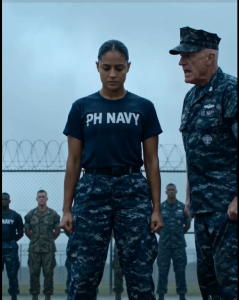
He did not hide it.
From the first morning, Lara was treated like an inconvenience. The soldiers glanced at her, then looked away as if she had already failed. Some whispered. Others smirked openly.
“She must be lost,” one muttered.
“Maybe the front office is hiring,” another said.
No one believed a young woman who seemed so unremarkable could stand beside them.
During drills, Lara was not placed in line. The commander pointed toward a wooden bench near the edge of the training ground.
“Sit and watch,” he said.
So Lara sat.
She watched men fall, curse, rise, and keep going because quitting meant shame.
No one noticed. To them, she was simply the girl on the bench.
Days passed. At first, Lara obeyed without protest. Her face revealed nothing, but inside, the silence grew heavier. She had not come to be protected or tolerated. She had come to prove something, though no one had cared enough to ask what it was.
By the seventh day, the soldiers were preparing for another brutal strength session. A barbell lay in the center of the yard, loaded with more than one hundred kilograms. Even experienced fighters approached it with caution.
The commander barked orders, then turned toward Lara and nodded at the bench.
She did not move.
For the first time all week, she held her ground. Conversations faded. The commander looked back slowly, irritation crossing his face.
Lara drew a steady breath and stepped forward.
“Sir, permission to speak.”
His eyes narrowed.
“Granted.”
“Sir, I want to train on equal terms with everyone.”
A faint smile pulled at his mouth.
“Not allowed. Follow the order.”
But Lara remained where she was.
“No, sir. I have been here for a week, and you have not given me one chance to show what I can do.”
The commander stared at her, then hardened.
“So you want to show your strength?”
Before she could answer, he grabbed her arm and marched her to the center of the field. He stopped beside the loaded barbell and released her sharply.
The soldiers became alert. A few smiled. They knew that weight. They had seen trained men fail under it.
The commander pointed down.
“Lift it and hold it for five minutes. If you fail, pack your things and go home. The army does not keep the weak. You can find a quiet job somewhere else.”
Laughter moved through the group.
Then he added, full of mockery, “And if you succeed, I will make you my assistant.”
“Careful,” one called. “Do not drop it on your foot.”
“You will break your back.”
“Better quit now.”
Lara did not answer. She looked at the barbell, then at her hands. The weight was enormous. They wanted her to struggle, shake, fail, and leave with humiliation burning in her face.
The commander raised his watch.
“Time starts now.”
Lara bent down and wrapped both hands around the bar. For a moment, nothing happened. Her back settled into position. The field seemed to hold its breath.
The first pull was slow.
The plates left the dirt by a few inches, then stopped. Someone laughed under his breath. The commander’s smile widened.
But Lara did not panic.
She exhaled, lowered the weight carefully, adjusted her grip, and closed her eyes for half a second. When she opened them, something in her expression had changed. She had entered a quiet place inside herself where their voices could not follow.
She pulled again.
This time the bar rose cleanly to her knees, then to her hips. Her arms locked. Her feet pressed into the ground. The laughter vanished.
The commander’s smile faded.
Lara stood still, holding the weight as if every muscle in her body had accepted one command: endure. Her face was pale, but calm. Her breathing stayed controlled. The bar trembled slightly, yet it did not fall.
At three minutes, even the instructors stared.
Sweat rolled down Lara’s temple. Her fingers turned white around the steel. Pain cut through her shoulders and legs, but she refused to show it. She focused on her breath, the dirt beneath her boots, and the reason she had come.
The commander glanced at his watch. His jaw tightened.
Four minutes.
No one spoke.
The woman they had dismissed as weak was still standing in the center of their field, carrying a weight many of them feared. Yet what stunned them most was her control. She did not scream. She did not seek applause. She simply endured.
When the fifth minute arrived, the commander did not call time immediately. He stared as if he needed another second to believe it.
Then, quietly, he said, “Time.”
Lara lowered the barbell with care. The plates hit the ground with a heavy thud. She straightened slowly. Her arms shook, but she remained standing.
No one laughed.
The commander walked toward her. For the first time, he looked at her not as a mistake, but as a soldier.
“Where did you learn to hold like that?”
Lara wiped sweat from her brow.
“My father was in this unit, sir. Before he died, he trained me every morning. He told me strength is not noise. Strength is staying when everyone expects you to leave.”
The words struck harder than the barbell hitting the dirt.
“What was his name?” he asked.
“Captain Daniel Hayes.”
The field went completely still.
Every man there knew that name. Captain Hayes had been a legend in the unit, a commander who once carried two wounded soldiers through danger and refused to abandon his team.
The commander’s face changed. The mockery was gone, replaced by shame.
Lara continued, steady. “I did not come here for special treatment. I came because he taught me to finish what I start.”
Then the commander removed his cap. One by one, the soldiers around him straightened. The laughter from earlier seemed cruel and small now.
Finally, the commander nodded.
“Fall in,” he said.
Lara looked at him, unsure she had heard correctly.
He pointed to the line of soldiers.
“You asked to train on equal terms. Take your place.”
She walked into formation. The man beside her shifted just enough to give her room.
The next drill began, and Lara ran with them. She struggled, as everyone struggled. She stumbled once, then stood. She breathed hard, but she kept moving.
A warrior is not always the loudest person in the field. Sometimes the strongest one is the person everyone underestimates, the one who sits quietly, learns patiently, and waits for the moment to rise.
By sunset, no one called her ordinary again.
Word count: 1199 words.