I buttoned the last pearl button on my plain white blouse and studied myself in the cracked mirror above the kitchen sink. The blouse was clean and pressed, but it still looked like what it was: a uniform meant to make a woman visible only when something went wrong. My navy skirt touched my knees, my black flats were polished, and my hair was pinned back tightly. Before leaving, I checked my phone.
One new message waited from my supervisor.
Sterling gala tonight. $500 bonus if you keep your mouth shut and stay invisible.
I read it twice, though I understood it immediately. Stay quiet. Stay small. Stay useful. In houses like the Sterlings’, silence was not just expected from the help. It was purchased. Five hundred dollars was not kindness. It was a warning with a price tag.
Still, I swallowed my anger. I needed that money. My daughter’s insulin was not going to pay for itself. Every vial, every doctor visit, every late-night panic had taught me that pride did not lower a pharmacy bill. Pride did not keep my little girl safe when her blood sugar dropped. Pride could wait. Her life could not.
So I typed, Understood, and hit send. I told myself I could survive one evening of being unseen. I had survived worse: double shifts, empty refrigerators, and the quiet fear of choosing which bill could wait. Tonight was only a room full of strangers who believed money made them larger than everyone else.
By the time I reached the Sterling estate, evening had settled into a deep blue glow. Cars slid toward the front entrance. Men in tuxedos stepped out without looking at the valets. Women in expensive gowns laughed softly.
I did not enter through those doors, and no one expected me to.
That was where people like me belonged. I signed in with the catering manager and took hold of a cart stacked with linen napkins, water pitchers, and crystal glasses.
Inside, the mansion felt less like a home than a museum. Marble spread across the floors. Gold trim curled along the walls. Chandeliers spilled cold light over everything below.
I kept my head down and moved my cart toward the ballroom, ready to disappear.
“You’re the new girl?”
The voice stopped me before I reached the swinging door. It was smooth, sharp, and used to being obeyed.
A woman stepped into my path. She wore a cream designer suit, a diamond bracelet, and a perfect blond twist. I recognized her from magazine covers.
Victoria Sterling.
Richard Sterling’s sister.
She looked me over like a scratch on furniture. Not with real anger. This was colder.
“Yes, ma’am,” I said.
Her eyes moved from my blouse to my skirt, then to one worn shoe. “Just so we’re clear,” she said, lowering her voice without softening it, “you don’t speak to guests. You don’t make eye contact. You do not offer opinions, directions, sympathy, or anything else no one asked you for. Tonight, you are furniture.”
I kept my face still. “Yes, ma’am.”
Victoria smiled, but there was no warmth in it. “Good. My brother is making some ridiculous announcement tonight about his mute daughter, and the last thing this family needs is staff wandering around as if they belong in the story.”
Her brother was Richard Sterling, a name known even by people who never read business news. His wife had died years earlier, and his daughter, Eleanor, was rarely seen in public. Some called the girl fragile. Others simply called her mute.
Eleanor was quiet, gentle, and kept away from crowds. Tonight’s gala was supposedly in her honor, though no one seemed sure why.
Victoria leaned closer. “If anyone asks you anything, you find senior staff. If Eleanor is nearby, you give her space. She gets overwhelmed, and my brother becomes difficult when people upset her.”
“I understand.”
“Do you?” Her eyebrows lifted. “Because some new hires see a house like this and start imagining opportunities. A compliment here. A conversation there. Maybe a sad little story about bills or children.” Her gaze flicked toward my phone pocket. “Do not try it here.”
Heat rose behind my eyes, but I forced it down. She did not know my daughter’s name. She did not know about the glucose meter on our kitchen table, or the way my child tried to be brave when the needle came out. Victoria knew nothing about me except my uniform.
“Yes, ma’am,” I said again, because rent was due, medicine was expensive, and one sharp answer could cost me more than dignity.
“And remember,” she said, “in this house, silence is appreciated.”
I almost laughed at the irony. A gala built around a girl who did not speak, managed by people who demanded silence from everyone beneath them.
But I did not laugh. I nodded, pushed my cart through the swinging door, and entered the ballroom.
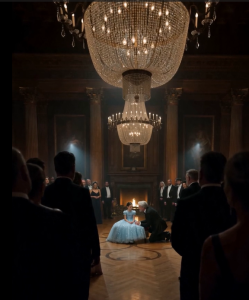
The room glittered with wealth. White roses spilled from silver vases. A string quartet played near the far wall, its music floating above the hum of conversation. Guests stood in clusters, smiling while measuring one another. Waiters moved like shadows between them.
I became one of those shadows.
I refilled water glasses. I collected plates. No one thanked me, which meant I was doing the job correctly. A man in a navy tuxedo brushed past without apology. A woman set her empty glass on my cart without looking away.
I kept moving, silently counting each breath until the night ended.
Then, near the staircase, I saw her.
Eleanor Sterling stood half-hidden beside a tall arrangement of white roses. She was sixteen or seventeen, with dark hair falling over a pale blue dress. Her hands were clasped tightly in front of her, fingers working against each other in nervous little motions. She was surrounded by beauty, but she looked painfully alone.
Richard Sterling stood a few feet away, his smile controlled and practiced. Victoria hovered nearby, watching both him and the room as if guarding a secret.
Eleanor’s eyes lifted and met mine.
For one second, I forgot Victoria’s warning.
There was no arrogance in the girl’s face. Only fear, sharp and familiar. I had seen that look in hospital waiting rooms, in my own daughter when she pretended she was not scared.
I lowered my gaze quickly and reached for a stack of plates.
Stay invisible, I reminded myself. Five hundred dollars. Insulin. Silence.
Across the ballroom, a waiter bumped the edge of my cart, and one crystal glass tipped. I caught it before it fell, my heart hammering. No one noticed. The music continued. Laughter rose. Victoria turned her head slightly, checking on me, making sure I remembered my place.
I did.
But as Richard Sterling stepped toward the microphone at the center of the room, and Eleanor’s frightened eyes searched the crowd again, I felt the message in my pocket like a stone.
Keep your mouth shut.
Stay invisible.
For my daughter, I had agreed.
But for the first time that night, I wondered what kind of truth could make a family so desperate for silence, and what it would cost if someone like me finally stopped being furniture.
Bài viết phần thân đã được kiểm tra đủ 1199 từ.