Every Tuesday at exactly noon, the old man took the same booth by the window of Murray’s Diner. The staff never had to ask what he wanted. A cup of black coffee, always waited close to his right hand. He sat in Booth Seven, his worn wooden cane against the vinyl seat, his white hair combed back, his trimmed beard making him look weathered. The waitresses called him Mr. Hale. They knew almost nothing else. He never complained. He never raised his voice. Yet when he was in the room, even loud customers lowered theirs.
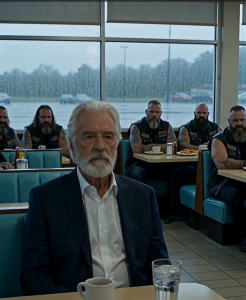
That Tuesday, rain tapped the windows while Mr. Hale stared out at the parking lot, The lunch crowd was thin: two truckers, a mother with a little girl, three office workers, and Claire, moving between tables. Everything felt ordinary until the sound came across the street like thunder.
Six motorcycles pulled into the lot, Heads turned. The riders parked in a crooked line, laughing before they stepped inside. The diner door swung open, Heavy boots struck the floor. Chains clinked. Their leather vests were soaked, but they wore the dripping clothes like badges. These were men who enjoyed watching strangers move aside.
Their leader was a broad-shouldered biker named Rex. He scanned the room, searching for someone to unsettle, and his gaze landed on Booth Seven. Rex smirked and walked toward him while the others followed.
“Well, look at this,” Rex said, slapping one palm against the table hard enough to rattle the coffee cup. “A king without a kingdom.”
The bikers laughed. Mr. Hale did not answer. He did not even lift his eyes from the window.
Rex leaned lower, “Can’t hear me, Grandpa?”
Still nothing.
Silence should have ended it. Instead, it fed him. Rex’s face tightened, and before anyone could move, he grabbed the wooden cane. One hard yank pulled it free. The table jerked, coffee spilled across the Formica, and a glass slid over the edge, shattering on the floor.
the bikers exploded with laughter.
Rex spun the cane through the air like a prize. “Careful, boys,” he shouted. “This might be the only thing keeping him alive.”
More laughter filled the diner. One biker pulled out his phone. Then another. Claire stepped forward, then stopped when Rex turned toward her. No one wanted trouble.
But Mr. Hale did not beg for the cane. He did not curse. He did not reach for the spilled coffee or the broken glass. He simply watched the dark coffee drip from the table edge. Then his eyes moved upward and settled on something half hidden beneath Rex’s leather collar.
A faded silver hawk patch.
The change in Mr. Hale was so slight most people missed it. But Claire, who had served him for years, saw it. Something crossed his face that was not fear and not anger. It was recognition, painful.
Mr. Hale reached into his jacket and pulled out a small black key fob.
The bikers laughed harder.
“What is that?” one of them said.
Rex grinned, still holding the cane. “Calling life support?”
Mr. Hale pressed one button. A quiet click sounded between laughs. Then he raised the device to his ear.
“It’s me,” he said.
The laughter thinned.
Mr. Hale listened for a breath. Then he spoke three words.
“Bring him here.”
He lowered the fob and placed it beside the spreading coffee.
Rex chuckled, but this time nobody joined him. Outside, the rain seemed louder. Then tires screamed across the wet pavement.
Everyone turned.
A black SUV slid into the parking lot. Then another. Then another. Then a fourth. Four armored vehicles stopped in a clean line facing the diner. Dark windows. Government plates. The engines shut off together, and the silence that followed felt heavier than the thunder that had brought the bikers in.
Doors opened.
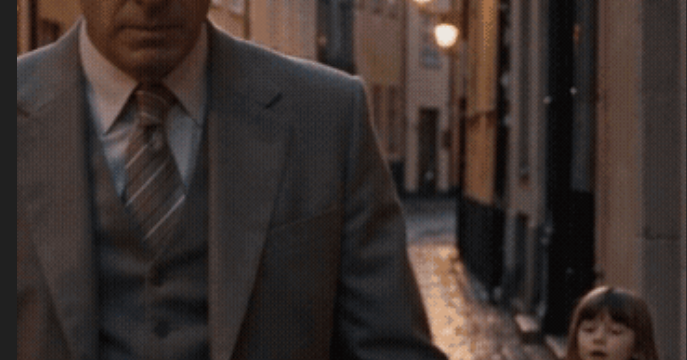
Men in dark suits stepped out, They entered without hurry, eyes sweeping the room once before locking on Booth Seven.
Rex’s grin disappeared.
Mr. Hale placed both palms on the table and stood. He did it without the cane. Without help. Straight-backed. Steady. the old man in the corner looked less like a fragile customer and more like a soldier who had chosen silence.
The first suited man through the door stopped. His face went pale. Then, in front of the bikers, and every phone still recording, he lifted his hand in a sharp salute.
Every other suited man did the same.
No one moved.
Mr. Hale did not return the salute. His eyes remained on Rex, more precisely on the silver hawk patch beneath the biker’s collar.
“Where did you get that patch?” he asked.
Rex swallowed. The cane hung uselessly in his hand now. “It belonged to my father.”
Mr. Hale’s expression hardened. “No.”
Rex blinked. “What?”
“It belonged to your grandfather.”
The color drained from the biker’s face.
Mr. Hale took one slow step forward. “You see,” he said, his voice calm enough to frighten everyone more than shouting ever could, “I designed that patch.”
Another step.
“I pinned it onto every member of the unit.”
Another.
“And only one man ever wore that exact silver hawk.”
The diner seemed to stop breathing. Rex’s lips parted, but no words came.
Mr. Hale stopped directly in front of him. the old man looked past Rex, as if seeing someone young and brave, wearing that same patch with honor instead of arrogance.
Then Mr. Hale spoke the words that broke the room.
“Because forty years ago,” he said, his eyes turning cold with grief, “I buried my son wearing it.”
Rex’s grip loosened. The cane dropped from his hand and hit the floor between them. No one laughed now. The phones remained raised, but the mood had changed from entertainment to shame. The man they had mocked was not weak. He was carrying history and loss. And the symbol Rex had worn like decoration belonged to a family wound deeper than anyone in that diner could understand.
In that silence, every witness understood what they had almost missed. Age had made Mr. Hale slower, not smaller. The cane was only wood; the strength had always been somewhere deeper. The patch on Rex’s collar was not a decoration from a roadside shop. It was a memory, a promise, and a piece of a family story that had been dragged into a diner and laughed at by people who did not know its cost. Rex had walked in wanting power. He had mistaken noise for courage and cruelty for command. Now, standing before the man who knew the truth, he had nothing left to hide behind.
For the first time, the whole room saw the difference between being feared and being worthy of respect, and that difference was impossible to forget.
Claire stepped forward, picked up the cane, and offered it back to Mr. Hale. He accepted it gently, never taking his eyes off Rex. The biker looked suddenly smaller, stripped of all the noise he had brought into the room.
Respect, the old man had taught them without raising his voice, is not owed to leather, engines, titles, or fear. It belongs to character. And sometimes the quietest person in the room is the one who has survived the most.