“Would you like a rose, ma’am?”
Victoria Rosewood looked up from her wine glass.
A little girl stood beside her table with a woven basket of red roses balanced against her hip. She could not have been more than nine years old. Her hair was tied in a high ponytail, loose dark strands framing a small, serious face. A beige sweater hung from her shoulders, and her shoes looked damp from the evening rain. Still, her eyes were clear, curious, and gentle.
Victoria had chosen the restaurant because it was quiet. It was the kind of place where candles glowed, waiters moved like shadows, and people lowered their voices because wealth was already understood. Outside, traffic blurred through the rain. Inside, a pianist played softly.
She had come there to escape the Rosewood name for one hour.
All her life, that name had opened doors and closed others. It came with polished silver, old portraits, public expectations, and family stories told in fragments. Victoria knew how to smile when relatives judged her and nod when board members underestimated her. Tonight, she only wanted dinner, wine, silence, and peace.
The child lifted one rose from the basket.
“Would you like one?” she asked again.
Victoria gave a polite smile. “Sure.”
The girl placed the rose on the white tablecloth beside Victoria’s plate. She handled it carefully. Its petals were deep red, curled tightly at the center, shining in the candlelight.
Victoria reached for her purse.
Then the girl’s eyes dropped to Victoria’s hand.
The change was tiny, but Victoria noticed it. She had built a life on noticing tiny changes. In boardrooms, it helped her see who was pretending. In family rooms, it helped her survive.
The little girl was staring at Victoria’s ring.
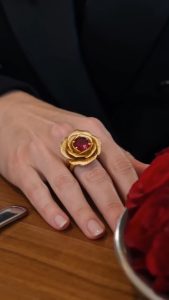
It was gold, shaped like a rose, with petals wrapped around a red ruby. Victoria had worn it since her grandmother’s funeral. She had been told it belonged to the Rosewood women and had passed from one generation to the next. It was not merely jewelry. It was proof of blood, history, and belonging.
The girl smiled softly.
“Your ring looks just like my mom’s.”
Victoria’s fingers stopped at the clasp of her purse.
Her smile faded. “No. This is my family’s ring.”
The girl tilted her head. She did not look embarrassed or corrected. She looked certain.
“Is there a name inside it?”
Victoria went still.
Around them, the restaurant continued as if nothing had happened. Glasses chimed. Forks touched plates. Someone laughed near the bar. The pianist moved into another song. But to Victoria, the room seemed to lose all sound.
No stranger should have known that.
She drew her hand closer. “Why would you ask me that?”
“Because my mom’s ring has a name inside it,” the girl said.
Victoria’s throat tightened. “What name?”
The child leaned closer, lowering her voice.
“Rosewood.”
The word landed between them with the force of a secret finally spoken aloud.
Victoria stared at her. That name had been printed on buildings, invitations, legal papers, and charity programs. It had followed her through every room she entered. But inside that ring, hidden on the inner band, it was private. Only the family knew about the engraving. Only family was supposed to know.
Her pulse quickened.
No little girl selling roses in a restaurant should know that name. No child in a loose sweater, standing with rain on her shoes, should recognize a ring locked inside the Rosewood line for generations.
Victoria leaned forward, and when she spoke, her voice trembled.
“Where is your mother?”
The girl blinked. “She’s working. Not far from here.”
“What is her name?”
The girl hesitated briefly. Not because she was frightened, Victoria thought, but because she had learned that questions from adults could be dangerous even when they sounded kind.
“Anna,” she said. “Anna Reed.”
Victoria searched her memory. Reed meant nothing.
But Anna did.
A sharp image surfaced from years ago: a Christmas dinner, a door half closed, angry whispers from the hall, her grandfather’s voice cold and final. She remembered a portrait that disappeared from the upstairs corridor after his death. She remembered an aunt mentioning a young woman named Anna, then stopping when the room went silent. After that, no one said the name again.
Victoria looked back at the girl. “Did your mother give you the ring?”
The child nodded. “She keeps it in a little blue box. She doesn’t wear it when she works. Sometimes she lets me hold it if I’m careful.”
“What is your name?”
“Lily.”
The simple answer made Victoria’s chest ache.
Lily. Another flower name. The Rosewood family had always loved naming daughters after things that bloomed, as if beauty could cover every wound.
Victoria slowly slipped her own ring from her finger. Her hands were not steady. She turned the band toward the candlelight and looked inside. There it was, engraved in small worn letters.
Rosewood.
She had seen it countless times. Yet now it felt less like an inheritance and more like a question.
Lily watched her with cautious patience.
“My mom says roses remember where they came from,” the girl said. “Even when people try to move them.”
Victoria closed her eyes.
That was not a child’s thought. That was a message carried from a woman who had lived with hurt long enough to soften it into something her daughter could repeat without understanding the weight.
When Victoria opened her eyes, she took several bills from her purse and placed them beside the rose.
Lily looked down and shook her head. “That’s too much.”
“Then take it for telling the truth.”
The girl still did not touch the money. “Are you mad?”
The question nearly broke Victoria’s composure.
She had been trained to appear calm through disappointment, pressure, betrayal, and grief. But this little girl, with a basket of roses and a voice like a match in the dark, had opened a door Victoria never knew existed.
“No,” Victoria said softly. “I’m not mad.”
“Then why do you look sad?”
Victoria looked toward the rain-streaked window. “Because I think someone in my family may have been forgotten.”
Lily’s face changed.
Hope appeared there, small but unmistakable.
Victoria stood. Her dinner remained untouched. Her wine sat dark in the glass. The rose lay on the table like evidence.
“Lily,” she said, “can you take me to your mother?”
The girl hugged the basket closer. “Now?”
“Yes. Now.”
Lily studied her face, deciding whether this elegant stranger with the matching ring could be trusted. At last, she nodded.
Victoria picked up the rose and held it carefully.
They walked through the restaurant together. Conversations returned around them, but Victoria barely heard them. No one understood that a woman with an old family ring was following a child toward a truth that might change everything.
At the front door, Lily paused beneath the warm lights.
“My mom doesn’t like surprises,” she warned.
Victoria looked at the gold rose ring in her palm.
“Neither do I.”
Then the door opened, the rain rushed in, and Lily led her into the city night toward Anna, the other ring, and the missing piece of the Rosewood family.