I had only been working nights in the morgue for six weeks when I learned a hospital’s quiet hours can be more unsettling than screaming. By day, St. Mary’s had a rhythm. Nurses moved room to room, phones rang, carts rattled over floors, and even sorrow had people around it. Families cried in waiting areas. Doctors gave updates in low voices. Elevators opened and closed. Life, worry, and loss shared the same bright hallways. But after midnight, the hospital changed. On the lower level, behind two heavy doors, the silence felt personal. The fluorescent lights looked pale. The air smelled of disinfectant, cold and metallic. Even the old clock above my desk seemed to tick louder than it should have.
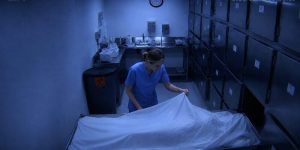
That night, I was alone with the refrigerator units humming behind me and my pen tapping against intake forms. Every small sound seemed to belong to someone else.
A little after one, the double doors swung open. Two attendants came in, pushing a stretcher covered with a white sheet. They were tired, damp from rain, moving with the blank efficiency people learn when nothing is left to fix. The woman beneath the sheet had been pronounced dead less than forty minutes earlier.
Her name was Claire Holloway. She was thirty-two years old. The paperwork said she had collapsed during a private dinner party on the east side of town. Sudden cardiac arrest. Unresponsive when emergency responders arrived. Pronounced dead in the emergency unit after resuscitation attempts failed.
It should have been routine.
But from the moment they brought her in, something felt wrong.
I first noticed the man behind the stretcher. He was Claire’s husband, Daniel Holloway. I had seen grieving husbands. Some came in shattered. Some talked too much because silence scared them. Some stared as though waiting for their loved one to open her eyes and prove the doctors wrong.
Daniel did none of those things.
He walked behind his wife’s body in a dark coat, rain on his shoulders, his face showing less grief than careful attention. He did not touch the stretcher. He did not reach for her hand. He barely looked at her face. He watched the attendants guide the wheels as if making sure something important had been delivered.
Then he turned to Dr. Mercer, who had signed Claire’s death paperwork.
“She’ll stay down here until morning?” Daniel asked.
His voice was so calm that it made my skin tighten.
Dr. Mercer gave a tired nod. “Yes. We’ll hold her here until the next steps are arranged.”
Daniel looked around the room. His gaze moved over the refrigeration units, the cabinets, the desk, and finally me. “Is anyone usually in here overnight?”
“Only staff, if they’re finishing paperwork,” Dr. Mercer said with a shrug.
Daniel nodded slowly, and I remember thinking that the answer mattered to him more than it should have. The attendants left. Dr. Mercer took the file. Daniel lingered beside the stretcher, staring at the white outline of his wife’s body. Then he looked straight at me.
“Please make sure she’s treated respectfully,” he said.
It was a normal sentence. A husband could mean only love. But the way he said it made the room feel colder.
Before I could respond, he turned and followed Dr. Mercer out. The doors closed behind them, and I stood there longer than I wanted to admit.
Claire had not yet been moved into refrigeration because one drawer still needed to be cleared. Her stretcher remained in the center of the room behind my desk. As I began the intake notes, I could see her shape reflected faintly in cabinet glass.
I tried to focus on ordinary tasks. I labeled sample bags. I checked the instrument tray. I sanitized the counter. I reread the file. Healthy female. No major medical history listed. No long-term heart condition. No prior admissions to St. Mary’s. Nothing explained why a thirty-two-year-old at dinner would collapse and be gone before dawn.
Unexpected deaths happen. I knew that. Still, there was an emptiness in the report, as if Claire’s death had arrived faster than the truth could follow.
After a while, I walked over to the stretcher.
The sheet was folded neatly below her shoulders. Someone in the emergency unit had cleaned her face and brushed her hair back. If not for the stillness, she looked like a woman sleeping after an exhausting night.
I am not a doctor. But after six weeks there, I knew how quickly death leaves signs on a face. Claire did not look changed enough. Her lips were pale, but not blue. Her skin had not taken on the dull grayness I had learned to expect. Her hands rested over her stomach, soft-looking beneath the cold overhead lights.
I told myself to stop being foolish. Quiet rooms make the mind reach for stories. Fear fills empty spaces when nothing else will.
I returned to the counter and forced myself back to the paperwork.
A few minutes later, I heard something behind me.
It was not a voice. It was not a breath. It was only the soft rustle of fabric against metal.
I turned.
The sheet was still.
For several seconds, I stared at it. Then I gave a nervous little laugh under my breath.
“Get a grip, Emily,” I whispered.
I turned back to the forms, but my hand was no longer steady. The pen scratched unevenly across the page. I tried to blame the refrigerator units, the old pipes, the vent above the door, anything except the shape under that white sheet.
Then the sound came again.
This time, it was clearer. A slow, faint dragging, like fingertips moving weakly beneath cloth.
My chair scraped the floor as I spun around.
The room looked the same. The stretcher sat under the lights. The metal rail gleamed along its side. The lockers lined the wall in a silent row. The white sheet covered Claire from the chest down.
But one side of the sheet, near her left arm, was no longer flat.
A small rise had formed under the fabric.
I stepped away from the counter. For one desperate second, I told myself the vent had lifted the edge, but the rest of the sheet did not move. My heart pounded so hard it hurt.
I moved closer.
Another tiny motion came from beneath the sheet.
This time, there was no mistaking it. Something under the fabric was trying to lift.
I reached toward the sheet, barely breathing. Before my fingers touched it, Claire Holloway’s left hand slowly pushed upward from beneath the white fabric and rose into the air.
Her fingers curled once, weakly, toward the ceiling.
I froze.
Every hair on my arms stood up.
Because bodies declared dead do not raise their hands.
I shouted for help, hit the emergency call button, and kept my eyes on that trembling hand until the doors burst open. What Claire whispered after we pulled her back from the edge of death turned one strange night in the morgue into a crime investigation no one at St. Mary’s would ever forget.