The bride was already gone before the last toast ended.
Minutes earlier, the ballroom had been full of music, laughter, and phones held high beneath chandeliers. Guests filmed the first dance. Champagne glasses touched. Flowers glowed under lights. Everything looked perfect, the kind of wedding people would talk about.
Then the bride collapsed.
She fell on the dance floor, her silk gown spreading around her like spilled moonlight. Her bouquet slid beneath her hand and was crushed under her fingers. At first, people thought she had fainted from excitement, nerves, or the heat. Someone laughed nervously. Someone called her name. The groom stepped back, staring down as if he did not understand what he was seeing.
Within seconds, the music stopped.
By midnight, the young bride had been declared dead.
By two in the morning, she was inside the morgue at St. Mary’s Hospital.
And by sunrise, nearly everyone who had signed the paperwork would be praying they had looked closer.
The ambulance arrived without sirens. Its lights flashed across the rear brick wall, then went dark. It rolled toward the service doors where bodies were brought in when families were too broken to follow. Behind it came three black cars, still decorated with white ribbons and wedding flowers. In the hospital glow, the cars looked painfully out of place, as if a celebration had taken a wrong turn.
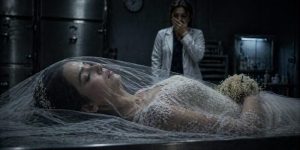
The bride was wheeled inside on a stretcher, still wearing her wedding dress.
Her veil had been folded carefully over her chest. Her hair remained pinned in soft waves. Her makeup had not been touched, and her lashes rested against her cheeks as if she had fallen asleep before the reception ended. Someone had placed white roses in her hands. She looked less like a body and more like a woman waiting to wake up.
Her new husband walked beside the stretcher.
He did not cry.
He did not beg anyone to save her.
He did not reach for her hand.
He only watched as the attendants pushed her through the hallway. His face was calm in a way that made the nurses lower their voices. Grief can look strange. It can leave people silent and empty. But this was different. His stillness seemed practiced, as if chosen before he arrived.
Emily noticed him right away.
She had worked nights in the morgue for less than three months. That was long enough to stop jumping when a sheet shifted from the vents, but not long enough to ignore the warnings her instincts gave her. She had learned that the dead told quiet truths. Families often told louder lies.
Everyone around the bride was falling apart.
The bride’s mother had been sedated and sobbed into a handkerchief. Two bridesmaids held each other in the corridor, their faces streaked with mascara. An older man kept saying, “She was laughing. She was just laughing,” as if repeating it might bring her back.
But the groom stood apart from them.
Silent.
Dry-eyed.
Watching.
When the intake forms were brought over, he signed each page with steady hands. His signature never shook. He asked no questions about final moments, mistakes, or whether anything more could be done. He simply signed where they told him to sign, then looked through the small window in the morgue door as if making sure something had been completed.
Emily felt a chill that had nothing to do with the temperature.
When the family was finally led away, the bride remained.
Dr. Carter came in briefly, tired and distracted, wearing the flat expression of a man who had seen too many tragedies in too few hours. He checked the file, glanced once at the bride, signed the intake papers, and told Emily to prepare her for storage until the official examination.
Then he left.
The cold room settled into silence.
Emily stood beside the steel table and looked down at the bride.
She had seen death before. Overdoses. Car crashes. Drownings. Sudden heart attacks. Seizures in ordinary days. Death always changed a person quickly. It took warmth first, then color, then softness. Skin shifted. Lips darkened. Hands grew heavy and stiff. Even when a body looked peaceful, something human seemed to step away.
But this bride had not changed enough.
Emily leaned closer.
Under the harsh fluorescent lights, the bride’s skin still carried warmth in its tone. It was pale, but not gray. Her lips were faded, but not blue. Her cheeks held the slightest trace of pink. The room was cold. Bodies cooled quickly here. This one did not look ready for the drawer.
Emily hesitated, then reached down and touched the bride’s hand.
She pulled back at once.
Warm.
Not warm like a person standing in sunlight, but not cold. Not what she should have been after hours declared dead. Emily swallowed and forced herself to breathe slowly. She touched the wrist again.
The skin was soft.
Not stiff.
Not frozen.
Not dead enough.
Her stomach tightened.
She looked toward the door, half expecting someone to appear and tell her she was imagining things. No one came. Only the hum of the lights and the low mechanical breath of the refrigeration unit filled the room.
Emily bent closer and watched the bride’s chest.
Nothing moved.
She told herself shock could make the mind see what it wanted to see. She had been tired. The hour was late. The wedding flowers, the young face, the untouched dress, all of it was enough to make anyone uneasy.
Then the fabric over the bride’s ribs shifted.
Barely.
A rise.
A fall.
So slight it could have been a trick of the light.
Emily froze.
Her own heartbeat roared in her ears. She lowered her face toward the bride’s mouth. For one long second, there was nothing. Then she felt it, a thin whisper of air against her cheek.
Alive.
Emily stumbled backward, slamming into a metal tray. Instruments crashed to the floor, the sound exploding through the morgue like a gunshot. Her hands shook as she rushed back to the table and pressed her ear against the bride’s chest.
Silence.
Then—
Thump.
Faint. Deep. Slow.
Another pause.
Thump.
A heartbeat so weak it could have been missed by anyone who was not listening for a miracle.
Emily’s throat closed. She grabbed the emergency phone and called for help, her voice breaking as she shouted that the bride was alive. But before the line fully connected, her eyes fell on something beneath the edge of the veil.
A tiny puncture mark.
Just below the bride’s ear, hidden where her hair had been pinned.
Emily gently turned the bride’s head and saw another mark near the hairline. Not an accident. Not from a fall. Not from wedding nerves or sudden illness.
Someone had done this carefully.
Someone had made a living woman look dead.
And as alarms began screaming through the hospital hallway, Emily finally understood the groom’s calm face, his steady signature, and the way he had watched through the morgue door.
The bride had not died at her wedding.
She had been delivered.
And whoever sent her there had never planned for the morgue attendant to notice she was still breathing.