Noah Carter had spent eleven years surviving by never stopping. In the empty country between settlements, a man who paused too long could lose his horse, his water, or his life. So he kept his eyes forward and his heart locked behind a wall grief had built long ago.
That morning, the trail looked unforgiving. The sun burned white over the ridgeline, flattening everything into glare and dust. Heat shimmered above the sand. Dry brush scratched at the wind. His gray horse, Dust, moved with the patience of an animal that understood thirst. Noah sat loose in the saddle, hat low, hand near the canteen at his hip.
“Keep moving,” he muttered.
Dust took two more steps, then stopped.
Noah frowned and tightened the reins. “I said move on.”
The horse did not obey. Dust lifted his head and turned his ears toward the ravine below.
Noah listened. At first he heard only buzzing heat, creaking leather, and the dry rattle of mesquite branches. Then another sound reached him, small enough for a bird. It was thin, weak, and broken.
Not quite crying.
Something smaller, because whatever made it barely had strength.
Noah leaned in the saddle and looked down.
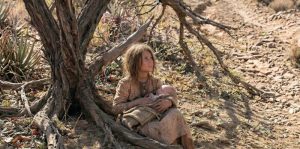
Under a splintered mesquite tree, half hidden by shadow and dust, sat a little girl. Her dress was filthy, her face streaked with dirt and dried tears. One leg lay crooked beside her. In her arms, wrapped in a torn blanket, was a baby.
The baby made that frail sound again.
Noah went still.
A man could pass a campfire without asking who sat beside it. He could ride past strangers and pretend their trouble belonged elsewhere. He could tell himself kindness got people buried. Noah had told himself those things for years.
But he could not look down at that child and keep riding.
He dismounted slowly, left Dust on the ridge, and climbed down carefully. He kept his hands open where the girl could see them. She did not scream or reach for him. She only watched with exhausted child’s eyes.
Noah stopped a few feet away and crouched.
“Hey,” he said gently.
Her lips barely moved. “Hey.”
He glanced at the baby. The little boy’s mouth was cracked. His cheeks were red from the heat, and his tiny hands clutched the blanket like the last safe thing in the world.
“That yours?” Noah asked.
“My brother,” she whispered. “His name is Samuel. He’s hungry. I don’t have anything left.”
Noah’s jaw tightened. He looked toward the road. Fresh wagon tracks cut through the dust above them, still sharp. Whoever had left them had not been gone long.
“Where are your people?”
The girl turned toward the trail. For a moment, her expression went empty, as if the answer had emptied her.
“Gone.”
Noah waited.
“My stepfather said me and Samuel were slowing the wagon down,” she said. Her voice was flat, but every word struck like a nail. “He said a crippled girl and a sick baby weren’t worth the water they drank.”
She swallowed hard.
“So he stopped and told me to get out.”
The desert seemed to quiet around them.
Noah had seen cruelty. He had seen men steal from widows, cheat at cards, shoot over insults, and leave partners to die. He had learned not to be surprised. But this was different. This was a grown man looking at a child and an infant and deciding the wagon needed water more than they needed life.
“And your mother?” he asked.
At last, the girl’s face changed. Pain moved across it, young and old at the same time.
“She cried,” Clara said. “But she stayed in the wagon.”
The baby whimpered again, weaker than before.
Noah pulled the canteen from his belt and held it out. The girl’s eyes fixed on it with the stare of someone who had dreamed of water. But she did not drink.
Instead, she dipped one dirty finger into the canteen and touched it carefully to the baby’s cracked lips. Once. Then again. Then again. She moved as tenderly as a mother, though she was only a child herself.
Noah watched her and felt something inside him shift.
“What’s your name?” he asked.
“Clara,” she said softly. “Clara May Bennett.”
“Noah Carter.”
She studied him, as if deciding whether a name meant anything in a world where mothers cried and still rode away.
Then she said, “You’re going to leave us too, Mr. Carter.”
The words hit him harder than any bullet ever had.
Noah looked at the wagon tracks fading into heat, then at the baby wrapped in rags and Clara’s twisted little leg. For eleven years, he had believed an empty heart was safer. If he loved nothing, nothing could be taken. If he needed no one, no one could abandon him. If he never stopped, grief could never catch him.
But standing there under that merciless sky, he understood the lie in it.
A man could ride past pain only so many times before he became part of it.
Noah rose slowly. He removed his coat and wrapped it around Samuel with care that surprised even him. Then he knelt before Clara.
“No,” he said.
Her eyes searched his face.
“I’m not leaving.”
Her lips trembled, but she did not speak.
Noah glanced at her injured leg. “This may hurt some, but I’ll be careful.”
She nodded once, trying to be brave.
He slid one arm under her back and the other beneath her knees. She gasped when he lifted her, but she clutched Samuel close and did not cry out. Noah carried them up the slope one slow step at a time, feeling heat burn through his shirt and their weight settle like a promise.
Dust waited at the top, calm as stone.
Noah eased Clara into the saddle first, then secured Samuel in the coat against her chest. He gave her the canteen.
“Small sips,” he said. “For both of you.”
Clara obeyed, still watching him as though she feared kindness might disappear if she blinked.
Noah took the reins and walked beside Dust, leading the horse from the ravine toward the trail. The wagon tracks ran ahead, but he did not follow. There was a town east of the ridge, a doctor if luck was with them, and shade before sundown if Dust held steady.
Behind him, Clara’s quiet crying finally broke through the silence.
Not the hopeless crying of a child left to die.
The kind that comes when someone finally believes they have been found.
Noah did not tell her everything would be easy. He did not promise her mother would come back, her leg would heal straight, or the world would become gentle. He only kept walking, one step after another, because sometimes the first act of mercy is not a speech. Sometimes it is a man taking the reins and refusing to ride away.
By noon, the ridge was behind them. By afternoon, the desert still burned, but Clara rested against the saddle and Samuel slept beneath Noah’s coat. Noah Carter, who had spent eleven years never stopping, moved for the first time toward something that felt like life.