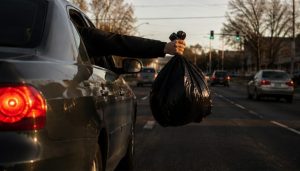
The driver ahead of us barely slowed down. The passenger window rolled open, a large black bag flew out, and it struck the pavement with a heavy thud. It rolled twice, stopped near the center line, and the car disappeared around the corner without a single brake light.
For a moment, my husband and I just stared.
We had been driving home after a long Saturday, tired. The sky was fading from orange to purple, and the streets were beginning to empty. Inside our car, we talked about dinner, groceries, laundry, and how quickly weekends disappear.
Everything felt normal until that bag landed in the road.
“What on earth was that?” my husband whispered, pressing the brake.
“I don’t know,” I said, watching the other car vanish. “But they aren’t coming back.”
Cars began honking and swerving around the bag. One crossed into the opposite lane, and another nearly caused a rear-end crash. Whatever was inside, it had become a danger on that road.
My husband pulled over carefully. “We can’t leave it there,” he said.
I agreed, though uneasiness settled in my chest. The bag did not look like ordinary trash. It was tightly tied at the top, dark and slick against the asphalt, and heavier than household garbage should have been.
We stepped out into the cold evening air. Leaves scraped along the curb, and traffic hummed behind us. The streetlights had just begun to glow, giving everything a dull yellow edge.
My husband walked toward the bag first. I followed, watching each approaching car.
“There’s a public trash can over there,” he said, pointing near the corner. “We’ll just move it before someone gets hurt.”
He crouched down and grabbed one side. I reached for the other. The plastic felt cold under my fingers. We lifted carefully, expecting old clothes or spoiled food.
Then the bag moved.
Not from the wind. Something inside pushed back.
I let go instantly. My husband dropped his side too, and the bag hit the pavement again.
“Did you feel that?” I asked, barely able to speak.
His face had turned pale. “Yes.”
We stood frozen, staring down at it. For one second, I tried to convince myself the contents had settled or fear was making us imagine things.
Then it trembled again.
A small, weak sound came from inside.
My whole body went cold. It was muffled and faint, but it was not bottles, paper, trash, or any loose object shifting. It sounded alive.
My husband dialed emergency services. His voice shook as he gave our location and described the car, the bag, the movement, and the sound. The dispatcher told us to stay on the line, keep ourselves safe, and avoid disturbing the bag more than necessary.
But traffic was still moving around us. We could not let another car strike it.
My husband waved at an approaching vehicle while I stepped toward the curb and raised both arms. The driver slowed, saw our faces, and stopped with hazard lights blinking. Another car stopped behind him. Within a minute, several strangers had formed a protective line with their vehicles, blocking the lane and keeping traffic away.
“What happened?” a woman asked as she hurried over.
“There’s something inside,” I said.
Before she could answer, the bag moved again.
No one laughed. No one accused us of overreacting. Everyone went quiet.
My husband knelt beside the bag, close enough to hear but careful not to press on it. “Help is coming,” he said softly, though I think he was saying it as much for himself as for whatever was inside.
Then we heard it clearly.
A tiny cry.
The woman beside me covered her mouth and began to sob. My knees weakened. The ordinary world we had been living in only minutes earlier seemed to fall away. There was no dinner to plan, no laundry to fold, no tired Saturday night waiting for us. There was only that black bag in the road and the small, fragile sound coming from inside it.
The dispatcher asked if the bag was tied.
“Yes,” my husband said. “Very tight.”
She told him not to pull hard and not to shake it. A man from one of the stopped cars offered a small pocketknife. My husband took it with trembling hands and carefully cut only the outer knot, keeping the blade away from the contents. I stood beside him, holding my breath.
The plastic loosened.
When the opening fell back, every person around us became silent.
Inside was a newborn baby wrapped in a thin cloth, trembling in the cold. The baby was tiny, red-faced, and barely crying, with little hands curled against the chest. For a moment, my mind refused to accept what I was seeing. Someone had thrown that helpless child into the road and driven away.
“Oh my God,” I whispered, dropping to my knees.
My husband told the dispatcher what we had found. Her voice became calm and firm. She instructed us not to remove the baby unless there was immediate danger, but to keep the opening clear and shield the child from the cold.
A woman ran to her car and returned with a clean blanket. Another person used a jacket to block the wind. Someone else directed traffic farther back. These were strangers, people who had been on their way home to their own families, yet in that moment every one of them understood that nothing mattered more than keeping that baby alive.
The baby cried again, still weak, but it was enough to give us hope.
Sirens arrived within minutes, though it felt much longer. Police officers secured the area while paramedics moved quickly and gently. They checked the baby, wrapped the child in warm layers, and carried the tiny bundle to the ambulance. I watched the doors close with tears running down my face.
An officer took our statements. We told him everything we could remember: the car’s color, the direction it went, the open passenger window, the moment the bag was thrown. Other drivers shared what they had seen. One had a dash camera. Another remembered part of the license plate. Little by little, the car that had disappeared into the evening began to leave a trail behind it.
That night, my husband and I sat at our kitchen table without eating dinner. We held hands and said very little. Every time I closed my eyes, I heard that faint cry from inside the bag.
The next day, an officer called. The baby had survived and was receiving care.
I cried so hard I had to sit down.
We were not told every detail, and we did not need to be. What mattered was that the child was alive. A life that had been left in the road had been found because people stopped, listened, and refused to look away.
I still think about how easy it would have been to keep driving. We were tired. It was getting dark. We could have assumed it was trash and gone home.
But sometimes compassion begins with one small choice.
That black bag was meant to be ignored. Instead, it became the reason a baby was saved.