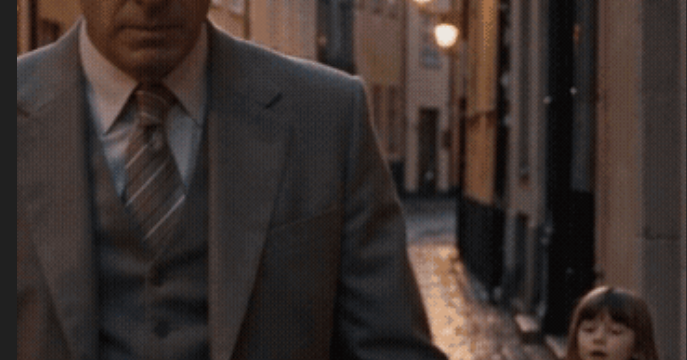
The Grand Azure Hotel rose above the crowded heart of the city with mirrored glass, gold, and spotless marble. In its lobby, lilies perfumed the still, expensive silence. Behind the mahogany front desk stood Tiffany Vance, and convinced she knew exactly who belonged there. She treated the lobby like her stage and herself as its gatekeeper.
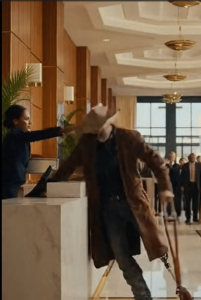
That hot afternoon, the revolving doors turned, letting in humid air and a man who made Tiffany’s smile tighten. He was around sixty, broad-shouldered but weathered, with a silver beard, faded denim jacket, flannel shirt, and battered Stetson. He moved slowly because each step took effort.
Clack. Thud. Clack. Thud.
His wooden crutch struck the floor, followed by the heavy step of his remaining natural leg. His other trouser leg revealed a plain metal prosthetic beneath the chandeliers. Guests in designer suits glanced over sparkling water. Some looked curious. Some looked amused. Tiffany saw only an eyesore.
“Can I help you?” she asked, with politeness but no kindness.
The man stopped before her. His blue eyes were steady. “Afternoon, ma’am,” he said in a low, gravelly voice. “I have a reservation under the name—”
“I highly doubt that,” Tiffany cut in. She did not search. “This is not a roadside motel, sir. A shelter or diner on Fourth Street may suit you better.”
A few guests shifted. The man did not raise his voice. “The room was booked well in advance. If you check the system, I’m sure you’ll find it.”
Tiffany bristled. Investors were watching, and she imagined them judging her. She stepped from behind the desk, heels striking marble.
“I’m asking you to leave,” she snapped. “Now.”
“Ma’am, please just check the reservation.”
“I don’t need a computer to tell me you don’t belong here,” she hissed.
Then pride turned cruel. Tiffany shoved both palms against his chest. Balanced on one natural leg and leaning on a crutch, he could not catch himself. His crutch skidded across the marble with a sharp screech, and he fell hard. The sound echoed.
Nobody moved. A woman gasped and clutched her pearls. Another guest whispered, “Oh my God,” pulling her child close.
The man’s Stetson rolled away. He lay still, his metal leg angled against the floor. He did not cry out. He did not beg. His silence made Tiffany look worse. Fear flashed across her face, but pride covered it.
“Don’t bring your filth into this hotel!” she shouted, loud enough for the bellhops to stiffen. “People like you contaminate places like this. You think you can walk in here and ruin everything we built? You are a stain on this establishment.”
The words were uglier than the fall. The man slowly reached for his crutch, moving with painful dignity. A parent murmured, “You should be ashamed,” but did not step forward.
Tiffany kept going, desperate to blame him. “Stay down or get out. I’ll have security drag you to the curb where you belong. We don’t want your kind here. We don’t want to look at you, and we certainly don’t want the smell of the street on our carpets.”
At last, the man got his crutch beneath his arm and stood. Even injured, he seemed taller. He brushed dust from his jacket and stared without a word. His face held no rage, only disappointment.
Then the glass doors burst open.
Outside, tires screamed against the private driveway. Three black armored SUVs swept to the entrance and stopped in formation. Doors slammed like thunder. Guests crowded the windows. This was a security operation.
From the center vehicle stepped Robert Sterling, the city mayor. His charcoal suit was flawless, his expression hard. He was known for power, loyalty, and little patience. He marched inside alone.
Tiffany’s heart jumped. She smoothed her hair and forced a smile, assuming he had come for the ballroom event.
“Mr. Mayor,” she began, extending her hand. “We are so honored—”
He passed her. His eyes were fixed on the man in denim.
The lobby went silent enough to hear the air-conditioning hum. The mayor stopped before the man with the crutch, lowered his head in respect, and brushed dust from the denim shoulder.
“Mr. President,” he said, his voice cutting through the room. “Please forgive our late arrival. The security sweep took longer than expected.”
Tiffany felt the blood drain from her face.
Mr. President?
The man straightened. In that instant, the humble cowboy appearance fell away, revealing a commanding presence that made even the mayor look small. He was Silas Thorne, President of the Thorne Global Initiative, a veteran, philanthropist, and one of the most powerful private citizens in America. He had funded city infrastructure and owned the land beneath the Grand Azure.
“It’s all right, Robert,” Silas said. “I was receiving a lesson in hospitality.”
The mayor’s gaze moved to Tiffany, then to the crutch, then to the marks on Silas’s chest. His face darkened.
“A lesson?” he repeated quietly.
Tiffany’s confidence collapsed. Her tablet and gold pen clattered to the floor. “I didn’t know,” she stammered. “I thought…”
Her voice failed. Her eyes rolled back, and she fainted onto the same marble where she had left him.
Silas did not look down at her. He picked up his Stetson, dusted it, and put it on.
“Robert,” he said.
“Yes, Mr. President?”
“Don’t fire her yet.”
The mayor froze. “Sir, she assaulted you. She insulted your service, your injury, your—”
“I know what she did,” Silas said. He turned toward the guests, ashamed of their silence. “But firing her would be too easy. She measures people by clothes, money, and the way they walk. For one month, she will work in the laundry room, cleaning what she fears. Her uniform will state that she is on probation for discrimination.”
The mayor nodded.
“And find the manager,” Silas added. “If he trained her to think this way, he is gone by sunset. Another name may be on the sign, but my family name is on the deed. I will not have it run by bigots and cowards.”
Security formed a perimeter as Silas moved toward the private elevators. Guests looked away, embarrassed. Bellhops stood pale and silent. Tiffany was revived in a velvet chair, tears streaking her face.
Silas felt no victory. Only sadness. He had lost his leg in a war for human dignity, yet basic decency still had to be defended.
“The world is changing, Robert,” he said as the elevator doors began to close.
“Yes, sir.”
“Make sure it changes for the better today,” Silas replied. “I’m tired of the dust.”
Downstairs, the Grand Azure returned to order, but it was changed. Tiffany looked at her hands and understood that the only ugliness in the lobby had been her own reflection. In that silence, every witness understood a painful truth: cruelty often begins with a glance, but character is revealed by what a person does when someone powerless is lying at their feet. From that day forward, the story of the cowboy president would travel across the city as a warning: never mistake hardship for shame, and never look down on someone who has walked a harder road than you.