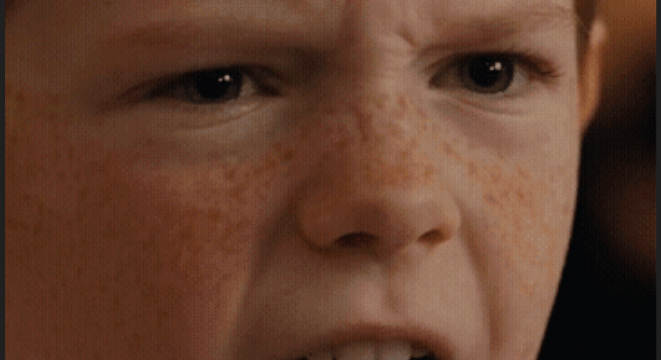
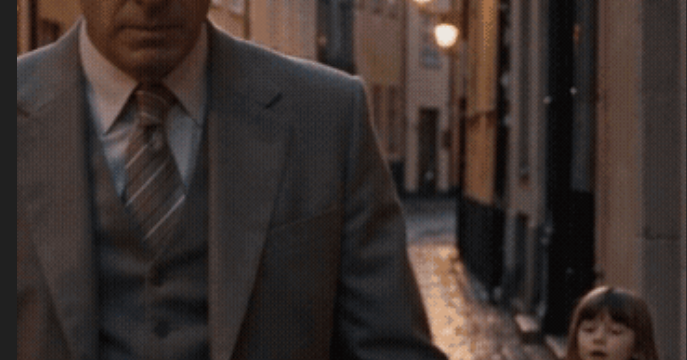
The classroom went silent the moment the door slammed open.
Every pencil stopped. Every whisper died.

Mr. Harris stood in the doorway with grief written across his face. He was not wearing his work jacket. His tie hung loose. His eyes were red, not from anger alone, but from a pain so deep it made even the boldest children look down at their desks.
“Where is she?” he demanded.
Mrs. Lane, the fifth-grade teacher, stepped away from the board. “Mr. Harris, please. The students are in the middle of class.”
“My daughter is in the hospital,” he said, his voice shaking. “And nobody will tell me why she came home crying every day for three weeks.”
A few children gasped. Several stared at the floor. One girl began to cry.
At the back of the room, Lily Harris’s empty desk sat near the window. Her purple backpack still hung from the hook beneath it because she had left school in such a rush the day before. A drawing of a yellow house and three stick figures peeked from the front pocket.
Mr. Harris saw it, and his face twisted.
“My little girl used to love this classroom,” he said. “She used to talk about spelling bees, science projects, and reading groups home. Then she stopped talking. She stopped eating breakfast. She begged me to let her stay home. Yesterday, she collapsed in the hallway after saying she was afraid to come through that door.”
Mrs. Lane swallowed hard. “We were looking into some concerns.”
“Concerns?” he repeated. “That is what you call it when a child is terrified?”
The principal, Mr. Dawson, hurried in behind him. “Mr. Harris, we need to speak privately.”
“No,” the father said. “Whatever happened to Lily happened here, in front of somebody. So somebody here knows the truth.”
Most of the children sank lower in their seats. Some glanced toward a group near the shelves, where two boys shifted uneasily. One of them, Tyler, had always been loud, always smiling when adults were watching. Now he stared at his hands.
Then Mr. Harris noticed one student who had not moved.
Maya Brooks sat in the second row, small and still, with both hands folded on her desk. She did not look frightened the way the others did. She looked as if she had been waiting for someone to finally ask.
Mr. Harris pointed gently, not accusingly. “You. You know something.”
Mrs. Lane said, “Maya, you don’t have to answer in front of everyone.”
“Yes,” Maya said softly. “I do.”
Her voice was quiet, but it carried across the room.
Mr. Dawson closed the door. “Maya, be careful.”
Maya looked at the principal, then at Mr. Harris. “I was careful for too long.”
No one breathed.
She stood up, her knees trembling. “Lily wasn’t making things up. She wasn’t being dramatic. She wasn’t trying to get attention. Every day, Tyler and his friends took something from her. Her pencils. Her lunch card. Her drawings. They told her if she cried, everyone would call her a baby.”
Tyler’s face went pale. “That’s not true.”
Maya turned toward him. “It is true. And you know what happened yesterday.”
Mrs. Lane gripped the edge of a desk. “What happened yesterday?”
Maya reached into her folder and pulled out a folded sheet of paper. “Lily wrote this during reading time. She passed it to me because she was scared.”
Mr. Harris stared at the paper like it might burn him.
Maya unfolded it and read, “Please don’t tell my dad. He already looks sad since Mom died. I don’t want to make him sadder.”
The room seemed to break open around those words.
Mr. Harris covered his mouth. His wife had passed away the year before. Lily had been only ten, and ever since then she had tried to be brave for him. She made her own cereal. She folded towels without being asked. She smiled when he forgot dinner was still in the oven. She had been carrying more than any child should carry, and now he understood that she had also been hiding pain to protect him.
Maya kept reading, though tears slipped down her cheeks. “They said if I tell, they’ll say nobody likes me because I’m weird. I just want to sit somewhere safe.”
Mr. Harris closed his eyes.
Mrs. Lane whispered, “Oh, Lily.”
Maya lowered the note. “I should have told sooner. But I was scared too. Tyler told me my dad would lose his job at the school if I caused trouble.”
Mr. Dawson’s head snapped toward Tyler. “Your father does not have that kind of power here.”
Tyler began to cry, but Mr. Harris did not shout at him. That surprised everyone. He looked at the boy, then at the adults.
“My daughter needed protection,” he said. “Not silence.”
The words landed harder than anger.
Mrs. Lane wiped her eyes. “You’re right. I saw pieces, and I thought I could handle them quietly. I should have acted faster.”
Mr. Dawson nodded. “We will call the parents today. We will review the hallway cameras. We will put a safety plan in place before Lily returns. And Maya, you did the right thing.”
Maya shook her head. “Not yet.”
She reached under her desk and picked up a small paper bag. Inside was Lily’s missing lunch card, three colored pencils, and the drawing from the day before, wrinkled but not ruined.
“I kept them because I didn’t want them thrown away,” Maya said. “Lily said the yellow house was for when she and her dad felt happy again.”
Mr. Harris took the drawing with both hands. In the picture, one stick figure had angel wings above the roof. The other two stood by the door, holding hands.
For the first time since entering the room, he cried without trying to hide it.
That afternoon, when Lily woke in the hospital, her father was beside her. He did not demand explanations. He did not ask why she had kept the secret.
He held up the drawing and said, “Maya saved this for you.”
Lily’s tired eyes filled with tears. “She did?”
“She did. And she told the truth.”
Lily looked toward the door, where Maya stood with her mother, twisting her sleeve.
For a long moment, neither girl spoke.
Then Lily whispered, “You stayed?”
Maya nodded. “This time, I stayed.”
Lily reached out her hand. Maya took it.
Something changed in that room, not loudly, not all at once, but in the way broken things sometimes begin to mend. Lily learned she did not have to protect her father by suffering alone. Mr. Harris learned that grief had made him miss the quiet signs his daughter had been sending. Maya learned that courage was not the absence of fear, but speaking before fear could win again.
Weeks later, Lily returned to school. Her desk had been moved beside Maya’s. The class had new rules, but more importantly, it had new honesty. The children learned that silence can hurt, and kindness, when it finally stands up, can save more than one heart.
And every Friday, Lily drew another yellow house, each one brighter than the last.