For three days, the girl had not eaten a real meal. She had sipped fountain water and told herself hunger was only a sound she could quiet by staying still.
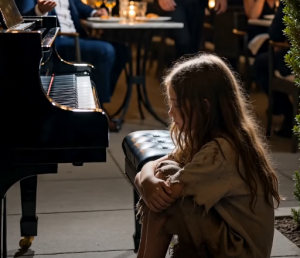
Now she sat curled on the sidewalk outside a brilliant restaurant, knees against her chest, protecting a piece of bread. It was dry and hard, barely larger than her palm, but it was the last thing her mother had given her before the hospital room went silent.
“Don’t eat it all at once,” her mother had whispered. “Save it for when you feel completely alone.”
The girl had not known loneliness could exist in a crowded city. She knew it now.
Behind her, the restaurant glowed with golden lights. Crystal glasses flashed above white tablecloths. Warm bread and butter scented the air. People laughed and toasted as if the sidewalk outside belonged to another world.
Most of them pretended not to see her. Some glanced down, then looked away. One woman stepped around her. A man nearly kicked her foot while laughing into his phone.
The girl lowered her eyes.
At a table near the patio, a loud man noticed her. He had been drinking with friends, enjoying the attention money bought. He pointed at her with his glass.
“Hey,” he called. “You there.”
The girl froze completely.
“Play something for us,” he sneered. “Or is begging your only talent?”
His friends laughed. The sound struck harder than hunger. She was not begging. She had only been wondering if tonight was the night to eat the last bread her mother had touched.
“Maybe she knows one sad little song,” a woman said.
“Come on,” the man added. “Earn your dinner.”
Her fingers pressed the bread until crumbs fell onto her skirt.
Then a chair scraped against the floor.
“That’s enough.”
The calm words cut through the laughter. Everyone turned.
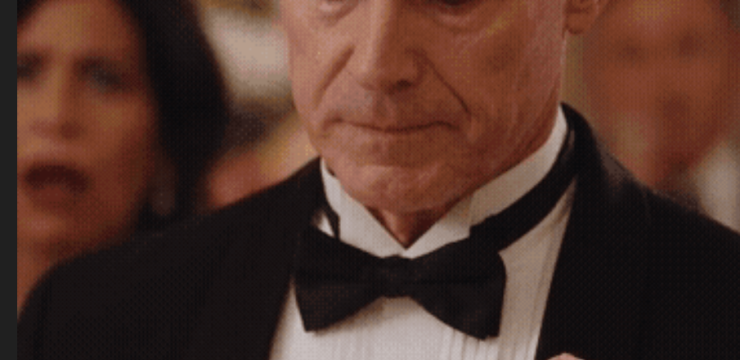
A man in a black suit rose from a corner table near the piano. He was tall and composed, with silver at his temples and a presence that made waiters step aside. He did not need to raise his voice.
The rude man smirked. “Relax. We were only joking.”
“No,” the man in the black suit said. “You were being cruel.”
Silence settled over the patio.
He walked toward the girl, not with disgust and not with shallow pity. He looked at her as if her face had unlocked a memory.
When he reached her, he bent slightly. “Are you hurt?”
She shook her head.
“Are you hungry?”
She looked at the bread, then away. Pride was one thing she still owned. “I’m fine.”
His expression tightened.
Behind them, someone muttered, “If she wants to perform, let her.”
The man ignored it. His eyes moved to the grand piano. Its black surface shone.
Then he turned back to her. “Can you play?”
The girl swallowed. For a moment she heard another piano, another life: her mother guiding her fingers across old keys in morning sun. She remembered a father’s shadow leaving before the rent notices, the sickness, and the nights when her mother coughed and pretended not to be afraid.
She nodded.
“I didn’t forget,” she whispered. “Even when I lost everything.”
The man went still. “What did you say?”
But she had already stood. She tucked the bread into her sweater pocket and walked past the patio tables. Guests leaned back to avoid touching her. The restaurant grew quiet with curiosity, then discomfort. The pianist received a small nod and stepped away.
The girl climbed onto the bench. Her feet could not reach the pedals. Her thin hands hovered above the keys.
For a few seconds, there was only silence.
Someone whispered, “This is ridiculous.”
Then she played.
The first notes were soft, almost shy, like a memory opening its eyes. Then the melody unfolded. It was not random tapping, not a street trick, not a child’s simple tune. It was graceful, precise, and heartbreaking. Her hands moved with impossible certainty, shaping music far too large for her body.
Forks stopped in midair. Conversations died. The rude man slowly lowered his glass.
The music carried hunger, loss, love, and the ache of being forgotten. It sounded like a mother singing through tears, like a door left open for someone who never came home.
A woman near the bar covered her mouth. “This can’t be real,” she whispered.
The man in the black suit stepped closer, pale now. He was no longer listening like the others. He was watching her hands, especially her left hand.
Then she played a pattern of notes so unusual and intimate that his breath caught. Recognition crossed his face, then shock, then fear.
Years earlier, he had written that passage for one person: a lullaby for a woman he loved and the baby daughter he promised to return to when his business troubles ended. He had left for one month, then six, then years. Shame kept him away. Success gave him excuses.
He had told himself they were better without him.
He had told himself many things.
The chord faded.
No one moved.
The man leaned beside her, his voice shaking. “Wait… you’re—”
The girl looked up. Tears filled her eyes, but they did not fall. She knew his face from an old photograph her mother had kept hidden inside a book.
“You left us,” she said.
The room stopped breathing.
He gripped the piano. No excuse came. None could cover three days without food, reach back into the hospital room, or erase the years a child waited for footsteps that never returned.
“I looked for you,” he said, hearing how weak it sounded.
The girl shook her head. “No. Mom looked for you.”
A gasp moved through the restaurant. The rude guest lowered his eyes.
The man sank to one knee, no longer powerful or protected by wealth. He was only a father facing the child he had abandoned.
“What was her name?” he asked, though he already knew.
“Elena,” the girl whispered.
He covered his face.
For years, Elena had been the letter he never answered, the number he never called, the guilt beneath success. Now she was gone, and her daughter sat before him with hunger in her bones and music in her hands.
He took a worn photograph from his pocket: his younger self beside Elena, holding a newborn in a yellow blanket.
The girl stared. “Mom had that picture too.”
His hand trembled. “I was a coward.”
Around them, every guest seemed to understand the difference between seeing someone and looking away.
With her permission, he lifted the bread from her pocket and placed it gently back in her hands.
“Your mother gave you this for when you felt completely alone,” he said. “You are not alone tonight.”
The girl did not answer at once. Forgiveness was too heavy for one moment. But when he opened his arms, she leaned in, not because everything was healed, but because she was too tired to stand alone.
He held her as if letting go would be another unforgivable mistake.
And beneath the golden lights that had once ignored her, the little girl finally cried.