The ballroom had been built to make ordinary people feel small. White marble stretched from wall to wall, reflecting every chandelier above. Crystal lights hung from the ceiling like frozen rain. A small orchestra played near the far end, soft enough to flatter conversation. Men in black tuxedos laughed over glasses of wine. Women in satin and silk gowns leaned close to trade compliments and quiet judgments. Everything in that grand room announced wealth, history, and control.
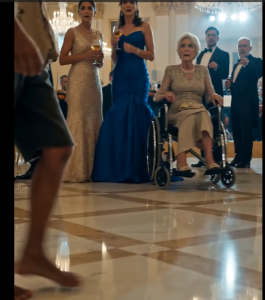
Then the doors opened, and a barefoot boy stepped inside.
At first, nobody understood what they were seeing. He was small, maybe ten years old, with dark messy hair, a torn beige shirt hanging loosely from his thin shoulders, and dark shorts dusty at the hem. His feet were bare against the cold marble. He looked as if he had walked there from another world, one filled with cracked sidewalks, hunger, and broken promises.
But he did not look lost. He carried himself like someone following instructions left by the long dead.
That was what made the room change.
The boy walked forward with quiet confidence, passing between groups of guests who slowly stopped talking. A woman in a blue gown lowered her wine glass without taking her eyes off him. Near the side of the room, a woman seated in a wheelchair turned her head and stared as if she had seen a memory come back to life. The orchestra continued playing for a few seconds, uncertain, then the music softened into nervous strings. Conversations faded. The rich and powerful watched the barefoot child cross the marble floor as though he had every right to be there.
No one moved to help him. They only watched, measuring him by his clothes before they had heard a single word from his mouth.
At the center of the ballroom stood Don Rafael Montes, the evening’s host. He was an older man with silver-gray hair, sharp eyes, and a black tuxedo tailored so perfectly it looked like armor. For decades, people had called him a builder of fortunes, a guardian of the old family name, a man whose approval could open doors and whose anger could close them forever.
Rafael saw the boy and stiffened.
To everyone else, the child seemed like an intruder. To Rafael, he looked like danger.
He stepped forward quickly, blocking the boy’s path. His polished shoes stopped inches from the boy’s bare toes. The divide between them was almost cruel: wealth and poverty, power and vulnerability, a tuxedo and torn cloth, marble shine and road dust.
The boy lifted his face.
Rafael leaned down, his voice low enough to sound controlled but sharp enough to cut. “¿Qué haces aquí? ¡Lárgate de este lugar!”
The meaning was clear even to those who did not speak Spanish. What are you doing here? Get out of this place.
Several guests exchanged uncomfortable looks. In rooms like that, people often confused cruelty with order, especially when it protected them from having to care.
The boy did not step back.
He stood still beneath the chandelier glow, his calm eyes fixed on the older man’s face. There was dirt on his cheek and a small tear in one sleeve, but there was no fear in him. His silence unsettled Rafael more than tears would have. A crying child could be dismissed. A frightened child could be escorted away. But this boy looked at him as if he had crossed that room for a reason older than the evening itself.
Rafael straightened slightly. “Do you know whose house this is?” he demanded in English, now speaking for the benefit of the crowd. “Do you know what kind of event you have walked into?”
The boy’s hands curled lightly at his sides. “I know.”
A ripple moved through the guests. The woman in blue pressed her fingers to her throat. The woman in the wheelchair leaned forward, pale with sudden recognition.
Rafael noticed her reaction and turned colder.
“Someone bring security,” he said.
But before anyone could obey, the boy spoke in Spanish, each word silencing even the rustle of silk gowns.
“Vengo a reclamar lo que es mío…”
I came to claim what is mine.
The orchestra stopped.
For a moment, the only sound was the faint clink of a wine glass trembling in someone’s hand. The sentence hung in the ballroom like a match held near a curtain. The guests looked from the boy to Rafael, then back again. Claim what is his? What could a barefoot child possibly claim in a room filled with old money, locked accounts, inherited estates, and names carved into stone?
Rafael’s face changed so quickly that those closest to him noticed. The pride in his expression drained away. His jaw tightened, but not with anger this time. It was fear. His eyes flickered over the boy’s hair, his face, the shape of his mouth, the stubborn lift of his chin. Recognition struck him like a private punishment.
The woman in the wheelchair whispered, “No.”
The word was barely audible, yet everyone near her heard it. The woman in blue looked at her, then at Rafael, and something like suspicion spread across her elegant face.
Rafael tried to recover. Men like him had spent a lifetime mastering rooms. He knew how to turn accusation into insult, confusion into command. He lifted one hand as if to dismiss the boy again, but his fingers trembled.
“You are mistaken,” he said.
The boy reached into the pocket of his torn shorts and pulled out a folded paper, worn at the edges from being carried too long. He did not open it yet. He simply held it where Rafael could see.
The older man’s breath caught.
That tiny reaction betrayed more than any confession could have. The room saw it. The guests saw it. The woman in blue saw it. The woman in the wheelchair covered her mouth, tears filling her eyes.
The boy’s voice remained calm. “My mother told me to give this only to the man who knew why I was born without a last name.”
A shocked murmur broke through the ballroom. Rafael stepped back as if the marble beneath him had cracked. For years, he had buried certain truths under money, distance, silence, and fear. He had trusted the world to honor his version of history because people usually did. Wealth had protected him from questions. Reputation had protected him from consequences.
But wealth could not erase a child standing barefoot in front of him.
Rafael looked at the folded paper, then at the boy’s face. In that instant, the ballroom no longer belonged to him. Every chandelier, every wine glass, every polished reflection seemed to turn against him. The guests who once waited for his approval now waited for his answer.
Outside, thunder rolled softly beyond the grand windows.
The boy finally unfolded the paper.
Rafael whispered, “Where did you get that?”
The boy did not answer. He only held the document higher.
And as Rafael stared at the name written across the bottom, his face went pale with the terrible knowledge that the poorest child in the room may have been the rightful heir to everything.