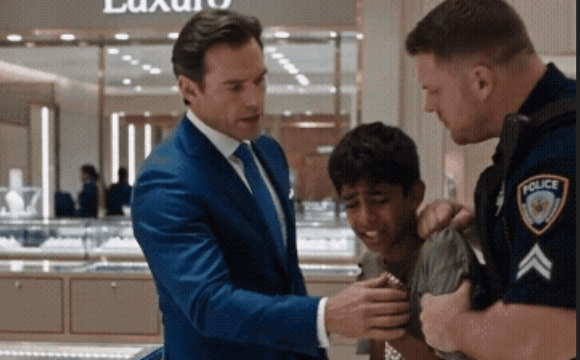
The luxury showroom made ordinary people feel small. White tile floors reflected polished cars, glowing signs, and the gold trim of display windows. Soft music played above shoppers moving between vehicles they could only dream about owning. Everything looked clean, expensive, and controlled.
Then a child’s voice broke through it.
“Papá…”
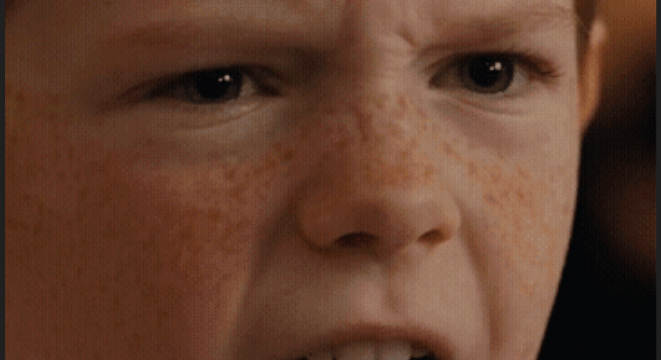
The word was weak, swallowed by footsteps, but it carried enough pain to make people turn. A boy of about eight stood near the main aisle, holding a crying baby girl close. His oversized gray-brown shirt hung from his shoulders. His canvas shoes were dirty, his face marked with dust and dried tears. In one hand, he held an old black-and-white photograph.
The man he called father kept walking.
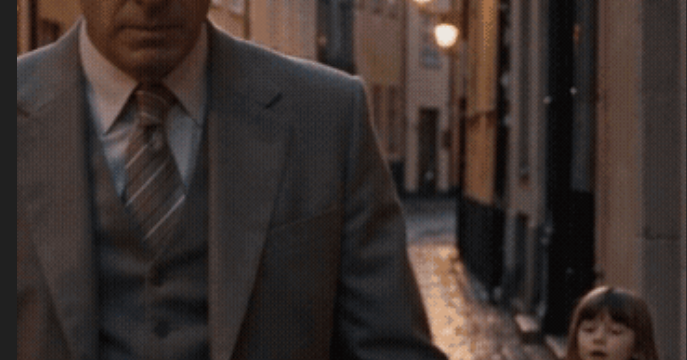
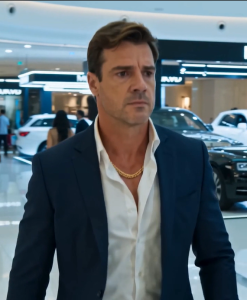
Adrián Vega wore a tailored dark blue suit, a white shirt open at the collar, and a gold chain flashing against his skin. He moved through the showroom with practiced confidence. Salesmen nodded. Customers stepped aside. To them, Adrián looked like wealth, success, and certainty.
But the boy called again.
“Papá.”
This time Adrián stopped. His shoulders stiffened before he turned. When he saw the child and the baby, confusion crossed his face, then defensiveness. He glanced around, aware of the elegant bystanders watching.
“¿Quién eres?” he asked sharply.
Who are you?
The baby cried harder, face red and streaked with dirt. Her light clothing was soiled, and her little hands clenched, reaching for comfort that never came. The sound echoed off the spotless floor and glass. In that bright, wealthy place, her suffering looked impossible to ignore.
The boy stepped closer, though afraid. He lifted the photograph toward Adrián. His fingers trembled so badly the old paper fluttered.
“Mamá me dio esta foto,” he said, voice breaking.
Mom gave me this.
Adrián stared at the picture without touching it. At first, his expression stayed hard. Then his eyes focused on the woman in the photograph. She was young, smiling, dark hair loose around her shoulders. The image was creased, but her face was clear.
Adrián’s breath changed.
For a moment, he was no longer standing in a luxury showroom. He was twenty years younger, laughing beside that same woman in a small apartment with cracked paint and cheap radio music. Her name had been Lucía. She had loved him before suits, before money, before people called him sir.
He had loved her too, once.
Then ambition came. Opportunity came. Fear came. He told himself he was leaving to build something. He promised to return when he was ready. But pride is clever. It turns delay into distance and distance into silence. Years passed, and Adrián buried Lucía in the same place he buried his old life.
The boy held the baby tighter. Tears ran down his dirty cheeks.
“Mamá murió,” he said. “Solo nos quedamos ella y yo. Tenemos hambre, papá.”
Our mother died. Only she and I are left. We are hungry, Dad.
The words struck harder than any accusation. A woman near a white car covered her mouth. A salesman lowered his eyes. The showroom, moments earlier filled with music and business smiles, became painfully still.
Adrián looked from the photograph to the boy, then to the baby. He saw Lucía in the boy’s eyes, her chin in the baby’s face, and truth arriving before everyone, carried not by lawyers or documents, but by two children who had nothing left except a faded photo and hope.
His polished exterior began to collapse.
“No,” he whispered, but it was not denial anymore. It was grief trying to speak.
The boy seemed to misunderstand. He lowered the photograph slightly, as if afraid he had made a mistake. “She said if something happened, I should find you. She said you would help us.”
Adrián pressed a hand against his chest. He had built companies, bought cars, and walked through rooms as if nothing in the world could touch him. Yet this barefoot truth had found him on a shining floor. He thought of the nights Lucía must have struggled alone. He imagined the boy learning too young how to calm a hungry baby. He imagined the mother, fading, still trusting the man who had not come back.
His eyes flooded at last.
The baby’s cries softened into broken whimpers. The boy shifted her carefully, clearly practiced at being both brother and protector. No child should have held that responsibility, but he did it with the tenderness of someone who had no choice.
Adrián stepped forward slowly. “What is your name?” he asked.
The boy swallowed. “Mateo.”
“And hers?”
“Sofía.”
Adrián repeated the names in a whisper, as if saying them made the truth permanent. Mateo and Sofía. His children. Not strangers, not a problem, not an interruption in his expensive day.
His children.
He reached for the photograph, but before his fingers touched it, his strength failed. The old picture slipped from Mateo’s hand and fluttered down in slow motion. It landed on the white tile beside the boy’s dirty shoes. The contrast was unbearable: clean luxury under a broken family’s last proof.
Adrián broke.
A loud sob escaped him, raw and uncontrolled. He covered his face, but it was useless. Everyone saw. The successful man in the tailored suit cried like someone whose heart had finally found the grave he had avoided. Status could not protect him. Money could not rewrite the years. No gold chain, no expensive car, no polished floor could hide the truth that two children had been hungry while their father lived surrounded by comfort.
He dropped to his knees.
Mateo froze, unsure whether to run or stay. Adrián lowered his hands and looked up at the boy with a face transformed by shame.
“I am sorry,” he said in Spanish, voice shaking. “I should have been there.”
Mateo did not answer. He had heard promises before from adults who disappeared. He only held Sofía closer.
Adrián understood. Forgiveness could not be demanded from a hungry child. It had to be earned, meal by meal, night by night, year by year. He removed his suit jacket and wrapped it gently around Mateo’s shoulders, then motioned for help.
“Call my driver,” he told the nearest employee. “And bring food, water, diapers, anything we have. Now.”
People moved quickly. The spell of shock broke into action. Someone brought a blanket. Another brought warm milk. A woman knelt beside Mateo and offered tissues. The showroom no longer felt like a palace for the rich. For the first time that evening, it felt human.
Adrián lifted the photograph from the floor. Lucía’s smile stared back at him, full of a trust he had failed to deserve. He pressed the picture to his heart.
“I found them,” he whispered to her. “I will not lose them again.”
The screen of that moment, if life had one, would have faded to black on the photo, the child’s shoes, the crying baby, and the father finally broken open by the truth. But for Mateo and Sofía, the story did not end in that showroom. It began there.
Because sometimes the richest place in the world is still empty until love walks in hungry, tired, and carrying the proof you can no longer ignore.