The white mansion looked perfect from the manicured lawn, with rows of white chairs, a runway-style aisle, and a ceremonial arch covered in roses. Ethan stood at the altar in his crisp black tuxedo, trying to look successful.
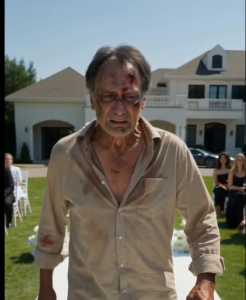
Then his father appeared at the end of the aisle.
Miguel Reyes walked quickly, almost stumbling, as if he had run straight from work. His tan shirt was stained with grease. Engine oil smudged his face, his hair was messy, and a bruise marked his forehead. He looked exhausted, humble, and out of place beneath the bright afternoon sun.
A few guests turned. Then more. The music seemed to thin into silence.
Ethan’s face hardened. He stepped away from the altar and blocked his father before Miguel could reach the front. “Tenías que venir así a mi boda?” he snapped.
Did you have to come to my wedding like this?
Miguel stopped. For a moment he looked only at his son. “Ethan,” he said softly, “I came as fast as I could.”
The bride, Camila, tilted her head with disgust. Her white lace gown was flawless, her red lipstick perfect, her expression colder than diamonds. She covered her nose with two fingers, though Miguel stood several feet away. Her mother, seated in the front row, whispered something to a woman in pale pink, and both of them laughed.
Camila took a step forward. “¡Dios mío, hueles a taller de ti!” she said sharply. “Toda mi familia sentirá vergüenza de esa pobreza.”
Her words cut through the wedding like a blade. She was saying he smelled like a workshop, that her entire family would be ashamed of that poverty. The guests laughed harder now, because some people laugh when kindness might cost them status.
Miguel lowered his eyes.
Ethan heard the laughter and turned red, embarrassment. This was exactly what he feared. He had spent years trying to erase the smell of oil, tools, and cramped apartments where his father came home exhausted. Now Miguel had walked into the most elegant day of Ethan’s life looking like proof of everything Ethan wanted hidden.
“Why would you come here like that?” Ethan demanded in English now, “You couldn’t even change? You couldn’t wash your face?”
Miguel lifted one hand toward the bruise on his forehead. “There was a problem at the shop. I had to finish something first.”
Ethan pointed down the aisle. “¡Y tú vienes a recordarle a todos de dónde vengo!”
You came to remind everyone where I came from.
The laughter faded under the weight of that sentence. Even the people who had mocked Miguel seemed to understand that something painful had been said. Miguel’s shoulders sank. He looked smaller, though he had carried Ethan through every hard season.
For twenty-six years, Miguel had raised Ethan alone after Ethan’s mother died. He fixed engines all week and took extra jobs on Sundays. He missed holidays, not from neglect, but because unpaid bills did not wait. When Ethan needed books, Miguel sold his watch. When Ethan became ashamed of him, Miguel told himself success had simply made his son busy.
But humiliation is different when it comes from the child you sacrificed for.
Miguel looked up. Tears gathered in his tired eyes, catching the sunlight. His voice shook, but he did not shout. “Solo quería entregárselos terminado.”
I only wanted to give it to you finished.
Camila frowned. “Give us what?”
Miguel reached into his pocket with trembling fingers. The guests leaned forward. Ethan’s anger faltered for the first time, as if some buried part of him recognized the sound of his father’s voice from childhood.
A low engine rev rolled across the mansion driveway.
Every head turned.
Parked near the entrance, shining under the bright sky, was a sleek dark gray Ferrari. Its body reflected the white mansion, the rose arch, and the stunned faces of the guests. One of the groomsmen whispered, “That car is here for the wedding?”
Miguel lifted a modern key fob. His hand shook the small metal piece caught the sunlight in quick flashes.
“It was my wedding gift,” he said. His voice cracked. “Era mi regalo de bodas. Trabajé dos años extra para comprarlo. Pero ya entendí. Les avergüenzo demasiado.”
He had worked two extra years to buy it, and now understood that he embarrassed them too much.
No one laughed.
The silence was worse than any accusation. Camila stared at the key, at the Ferrari, then back at Miguel. Her lips parted, but no clever insult came out. Her mother sat stiffly, suddenly fascinated by the floor. Guests who had laughed avoided each other’s eyes.
Ethan could not move.
He saw the car, but he also saw his father behind it: the late nights, the grease that never fully left his fingernails, the quiet man who had never bought himself anything nice. Ethan remembered being eight years old asleep in the shop while Miguel worked past midnight. He remembered his father warming soup on a portable burner because work had to be finished. He remembered promising, once, that when he grew up he would make his father proud.
Now his father stood bruised and humiliated, holding proof of love Ethan had mistaken for shame.
“Dad,” Ethan whispered.
Miguel closed his fingers around the key. “No,” he said gently. “Today is your wedding. I will not make your bride’s family uncomfortable.”
He turned away from the rose arch.
Ethan reached for him, but his hand stopped in the air. What could he say? Sorry was too small for the years he had allowed pride to grow between them. Camila stood frozen beside the altar, not flawless now, but a woman exposed by her cruelty. The lawn, mansion, candles, roses, and expensive chairs all seemed empty.
Miguel walked back down the white aisle alone.
This time, no one laughed. Guests lowered their heads as he passed. A few looked ashamed. Someone quietly stepped aside to give him room, as if respect had arrived too late but arrived anyway.
At the driveway, Miguel paused beside the Ferrari. He did not look back. He placed the key in his pocket, wiped his face with his sleeve, and continued walking toward the gate like a man taking his dignity with him.
In that silence, the wedding finally showed its true cost. It was not the flowers, the food, or the famous guests. It was the price of forgetting the person who had paid for your chances when you had nothing. Ethan had wanted a perfect image, but Miguel had brought something better than image. He had brought sacrifice. And sacrifice, once insulted in public, does not need revenge. It only needs to walk away with its head still higher than the people who laughed. That lesson would follow Ethan long after the music stopped completely.
Behind him, Ethan stood motionless in the silence of his ruined wedding. The gift was still there, shining under the sun, but the father who had earned it was leaving. For the first time that day, Ethan understood that wealth can buy a car, a mansion, even a perfect wedding. But it cannot buy back a heart after you break it in public.