The sun beat down on the military obstacle course, turning the dusty training field into a bright, unforgiving stage where every mistake could be seen. Wooden structures stood across the open ground, climbing ropes swayed lightly in the wind, and distant training sounds carried through the harsh daylight. At the base of one hanging rope stood Private Rivas, a bearded soldier with short dark hair, an olive green T-shirt, camouflage pants, and an expression that suggested he already believed he had won a contest that had not even begun. He wrapped one hand around the rough rope fibers and looked toward Lieutenant Arias with an arrogant smirk.
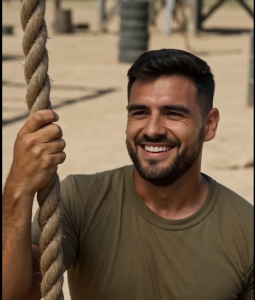
Rivas was clearly comfortable with an audience. Instead of treating the obstacle as another part of training, he decided to turn it into a chance to challenge his superior. With a condescending tone, he looked at Arias and said, “Lieutenant, that rope is too much for you.” His words were simple, but the meaning behind them was unmistakable. He was not offering advice or showing concern. He was openly questioning whether she had the strength and skill to handle the climb. The faint wind moved across the field while the background noise seemed to fade, leaving his comment hanging almost as visibly as the rope itself.
Lieutenant Arias did not react with anger. She stood with her hands on her hips, her posture straight and controlled. Her hair was secured in a neat bun, and the name patches on her olive green uniform shirt were clearly visible. She looked at Rivas steadily, showing no sign that his insult had shaken her confidence. Instead of raising her voice, she answered him with a calm question that immediately shifted the pressure back onto him. “Too much for me? Or too much for you, Rivas?” The challenge was delivered without drama, but its effect was immediate. Rivas could no longer hide behind a joke.
His smirk tightened. Pride took over, and he grabbed the rope with both hands. He positioned his boots in the dirt and prepared to climb as if the outcome were already certain. The rope creaked under his grip. For a moment, his body language still projected complete confidence. He had questioned Arias in public, and now he had to prove that the obstacle was as easy for him as he had implied. There was no graceful way to retreat from his own challenge. He pulled hard, trying to lift himself upward with strength alone, expecting everyone watching to see a quick demonstration of his ability.
Instead, the climb went badly almost immediately. Rivas barely managed to rise before his grip began to fail. The rope slid through his hands, his balance disappeared, and he dropped awkwardly back toward the ground. He landed on his knees in the dirt, more embarrassed than hurt. Dust rose around his boots and camouflage pants as the rope swung above him. The moment was not dangerous or graphic, but it was impossible to mistake the humiliation. Trying to recover what remained of his pride, he blurted out, “I can… Ah! I just… slipped.” The excuse sounded weaker than the confidence he had shown only seconds earlier.
Lieutenant Arias stepped forward while Rivas remained low in the foreground, brushing dust from his knees. His earlier smirk was gone. He did not have another insult ready, and the difference in his posture said more than any apology could have said at that moment. Arias approached the same rope without rushing. Her boots pressed firmly into the dirt, and the rope was still swaying from Rivas’s failed attempt. She reached for it with the composed focus of someone who had trained for the task rather than someone trying to impress a crowd.
Then Arias began to climb. Her movement was smooth, efficient, and controlled. From a low angle, the difference between the two attempts became impossible to ignore. She did not waste energy fighting the rope. She used practiced coordination, steady strength, and precise movement to rise quickly above the ground. The fibers shifted beneath her hands, but she maintained her rhythm. As she climbed, she delivered the lesson that defined the entire confrontation. “The difference is simple. I train, you show off.” Her voice remained steady while triumphant music seemed to match the confidence of every movement.
The statement was not merely another insult. It explained exactly why the challenge had turned against Rivas. His confidence had been built on appearance and assumption. Arias’s confidence was supported by preparation. She did not need to announce that she was capable before touching the rope. Her performance demonstrated it. With dust and bright sunlight behind her, she continued upward until she reached the top wooden beam with apparent ease. There was no hesitation, no dramatic struggle, and no need to prove anything beyond what everyone could already see.
Below her, Rivas looked up. His face had changed completely. The soldier who had begun the scene with a mocking smile now stared with a mixture of surprise, embarrassment, and reluctant admiration. His mouth remained slightly open as he watched Arias settle at the top. The public challenge he had created had become a lesson directed back at him. His pride had pushed him into a test he assumed he would dominate, but the result exposed the gap between boasting and preparation. Even the faint murmurs around the training ground seemed to underline how thoroughly the mood had changed.
Arias sat comfortably on the top beam, looking down from the obstacle she had just conquered. She was not breathless, shaken, or uncertain. Her calm expression carried the same authority she had shown before the climb. With a victorious smile, she gave Rivas one final line: “See? Superiority.” The words were teasing, but the larger message was about discipline. She had not defeated him through anger, intimidation, or rank. She had answered his mockery by doing the task he claimed was too difficult for her, and she had done it with controlled athletic skill.
For anyone watching, the lesson extended beyond one rope and one military training field. Rivas made his mistake before he ever started climbing. He underestimated another person, confused confidence with competence, and spoke before proving his own ability. When the moment of truth arrived, pride could not replace training. Arias took the opposite approach. She remained composed, accepted the challenge, and allowed preparation to speak for her. The contrast between them made the outcome both satisfying and memorable without requiring cruelty or injury.
The scene also showed why genuine authority often looks quieter than arrogance. Rivas tried to establish superiority through words, while Arias established credibility through action. She never needed to shout or threaten him. Even when she turned his challenge back on him, her response stayed focused on performance. That restraint made her victory stronger. By the time she reached the beam, everyone could see the difference between confidence built on preparation and confidence built on pride.
As Arias remained above the course, Rivas stood below with his earlier certainty gone. The shift had taken only seconds, but it was complete. Mocking confidence became embarrassment, a challenge became a demonstration, and an attempted insult became a lesson in discipline. The dusty rope course had exposed exactly what each soldier brought to the moment: one brought assumptions, and the other brought training.
Under the bright sun, surrounded by wooden obstacles and distant training sounds, Lieutenant Arias had answered Rivas without losing control. Her climb made the point clearly. Preparation speaks louder than boasting, respect should come before assumptions, and real strength rarely needs to announce itself before the work begins. Rivas had learned that lesson in the most public way possible.