The ballroom glittered beneath crystal chandeliers, every polished surface reflecting warm light across rows of white-clothed tables. Guests in tuxedos and evening gowns talked quietly over elegant music, lifting glasses and smiling as servers moved between them with practiced grace. Nothing about the formal gathering suggested that, within seconds, one child’s voice would expose a secret powerful enough to stop the entire room.
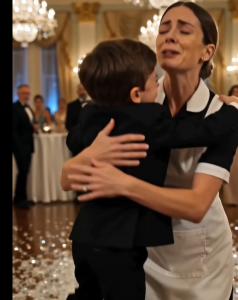
A small boy in a miniature black tuxedo suddenly appeared between the tables. His bow tie sat slightly crooked, and tears streamed down his face as he ran as fast as his short legs could carry him. He barely noticed the startled guests turning in their chairs. His eyes were fixed on someone across the ballroom.
Then he saw her clearly.
“Mommy!”
The young waitress holding a silver tray froze.
The tray tilted in her hands, glasses slid toward the edge, and then everything crashed onto the polished floor. Crystal shattered with a sharp burst that cut through the music. Conversations stopped. Heads turned.
But the woman did not look at the broken glass.
She looked only at the boy.
He reached her and threw himself into her arms. She caught him instinctively, pulling him tightly against the black-and-white uniform she had worn so carefully while working the event. Her face changed from shock to overwhelming emotion as she held him. The boy pressed his tearful face against her neck and sobbed with the kind of relief that comes after being afraid someone might never return.
“You came back! I knew you’d come back!”
The waitress closed her eyes.
Her hands trembled as she held him closer. Whatever reason she had for working secretly at the ballroom no longer mattered to the child. To him, she was not a server carrying drinks or clearing tables. She was simply his mother, and finding her had ended a fear he could not hide.
For a few precious seconds, the reunion seemed to silence everything else.
Then a sharp voice broke through the room.
“Get him away from her!”
An affluent woman in a shimmering gold gown stood nearby, her expression tight with anger. The warm chandelier light danced across her dress, but there was nothing warm in her reaction. She stared at the mother and child as though their embrace had violated some rule of the evening.
Before the waitress could respond, a man in a black tuxedo pushed forward from the crowd. His movements were fast and rigid, his polished shoes striking the floor with enough force to announce his anger before he spoke. People stepped aside as he approached.
The mother tightened her arms around the boy.
The child noticed the sudden hostility and slowly lifted his head from her shoulder. His cheeks were wet, his eyes red, but his expression was innocent. He looked toward the approaching man with confusion rather than fear.
Then he asked a question.
“Daddy, why does everyone call mommy the servant?”
The ballroom went silent.
Silent.
No one reached for a glass or whispered to a neighbor. Every face turned toward the child, because his innocent question had transformed an ordinary scene of discipline into something deeply personal, and the adults suddenly seemed afraid of the answer there.
Even the emotional music seemed to disappear beneath the weight of the word he had used.
Daddy.
The man stopped.
His angry expression did not vanish all at once. It seemed to crack apart. First came confusion, then disbelief, then a dawning horror that changed his entire face. His mouth opened slightly as he stared at the boy, then at the waitress holding him.
“What did you call her?”
His voice was no longer forceful.
The boy clung more tightly to the waitress, apparently unable to understand why such a simple answer had become so important.
“Mommy.”
The waitress went pale.
Until that moment, she had looked overwhelmed by seeing her son. Now fear entered her expression. Her eyes moved toward the man in the tuxedo, and the tenderness of the reunion was suddenly mixed with the anxiety of being exposed.
The woman in the gold gown no longer seemed fully in control of the scene. This was no longer about a server being out of place at a formal event.
The man studied the waitress’s face.
Something familiar surfaced.
His eyes widened.
His breathing caught.
“Rose?”
The name came out like a gasp.
She stood surrounded by broken glass, expensive gowns, black tuxedos, and stunned strangers, holding the child who had recognized her without hesitation. Her uniform suddenly seemed like the least important thing in the room.
The boy had revealed what appearances had hidden.
The man who had stormed forward ready to confront a servant now looked shaken by the possibility that the woman in front of him was someone deeply connected to his own life. His earlier anger had nowhere to go. The certainty that had carried him across the ballroom disappeared.
Only now, the guests understood how cruelly misplaced those words might have been. The child had not run toward a stranger. He had run toward his mother. He had not disrupted the evening out of misbehavior. He had crossed the ballroom because he believed someone he loved had finally returned.
The mother had apparently been working quietly, keeping her identity hidden while moving among people who saw only a uniform. The boy had destroyed that disguise with one joyful cry. Yet he had done something else too: he forced everyone to look past class, clothing, and assumptions.
A waitress could still be a mother.
A servant’s uniform could conceal a history no wealthy guest understood.
And a child could expose the truth without realizing he was doing it.
The ballroom remained frozen beneath the chandeliers.
Broken glass sparkled near Rose’s shoes. The abandoned tray reflected fragments of light. The boy’s small black tuxedo pressed against her uniform as he held on, afraid to let go now that he had found her.
Across from them, the man stared as recognition settled over him.
The scene had begun as an emotional reunion. It had become a public confrontation. Now it ended with something more devastating: recognition.
No one needed a long explanation to understand that the relationships in the room were not what they had appeared to be.
The people with the greatest social power suddenly seemed the least certain.
The woman treated like hired help stood at the center of the truth.
And the smallest person in the ballroom had spoken the words that changed everything.
The boy looked between the adults, still confused by their shocked faces. He had only called his mother “Mommy” and the man “Daddy.” To him, those names were natural.
To everyone else, they were a revelation.
Rose held her son tighter as the final seconds stretched into unbearable silence. The man’s lips remained parted, his face caught between memory, regret, and disbelief. The woman in gold stood rigid nearby. Guests stared from behind elegant tables, suddenly witnesses to a family truth no one had expected to see.
Under the glittering chandeliers, status had lost its power.
One child’s love had exposed what appearances tried to hide.
And with a single shocked whisper—“Rose?”—the elegant ballroom became the place where a buried connection finally came back into the light.





