The viewing room had been arranged with the quiet dignity families expect on the hardest days of their lives. Soft lamps cast a warm glow across the hardwood floor, floral wreaths surrounded a polished wooden casket, and a framed portrait of the man everyone believed had died rested nearby. The room smelled faintly of flowers and furniture polish. A dark rug softened the center of the space, while several mourners stood in silence, speaking only in whispers. Everything suggested finality. Everything appeared painfully still.
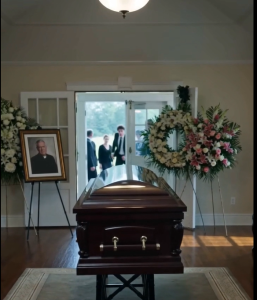
Then the door opened, and a young man in a black suit rushed inside.
“Dad! Dad!” he cried.
His voice broke through the solemn room so sharply that several mourners turned at once. His white shirt was rumpled beneath his black tie, and tears already streaked his face. He did not pause to greet anyone or ask where to stand. He moved straight toward the casket, desperate to reach the father he believed he had lost.
No one in the room understood that the person inside the casket was not dead.
Beneath the closed lid, darkness surrounded the middle-aged man trapped inside. His terrified eyes stared upward at the underside of the polished wood. Dark duct tape covered his mouth, preventing him from calling to his son. He could hear voices outside, but they were muffled and distant through the thick lid. He shifted as much as the confined space allowed, trying to make some kind of sound.
A dull thump disappeared beneath the funeral music.
Outside, the grieving son reached the casket and collapsed over it. He stretched both arms across the smooth wood as if holding the coffin might somehow bring his father closer. His shoulders shook with heavy sobs. The polished surface reflected the room’s soft lights and the trembling outline of his hands.
Maria, an older woman dressed in black, watched him from nearby.
Her expression was not simply sorrowful.
It was alarmed.
The son lifted his head, his face wet with tears, and looked directly at her.
“When did all this happen, Maria?” he asked, struggling to steady his voice. “I want to see my father one last time.”
The request seemed natural. In a viewing room, one final look was exactly what many grieving relatives might expect. The mourners behind him became quiet. Two men in black suits entered carrying the framed photograph of the deceased, then stopped when they sensed the tension gathering around the casket.
Maria stepped forward quickly.
Before the son could reach for the edge of the lid, she grabbed him and pulled him back.
He stared at her in confusion.
The sudden movement seemed wrong in a room built around quiet respect. Fabric rustled. Someone inhaled sharply. Maria’s eyes moved from the young man to the casket and back again. Her grip was tense, and her face had hardened with fear.
“No, you can’t!” she shouted. “It can’t be opened! Your father had a disease, a very contagious disease.”
Her explanation landed heavily in the silent room.
The son froze.
Only moments earlier, Maria had appeared to be another grieving relative standing beside a closed casket. Now she seemed desperate to keep anyone from touching it. Her voice was louder than necessary. Her breathing was uneven. Most troubling of all, her eyes kept darting toward the wooden lid.
The mourners noticed.
So did the son.
He looked at Maria, then at the casket, trying to understand why she was so frightened. His grief had not disappeared, but suspicion was beginning to cut through it. If his father had truly suffered from a dangerous contagious illness, why had no one warned him before he entered? Why had Maria waited until he asked to see the body before becoming so forceful?
No one answered those questions.
For the older guests in the room, the moment carried a different kind of weight. Many had attended enough funerals to know how grief usually moved: quietly, slowly, with relatives asking to touch a hand, adjust a flower, or whisper a final message. Maria’s reaction did not resemble ordinary caution. It felt urgent and personal, as if opening the casket threatened something she needed to keep hidden. That realization spread silently from face to face, turning sorrow into uneasy attention for everyone present.
The room went still.
Then came another faint sound.
It was soft enough that someone could have mistaken it for wood settling or an object shifting nearby. Under the tense music, however, it sounded almost like a muffled knock from inside the casket.
The son’s eyes widened.
One mourner holding the framed portrait stopped moving completely. Another turned his head toward the casket. Maria’s face changed for only a second, but that second mattered. Fear flashed across her expression before she tried to regain control.
Inside the casket, the trapped father fought against panic. He could hear his son’s voice outside, close enough to recognize, yet he could not answer. His breathing came quickly through his nose. The tape across his mouth kept every word trapped behind it. His eyes flicked upward as he listened for another chance to make himself heard.
He shifted again.
The sound barely carried through the lid.
Outside, the son stared at the casket.
The entire room now felt different. The flowers, portrait, polished floor, and formal clothing still created the appearance of a funeral, but that appearance had begun to crack. What had first seemed like grief was becoming a question no one could ignore.
Why was Maria so determined to keep the casket closed?
Her warning about disease might have sounded convincing in another moment, yet her panic made it harder to accept without explanation. She had not calmly advised caution. She had physically stopped the son, shouted at him, and watched the casket as though she feared what might happen if the lid moved even an inch.
The son slowly stepped closer again.
Maria remained between him and the casket.
Behind them, the mourners said nothing. Their silence was no longer ceremonial. It was the silence of people realizing they might be witnessing something very different from the funeral they had come to attend.
The framed portrait showed a composed, familiar face.
The man inside the casket wore that same face, but now his eyes were wide with terror.
He listened to the voices outside and tried to stay focused. He was alive. His son was only a few feet away. If he could create one clear sound, one unmistakable movement, perhaps someone would understand.
The suspense in the room tightened around the closed lid.
The son looked from Maria to the casket once more, his tearful expression changing from heartbreak to stunned uncertainty. Maria’s defensive anger no longer reassured anyone. The mourners behind him remained frozen, waiting.
Then, from inside the darkness, came another muffled movement.
The father stared upward, breathing through his nose, the duct tape still sealing his mouth. He could not call out, but his terrified eyes revealed the truth the room had not yet seen.
The funeral was not what it appeared to be.
And the final goodbye the son had come to make might instead become the moment his father was found alive.





