Heavy rain fell across the graveyard, turning the narrow paths into dark streams of mud and filling every shallow footprint with water. Black umbrellas formed a silent circle around an open grave while mourners stood shoulder to shoulder beneath a nearly black sky. Their coats were soaked at the edges, their shoes sank into the wet earth, and no one spoke above the steady pounding of rain. On a mound of fresh dirt rested a white casket, bright against the gray afternoon. Distant thunder rolled over the cemetery as a grieving father stood near it, rigid in a sharp black suit and tie, his face carrying the exhaustion of a man who believed he was about to say goodbye to his daughter forever.
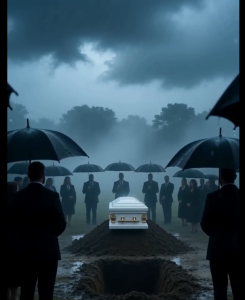
The burial was moments from continuing when movement broke the stillness.
A young boy came running between the headstones.
His gray T-shirt was stained with mud, his dark pants were soaked to the knees, and every step sent dirty water splashing around his shoes. He looked terrified, but he did not slow down. Several mourners turned as he pushed forward through the rain, staring directly at the white casket.
“Sir, don’t bury your daughter!” he shouted.
The words cut through the funeral like a siren.
Two men in black suits moved quickly to block him before he could reach the casket. They caught him by the arms as he struggled forward, breathing hard and trying to make the grieving father listen. Gasps traveled through the crowd. Umbrellas shifted. The low mourning music seemed to disappear beneath another growl of thunder.
“She’s not dead,” the boy cried. “She’s in a coma!”
The father immediately marched toward him.
Rain streamed from his beard and down the front of his black tie. His grief had already left him raw, and the interruption felt almost cruel. He glared at the child with anger sharp enough to silence the people nearby.
“What nonsense are you talking about, boy?” he demanded.
The boy stopped fighting for only a second. Instead of looking away, he turned his head toward a woman standing among the mourners. She wore a black mourning dress and a pearl necklace. Her hands were held tightly against her chest, and although she tried to remain still, fear had already entered her expression.
The boy lifted one shaking arm and pointed directly at her.
“Your wife gave her a sleeping serum.”
A murmur passed through the crowd.
The woman’s eyes widened. Her fingers pressed harder together beneath the pearls at her throat. For the first time, several mourners were no longer looking at the child. They were looking at her.
The father followed the boy’s pointing hand and saw his wife standing in the rain. His anger did not disappear. If anything, it became more defensive. The accusation struck at a person he trusted during the worst moment of his life, and he was not ready to accept it.
“My wife would never hurt her,” he said.
His voice was firm, but something had changed.
The boy heard it too.
Still held by the two men, he turned back toward the father. Rain washed across his dirty face and mixed with tears that he no longer tried to hide. He was frightened, exhausted, and clearly desperate, yet his eyes never left the man in front of him.
“Sir, look me in the eyes.”
The father stared at him.
For a few seconds, the cemetery seemed to narrow to the space between them. The umbrellas, the mourners, the open grave, and even the thunder faded behind the pounding rain. The boy did not look like someone enjoying the disruption. He looked like someone terrified that time was running out.
“The little girl is alive,” he said.
This time, he did not shout.
He spoke with certainty.
The father’s expression began to change.
The fury in his face weakened first. Then came doubt. His eyes searched the boy’s expression for a lie, a hesitation, anything that would allow him to dismiss the interruption and return to the painful certainty he had carried into the cemetery.
But the boy did not look away.
Behind them, the father’s wife remained frozen.
Her anxious face, tightened hands, and sudden silence now seemed impossible to ignore. The father glanced toward her again, and what he saw did not reassure him. He had expected outrage at the accusation. He had expected an immediate denial. Instead, she looked frightened.
Another crack of thunder rolled across the graveyard.
The father turned toward the white casket.
Until that moment, it had represented a terrible ending. Now, for the first time, it represented a question he could not afford to leave unanswered.
What if the boy was telling the truth?
What if grief had pushed everyone forward too quickly?
What if there was even the smallest chance that his daughter had not died, but had been placed in a condition that made others believe she had?
The possibility was enough.
A parent did not need certainty in a moment like that. He needed only one reason to stop.
The father’s shock hardened into fierce protectiveness. He stepped away from the boy and raised one hand toward the gravediggers and everyone standing near the burial site.
“Stop everything!”
The command echoed across the cemetery.
No one moved.
The men restraining the boy loosened their grip. Mourners stared from beneath their umbrellas. The father looked at the casket, then back toward the workers, his voice stronger now than it had been at any point during the funeral.
“Open the coffin!”
His wife went completely still behind him.
The rain continued to hammer the umbrellas and splash into the mud. The white casket remained closed. Nothing inside was shown, and no answer came before the moment ended. Instead, the scene held on the father’s decision: he would not allow the burial to continue until the boy’s claim had been investigated.
Only seconds earlier, he had believed the stranger was disrespecting his daughter’s funeral. Now the child’s insistence had forced him to question everything.
The most powerful part of the moment was not proof, because proof had not yet appeared. It was the father’s willingness to stop when doubt became impossible to ignore.
Grief can make people cling to certainty because uncertainty hurts even more. But sometimes one unexpected voice changes the direction of an entire moment. The boy had no polished appearance, no authority, and no place among the formally dressed mourners. He arrived covered in mud, shouting a claim that sounded unbelievable.
Still, he was willing to be restrained, challenged, and dismissed if that was what it took to make the father listen.
And the father, despite his anger, finally did.
The funeral did not end with a burial. It ended with a command, a terrified woman, a stunned crowd, and one urgent question hanging over the rain-soaked cemetery: had they been moments away from making a mistake that could never be undone?
For him, stopping the burial became the only responsible choice until the truth could emerge.
The answer remained hidden as the scene cut to black, leaving the white casket unopened on screen and the father standing between grief and hope.





