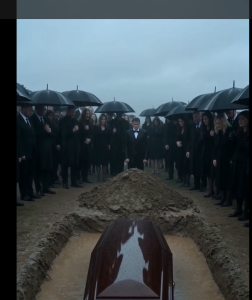
Rain fell steadily over the cemetery, turning the grass dark and filling shallow puddles between rows of weathered headstones. Beneath a heavy gray sky, mourners stood close together under black umbrellas, their formal clothes soaked around the edges despite every effort to stay dry. At the center of the gravesite rested a polished wooden casket above the open grave. Its dark surface reflected streaks of rain and the blurred silhouettes of grieving relatives. Quiet sobs mixed with the sound of water striking umbrellas, while low, somber music seemed to make the afternoon feel even heavier.
No one expected the funeral to become a scene of accusation.
Near the front stood a young boy in a black tuxedo, white shirt, and black bow tie. His wet hair clung to his forehead, and his face showed the exhausted grief of a child who had cried until there seemed to be nothing left. Beside him, a woman in a black leather coat watched him carefully. Her dark clothes were neat despite the storm, and her hair was pulled into a controlled bun. She seemed determined to keep the ceremony moving, even as the boy’s breathing grew faster.
Then the mourners shifted closer to the casket.
The boy suddenly broke from the crowd.
Before anyone could stop him, he rushed forward and threw himself against the wet wooden lid. His palms struck the casket as rain ran down his sleeves. He held on with desperate strength, his small body trembling as several mourners gasped.
“Don’t close it!” he screamed. “He’s not my father!”
The words cut through the cemetery louder than the rain.
For a second, no one moved. Faces turned toward him. Umbrellas tilted. Whispered questions passed through the group, but the boy refused to let go.
The woman in the black coat reacted first. She hurried forward, grabbed the back of his tuxedo jacket, and tried to pull him away from the casket. He twisted against her grip, sobbing and fighting to remain beside the man everyone had gathered to bury.
“Stop this right now!” she demanded.
The boy turned toward her, his face streaked with rain and tears.
“You lied to me my whole life!”
The woman froze for the briefest moment, but her hands remained on his jacket. That hesitation was enough for several people nearby to notice. Their grief began changing into confusion.
The boy pulled free and found his footing beside the casket. His shoes sank slightly into the muddy ground. He was drenched now, breathing hard, but he no longer looked only heartbroken. He looked determined.
His gaze moved across the mourners until it landed on one man.
The man stood near the casket in a tailored black suit, white shirt, black tie, and carefully folded white pocket square. Rain darkened the shoulders of his jacket, yet he remained completely still. His expression was stern, almost guarded, and unlike everyone around him, he did not appear surprised by the boy’s words.
That silence made the boy angrier.
He raised one shaking hand and pointed directly at him.
“Tell them who my real father is!”
A stunned hush spread through the cemetery.
The accused man did not answer.
Around him, mourners stared at one another as though they were trying to understand a story that had suddenly changed in front of them. A woman covered her mouth. Another person lowered an umbrella and stared at the man in disbelief. Several relatives became so overwhelmed that they sank to the wet ground, supported by others beside them. Nothing was graphic, but the emotional shock was unmistakable.
The boy kept pointing.
The woman in the black coat stood behind him now, no longer trying to drag him away. Her face had tightened, and the control she had shown moments earlier was beginning to crack.
Still, the man in the black suit remained silent.
Rain ran down his forehead and along the sharp line of his jaw. Water collected against his white pocket square. His eyes moved from the child to the casket, then back again.
Finally, he spoke.
“This is not the place,” he said, his voice strained. “He told me before to die…”
The unfinished statement created more questions than answers.
The boy’s expression changed immediately. Anger remained, but uncertainty moved through it. Some mourners leaned forward, waiting for the man to explain what the deceased had told him. Others looked toward the casket as if the truth might somehow be hidden inside it.
The man said nothing more.
That silence became almost unbearable.
The rain continued pounding the cemetery while the music fell lower, leaving only sobs, breathing, and the occasional sound of shoes shifting in mud. The boy looked from the accused man to the woman who had tried to stop him. Neither gave him the answer he wanted.
Then attention turned toward the coffin.
From the angle beside the grave, something could be seen resting inside, placed carefully over the deceased man’s chest. The camera never needed to linger on the body. What mattered were the papers.
Letters.
Several envelopes and folded pages rested together beneath the dim gray light. Their edges caught faint reflections from the wet surroundings, making them stand out against the dark interior of the casket.
The boy stared.
So did everyone else.
Those letters had clearly been placed there for a reason.
Perhaps the deceased had expected this moment. Perhaps he had known questions would surface after his death. Perhaps the man in the black suit knew exactly what the letters contained and had been instructed to remain silent until the right moment.
No one could know yet.
But the boy’s accusation had changed the funeral forever.
What had begun as a final goodbye was now filled with questions about identity, secrecy, and betrayal. A child who believed he had been deceived his entire life had forced the adults around him to face a truth they appeared desperate to avoid.
The woman in the black coat looked toward the letters, then lowered her eyes.
The accused man’s controlled expression tightened.
The mourners remained frozen around the grave.
For the people standing there, the rain could no longer wash away what had been exposed. Every glance carried suspicion, every silence felt deliberate, and every unanswered question seemed to point back toward the letters resting inside the coffin before them.
And the boy, still soaked by the rain, stood only a few feet from the casket, staring at the pages that might finally explain everything.
He had arrived at the cemetery believing he was burying his father.
Now he was no longer certain who his father was at all.
The mystery was not resolved before the scene ended. There was no dramatic confession, no immediate explanation, and no simple answer to erase years of secrecy. Instead, the funeral closed on something more powerful: the possibility that the truth had been waiting in plain sight, sealed inside letters beside the very man whose death had brought everyone together.
As rain continued falling over the grave, the final question was no longer whether the boy had disrupted the funeral.
It was whether the adults had hidden the truth from him for far too long.





