The first warning was not a siren or a command. It was the sound of fire tearing through the small stone cabin behind them, a hungry roar that seemed to shake the dry ground beneath their feet. Orange flames climbed over the wooden roof, pushing thick smoke into the daylight, while sparks and ash spun through the air like dark snow. A mother ran toward the open path with one child clinging to her hand and another strapped against her chest, knowing there was no time to save anything except the lives beside her.
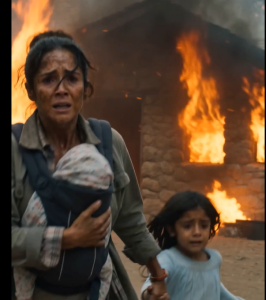
Her dark hair had been twisted into a messy bun, but loose strands whipped across her soot-streaked face as she ran. Dirt marked her cheeks. Smoke had settled into the gray jacket she wore over a plaid shirt, and every breath looked painful. The baby carrier was fastened tightly against her chest, holding an infant wrapped in a patterned blanket. One of her arms stayed close to the baby, guarding that small body from bouncing too hard as she moved. With her other hand, she gripped the hand of a frightened young girl in a light blue dress.
The girl was barefoot.
That detail made the escape feel urgent. She had not stopped for shoes. She had not stopped for a coat, a toy, or anything that might have once mattered inside the cabin. Her bare feet struck the dry, leaf-strewn ground again and again as she struggled to keep pace with her mother. Dust rose around her ankles. Brittle leaves cracked beneath each step. Twigs scraped the path, but she kept running because the hand pulling her forward was the only direction she trusted.
Behind them, the cabin burned with frightening intensity.
The mother glanced back once.
It was only a moment, but it carried the weight of everything she was leaving behind. The stone walls were still visible through parts of the smoke, yet the wooden roof was surrounded by flames. Fire flashed between the trees, painting the trunks with orange light. The home that may have held meals, sleep, conversations, and family memories had become something they could no longer approach. Whatever could be replaced would have to wait. Whatever could not be replaced had already been carried out.
She turned forward again.
Her expression hardened with determination.
The young girl stumbled for a step, her feet sliding over loose dirt and dry leaves. The mother’s grip tightened. She did not stop, but she adjusted her pace just enough to keep the child upright. The girl caught herself and continued moving, breathing in short, frightened bursts. Her blue dress swung around her legs as she ran, the fabric dusty near the hem. When she looked up at her mother, terror filled her eyes.
The trees around them should have made the rural landscape feel peaceful. Instead, smoke blurred the trunks and branches into uncertain shapes. Ash drifted through shafts of daylight. The air felt thick and unstable, and every crack from the burning cabin sounded close enough to demand more speed. The child whimpered, but she did not ask to stop. She seemed to understand, in the instinctive way children sometimes do, that stopping was not an option.
The mother looked down for the briefest second.
Her eyes were wet, but she did not let fear control her movements. Her jaw stayed tight. Her breathing was heavy. Soot and sweat marked her skin, and loose strands of hair clung to her face. Against her chest, the baby’s patterned blanket shifted with each stride, reminding her that two young lives depended on her continuing forward no matter how exhausted she felt.
She pressed one arm protectively across the carrier.
Then she ran faster.
From the side, the three figures moved through scattered trees while the burning cabin remained visible in the distance behind them. Flames flickered between trunks, bright against the smoke-darkened background. Their backs caught the fire’s orange reflection as they pushed deeper across the dry ground. Each step carried them farther from the structure, but danger still seemed to follow in the roar of the flames, the drifting embers, and the smell of smoke.
The mother’s only goal was distance.
She could think about possessions later.
She could think about where they would sleep later.
She could think about how the fire started later.
For now, she needed to get the children somewhere safe.
The girl continued beside her, still barefoot, still terrified, still moving. Her small hand remained locked inside her mother’s grip. There was no speech between them at first because neither had enough breath for it. Their communication existed in pressure, movement, and instinct. The mother’s hand said keep going. The girl’s hand said do not let go.
The baby remained mostly hidden inside the carrier, wrapped close against the mother’s body. That small bundle became the quiet center of the escape. While flames destroyed the cabin behind them, the mother protected what could not be rebuilt. She kept her body turned slightly around the infant whenever the path narrowed or low branches appeared, shielding the baby while continuing to pull the older child forward.
The farther they ran, the more the fire began to fade behind the sound of footsteps and panting. It was still there, still dangerous, but no longer the only sound in the world. The crunch of dirt beneath bare feet became sharper. The mother’s breathing became louder. The rustle of the baby’s blanket could be heard between steps. Somewhere ahead, beyond the smoke and trees, there was the possibility of safety.
But safety did not mean everything would return to normal.
The mother knew that before she said it.
She had seen the cabin burning. She knew what might already be lost. A home is more than stone and wood, yet stone and wood hold the objects that make daily life familiar. Clothes, photographs, dishes, blankets, keepsakes, and small things collected over years can disappear in minutes. Even when everyone survives, a disaster can divide a family’s life into before and after.
Her face showed that understanding.
Still running, she tightened her hold on the young girl’s hand and steadied the baby with her other arm. Her voice finally broke through the sound of their escape.
“Our life will never be the same.”
The words came out breathless and devastated.
They were not dramatic for the sake of drama. They were the recognition of a truth she could no longer avoid. The girl looked ahead through the smoke without answering. She was too frightened, too tired, and too focused on keeping her bare feet moving. Behind them, embers drifted through the air as the fire’s glow flashed between the trees.
The mother did not turn back again.
There would be time for grief once the children were safe. There would be time to understand what had happened, to count what remained, and to face the uncertain days ahead. In that moment, survival was enough. One hand held the girl. One arm protected the baby. Her lungs burned, her legs ached, and her heart carried the knowledge that home might already be gone.
But her children were still with her.
So she kept running.





