The house was quiet in the way homes often are late at night, when ordinary sounds seem louder than they should. A faint glow spilled from the rooms ahead, but the hallway itself was lined with long shadows. Family photographs hung along the wall, their smiling faces creating a strange contrast with the anxious silence now filling the home. A female police officer moved carefully down the hall, her dark hair pulled back and her uniform neat despite the late hour. Her badge caught a small flash of light each time she passed a frame. Close behind her walked the mother, dressed in a light gray bathrobe over her pajamas, looking embarrassed, nervous, and eager to explain why she believed the emergency call had been unnecessary.
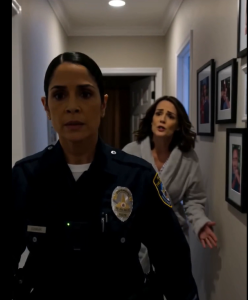
The officer did not rush. Her steps were measured, controlled, and quiet. The mother, however, seemed determined to fill the silence before they reached her daughter’s bedroom.
“I’m so sorry about this,” she said quickly. “She does this all the time. She has a wild imagination.”
Her voice carried the strained tone of a parent trying to apologize for an inconvenience while also convincing herself that nothing serious was happening. She kept close to the officer, glancing toward the bedroom at the end of the hall. Until that moment, she appeared more embarrassed than frightened.
Then the officer stopped.
One hand rose slightly, signaling for silence.
“Hold on,” she said.
The mother immediately stopped talking.
For a second, neither woman moved. The hallway became unnaturally still. There was no obvious crash, no visible disturbance, and no stranger stepping into view. Yet something about the silence had changed. The officer’s posture became more alert. Her expression remained calm, but her attention sharpened as she listened.
Then she moved forward again.
From behind the officer, the bedroom slowly came into view through the doorway. It was unmistakably a child’s room. The walls were pink, and soft glowing wall art cast a gentle light across the space. A white bed sat near the center of the room, its bed skirt hanging close to the floor. The lighting should have made the room feel comforting, even peaceful. Instead, the quiet made every detail seem unusually important.
The officer stepped through the doorway.
The mother followed, but this time she did not speak.
On the rug near the bed sat the little girl.
She was wearing pink patterned pajamas and had pulled her knees tightly against her chest. Her small body trembled as she stared toward the floor. She was not laughing, pretending, or waiting for attention. She looked terrified.
That single sight changed the mother’s expression.
Until then, she had treated the situation as another episode caused by an active imagination. Now she paused behind the officer, suddenly unsure of the explanation she had repeated so confidently in the hallway.
The officer studied the child carefully.
Her face softened with concern, but she did not lose the alertness that had made her stop moments earlier. She seemed to understand that fear in children can look different from fear in adults. A child might struggle to explain what happened. A child might freeze, whisper, or avoid looking at the person asking questions. The officer did not pressure her.
Instead, she slowly lowered herself to the girl’s eye level.
The movement was deliberate and gentle. Rather than standing above the child in full uniform, she knelt on the rug and gave the girl space. Her voice became warm and reassuring.
“What happened, sweetheart?” she asked.
The little girl did not answer immediately.
Her eyes were wet, and her lips trembled as she tried to control her breathing. She did not turn toward her mother. She did not look around the room for reassurance. Instead, her gaze remained fixed past the officer, toward the white bed behind her.
The officer noticed.
The mother noticed too.
The room seemed to grow quieter.
The soft pink light still glowed on the walls. The framed decorations had not moved. The bed looked ordinary. Nothing visible explained the child’s fear. Yet the girl’s eyes remained locked on the same place.
For the mother, the moment was becoming harder to dismiss. Her daughter had called for help, and now a trained officer was taking that fear seriously. What had sounded like another childhood story in the hallway no longer felt harmless inside the bedroom.
The officer stayed still.
She did not turn suddenly toward the bed. She did not frighten the child with fast movements or dramatic questions. She kept her attention on the girl, allowing her to speak when she was ready.
When children are frightened, adults sometimes rush to tell them there is nothing to fear. They may offer explanations before hearing the full story, especially when the concern sounds impossible or familiar. But in that bedroom, the officer did the opposite. She listened first.
The girl swallowed.
Her breathing remained fragile.
Then she whispered.
“There’s someone under my bed.”
The words were quiet, but they changed everything.
The mother’s face tightened with shock. The officer’s expression became even more focused. Neither woman laughed. Neither dismissed the statement. The bedroom remained still, with the white bed only a few feet away and the soft glow on the walls making the unseen space beneath it feel more unsettling.
No one under the bed was shown.
There was no hand reaching out, no shadow moving across the floor, and no sudden figure appearing in the doorway. The fear came entirely from what could not be seen. The child’s trembling voice, the officer’s alert silence, and the mother’s realization were enough.
For a brief moment, attention seemed to shift toward the bedframe. The hanging fabric along the edge blurred into the darkness beneath it. The officer remained between the child and the bed, maintaining a calm presence while clearly treating the warning as something that required care.
The mother stood behind her, frozen.
Only moments earlier, she had apologized for her daughter and described the situation as a product of imagination. Now she was facing a possibility she had not allowed herself to consider: her daughter might have been trying to communicate something real.
She had been frightened enough for police to come to the house, and her body language showed a fear that deserved attention.
She did not confirm something she could not yet see, but she also did not tell the child she was wrong. She created space for the girl to speak, observed her behavior, and treated the situation seriously without creating more panic.
The last image held on the little girl’s face. Her eyes remained fixed toward the white bed as the room fell completely quiet. The officer stayed close. The mother said nothing. Somewhere beyond the child’s gaze was the hidden space beneath the bed, still unseen and unanswered.
The screen cut to black before revealing anything more.
What remained was not an image of an intruder, but a chilling reminder about listening. Sometimes the most important warning does not arrive as a scream. Sometimes it comes from a frightened child speaking so softly that an adult has to stop, kneel down, and truly hear what she is trying to say.





