The ballroom glittered like a place built for people who never had to worry about money. Crystal chandeliers scattered warm light across polished marble floors, tall floral arrangements framed a long gift table, and elegant guests moved through the room holding champagne glasses while soft conversation floated beneath the music. Wrapped presents covered the table in glossy paper, satin ribbons, and carefully tied bows. Everything looked expensive, polished, and perfectly arranged.
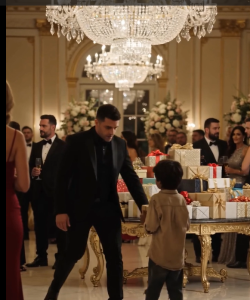
Then a young boy stepped through the entrance.
He looked as though he had walked in from a completely different world. His dark hair was messy, his face was marked with dirt, and his tan shirt was torn and worn thin from use. Faded jeans hung loosely from his small frame, and his old shoes made quiet sounds against the shining marble. In both hands, he held a small cardboard box tied with plain string.
He pressed it tightly against his chest.
For a few seconds, most people did not notice him. The party continued around him in a blur of sequined gowns, dark suits, flowers, crystal, and gold. The boy took another cautious step, staring toward the large table where guests had placed their beautiful gifts. His little box looked painfully ordinary beside them, but he carried it with the care someone might give to the most valuable thing in the room.
Before he could get closer, a man in a formal black suit moved into his path.
The man looked down at him with a firm, dismissive expression. Several nearby guests turned to watch.
“Lo siento, pequeño. Esta fiesta no es para ti.”
“I’m sorry, little one. This party isn’t for you.”
The words were not shouted, but they were clear enough to stop the boy immediately.
His shoulders tightened.
The room seemed to grow quieter around him.
A close look at his face revealed what the expensive lighting could not hide. Dirt smudged both cheeks, his eyes were wet, and his lips trembled as he tried not to cry. Instead of arguing, he pulled the cardboard box even closer to his chest. The string around it was simple and slightly frayed, and one corner of the box was bent.
It may have been the only gift he had to give.
The boy lowered his eyes.
Tears began to spill down his cheeks.
Behind him, the ballroom remained beautiful. Chandeliers sparkled overhead. Champagne glasses caught the light. Guests in formal clothing whispered to one another, uncertain whether to look away or keep watching. Yet the contrast only made the boy seem more alone.
He did not demand entrance.
He did not become angry.
He simply stood there crying, holding the worn box as though letting go of it would mean losing something far more important than cardboard and string.
Then, across the ballroom, an elegant woman looked toward him.
She stood near the gift table wearing a glittering evening gown that shimmered each time she moved. Diamond earrings framed her face, and a champagne flute rested lightly in one hand. Until that moment, she appeared to belong perfectly among the celebration, the flowers, the polished marble, and the expensive presents.
Then she saw the boy.
More importantly, she saw the box.
Her expression changed instantly.
The relaxed smile disappeared. Her eyes widened. Her body went still, and the hand holding the champagne glass began to tremble.
For one suspended moment, she stared as though she had seen something impossible.
Then the glass slipped from her fingers.
It struck the marble floor and shattered.
The sharp sound cut through the room.
Guests turned toward her in alarm, but she was already moving.
“¡Espera!”
“Wait!”
Her voice carried across the ballroom as she rushed past the gift table. The sequins on her gown flashed beneath the chandelier, and broken glass glittered behind her as startled guests stepped aside. Whatever concern she had about appearances vanished. She did not walk carefully or stop to explain herself.
She ran directly toward the boy.
The man who had blocked him turned in confusion.
The boy looked up through tears.
The woman reached him and stopped so suddenly that she almost lost her balance. Her breathing was uneven. Her diamond earrings shook as she stared down at the small package in his hands.
Then she reached for it.
She did not snatch the gift away.
Instead, she placed both hands around the box while the boy continued holding it. Her fingers pressed against the worn cardboard as though she needed to feel it to believe it was real.
Her face had gone pale.
The fear in her eyes was unmistakable.
The guests who had been whispering now fell silent. The man in the black suit no longer looked dismissive. Around them, the glamorous room seemed to disappear into soft focus, leaving only the woman, the child, and the simple string-tied box between them.
She stared at the string.
Then at the cardboard.
Then back at the boy.
Her voice came out strained.
“¿De dónde sacaste esa caja?”
“Where did you get that box?”
The boy did not answer.
He only looked up at her, tears still moving down his dirty cheeks.
That silence made the moment even heavier.
The woman’s reaction suggested that the box was not random and certainly not worthless. She recognized something about it immediately, something powerful enough to make her drop her glass, abandon the celebration, and rush across the room without hesitation.
Perhaps it was the way the string had been tied.
Perhaps it was the worn cardboard.
Perhaps there was a mark, memory, or history connected to it that no one else could see.
The story did not reveal the answer yet.
Instead, the final seconds focused on the woman’s terrified expression and her hands wrapped around the box while the boy continued to hold it. Behind them, the guests remained frozen, waiting for an explanation.
Only moments earlier, the child had been treated as though he did not belong because his clothes were worn and his gift was plain.
Now the entire ballroom was focused on him.
The most expensive packages in the room suddenly seemed unimportant.
The woman’s question changed everything.
The box that looked worthless among silk ribbons and luxury wrapping had become the center of the celebration, not because of its price, but because of what it might mean.
And the boy who had been stopped at the door was no longer invisible.
His tears, his determination to carry that small gift inside, and the woman’s immediate recognition hinted at a connection deeper than anyone in the room had expected.
As the tension reached its highest point, she kept staring at him, waiting desperately for an answer.
He remained silent.
The music swelled.
The guests did not move.
Then the scene cut to black, leaving one question hanging over the ballroom: how did a destitute child come to possess a box that an elegant woman recognized with such sudden fear?
Sometimes the humblest object in a room holds the story everyone else overlooked. And sometimes, the smallest object in the grandest room can carry a history powerful enough to silence strangers, reopen old wounds, and force the truth into the light again.





