There is a kind of silence that only an empty roadside can hold. It isn’t peaceful. It is the silence of cars passing without slowing down, of footsteps that never turn around, and of a world too busy to notice what is sitting right beside it. On a cold, overcast day along one such road, that silence surrounded a small family who had been left with nothing, and who were quietly running out of strength.
On a bare strip of crumbling, stony dirt, next to a worn concrete curb, sat a battered cardboard box. Beside it stood a mother dog. She was a rust-brown color with a dark muzzle, and she looked as though she had been carrying the weight of the whole world on her thin shoulders for a very long time. Her coat was dull and patchy. Her ribs and hip bones showed faintly beneath it, a plain reminder of how long it had been since she had a proper meal.
She stood hunched and swaying, her legs braced stiffly beneath her as if she were afraid they might give out at any moment. Every so often they did buckle, just slightly, and she would catch herself and straighten up again. Her thin tail hung low. Her head stayed lowered toward the box, never straying far from what mattered most to her. It was the posture of an animal who had nothing left to give, and who was giving it anyway.
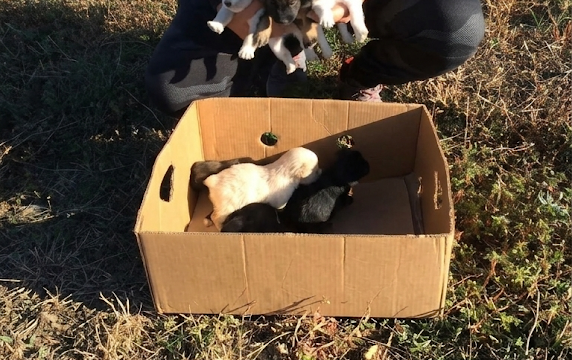
Inside the box lay the reason she kept standing. A litter of tiny, frail puppies, black, brown, and tan, were piled together in a trembling heap. Their small bodies pressed tightly against one another, tiny legs tangled together, each one trying to borrow warmth from the others. They were so small that the box seemed enormous around them, and the cold ground beneath it seemed even bigger.
Everything about the scene suggested they had been there for days. There was no food within reach, no clean water, and no shelter from the wind or the gray sky above. Nothing about that patch of dirt said anyone planned to come back. It looked like a place where a family had simply been left, and where the world had gone right on rolling past without stopping.
The mother’s body told the rest of the story. Her teats were swollen and heavy, the mark of a mother who had been feeding her babies while having so little to eat herself. It is one of the hardest truths in the animal world, and one that anyone who has ever cared for a mother and her newborns will understand. When there is not enough to go around, a mother gives her own strength first. She had been doing that for as long as she could.
She was shivering, and not a little. It was a violent, uncontrollable shaking that traveled from her trembling shoulders all the way down to her paws. Hunger and cold had worked their way into her bones. Her breathing was ragged and wet, and her thin ribcage heaved with every labored breath. Beside her, the puppies quivered together as one small, fragile mass, shaking in rhythm with the wind that drifted across the roadside.
Then came the sounds. A soft, steady whimpering rose from the mother and never fully stopped. Every few moments, a thin, broken cry escaped her and faded into weak, trembling sobs. Mixed in with it were the tiny squeaks of her puppies, so faint and fragile you had to hold your breath to hear them. If you have ever heard a sound that went straight to your heart and stayed there, you will know exactly what this was like.
Slowly, and with great effort, she lifted her heavy head. She turned toward the camera and looked straight into the lens. Her dark eyes were glistening and glazed, and she blinked slowly, as though even that small movement cost her something. A single tear rolled down her thin muzzle. For a moment, she simply held that gaze, and it felt as though she were asking a question that every one of us has been asked at some point in our lives: will anyone stop for us?
Then her head sank slowly back toward the box, trembling. A moment later she lifted it again toward the camera, her legs buckling slightly under the effort. Down and up, down and up, she moved between her puppies and the world beyond them, as though she could not decide which needed her more. In the end, she gave her attention to both. She was watching over her babies and, at the same time, looking for someone, anyone, who might finally come.
Look at the setting for a moment. There was the old metal lamp post standing at the edge of the curb. There was rough gray asphalt, with patches of thin green grass pushing up here and there, and a hazy line of trees fading into the distance beneath a pale, flat sky. It was a place made for passing through, not for stopping. And yet here was a mother who had nowhere else to go, standing in the middle of it with everything she loved gathered in a cardboard box.
There was no one else in sight. No hand reaching down, no voice speaking softly, no warm blanket or bowl of food. Just a mother dog, a box of tiny puppies, and the cold, muted light of an overcast afternoon casting gentle shadows beneath their thin bodies. It was the loneliest kind of scene, and the quietest. Only the scrape of cardboard, the shuffle of claws on loose dirt, and a faint cold breeze kept her company.
If you have lived a few decades, as many of us have, you know something about what it means to carry others. Many of us were the ones who stayed up late with a sick child, who skipped a meal so someone else could eat, who kept showing up long after we were tired. We know what devotion looks like when it costs everything. That is why a scene like this one lands so deeply. It is not just about a dog. It is about the quiet, stubborn love that refuses to quit.
That mother did not look like an animal who had given up. She looked like an animal who was running out of strength and refusing to stop anyway. Her whole body shook, but she stayed beside the box. She stayed upright when her legs wanted to fold. She kept turning her head back to her puppies, again and again, as if to make sure each small, trembling body was still there. Love like that does not need words.
It is easy to look away from sights like this. They are uncomfortable, and they ask something of us. But there is a reason stories like this one travel from one heart to another. They remind us that compassion is still alive in ordinary people, in neighbors and strangers, in those of us who pull the car over, or pick up the phone, or simply refuse to keep walking when something small and fragile needs us.
Think about how little it would take. A warm blanket. A bowl of clean water. A bit of food. A gentle voice and a steady pair of hands. These are small things, the kind most of us have within arm’s reach at home. For a mother who has been shaking in the cold and a litter that has been piled in a box without comfort, those small things would feel like the whole world.
Every day, animals in situations just like this one are waiting along roadsides, behind buildings, and at the edges of places we pass without a second glance. They do not ask for much. They cannot ask at all. What they have is the way they stand, the way they look, and the way they protect what they love. It falls to us to notice, and to decide that noticing is worth acting on.
If this story touches your heart, let it. There is nothing weak about feeling moved by a mother’s devotion, or by the sight of tiny puppies pressed together for warmth. It means your heart is still open, and an open heart is exactly what a world like ours needs more of. Share this story with someone who would understand. Support the local rescues and shelters doing this work every day. And the next time you see a frail animal in need, remember the mother by the cardboard box.
She stood in the cold with everything she had left, shaking, weary, and still watching over her family. She reminds us that love is not measured by how strong we are, but by how long we are willing to keep standing for the ones who depend on us. Maybe the most important thing we can do is be the person who finally stops, kneels down, and says, “You don’t have to do this alone anymore.”
Cold wind. Thin legs. A box full of tiny hearts. It is a picture none of us should ever forget, and one that asks every one of us to do a little more, care a little deeper, and never assume that someone else will stop. Because sometimes, the whole difference between a lonely roadside and a second chance is a single person who decides to care.