There is a particular kind of silence that fills an empty veterinary room. It is the quiet of cold steel, pale walls, and a door that stays closed. On this day, that silence was broken only by the soft, shaky sound of a very old dog trying to breathe.
She stood on a small pink towel laid across the examination table, and it was clear at a glance that standing was costing her everything she had. Her body was thin and hunched. Her skin, almost bare of fur, looked sore and reddened, with only a few damp tufts of grey clinging here and there. Around her frail frame, someone had wrapped clear plastic to hold in what little warmth she had left.
Her legs told the rest of the story. They were thin and braced stiffly beneath her, and they buckled again and again as she tried to hold herself upright. Her hind legs trembled so hard that the towel rippled beneath her paws. Her tail hung low. Her heavy head drooped toward the table, her eyes closed, as though even lifting her eyelids was more than her body could manage.
Anyone who has ever loved an older dog knows this posture. It is the look of a creature who has simply run out of strength.
She was shivering, and not the way a dog shivers after a bath or a chilly walk. This was deep and uncontrollable, a quaking that traveled from her narrow shoulders all the way down to her shaking paws. The cold, the pain, and the weakness all seemed to be moving through her at once. Her breathing was ragged and wet, and with every labored breath her thin ribs rose and fell in a way that was hard to watch.
Then came the sounds. First a continuous, faint whimpering, so quiet it almost blended into the hum of the clinic equipment. And every so often, a thin, broken cry would slip out of her and fade away into small, trembling sobs. There was nothing dramatic about it. It was the sound of a body that had been hurting for a long time.
The room offered no comfort. The walls were pale cream, the counter was steel, the edge of the table was cold stainless metal. A folded white towel and a piece of dark cloth sat beside her, and that was all. No one stood next to her in that moment. No hand rested on her back. Only the soft crinkle of the plastic wrap and the rustle of the towel marked each tremor.
Then something happened that made the moment even harder to bear.
Slowly, and with great effort, she opened her swollen eyelids. She lifted her heavy head, inch by inch, and turned her face toward the camera. Her dark eyes were glazed and glistening with tears. She blinked slowly, and a single tear rolled down her thin muzzle.
For a few seconds she simply looked, straight ahead, with a gaze so tired and so deep that it seemed to reach through the lens and into the heart of anyone watching. Then her head sank lower again, trembling. And once more, with fragile effort, she lifted it. Her legs gave a little beneath her on the soft towel, yet she held on.
It is difficult to look at a dog like this and not feel something shift inside you.
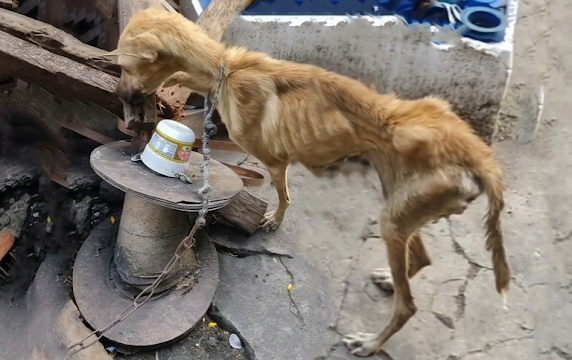
Her body carries the marks of a hard life. The bare, irritated skin, the thin frame, and the weakness in every limb are not signs of a single bad day. They speak of a long stretch of struggle and of care that did not come when it was needed. She is an elder, a senior soul who should have spent these years curled up somewhere warm, fed and safe, with a gentle hand to rest against.
Instead, she has arrived here, on a cold table, wrapped in plastic, shaking from head to toe.
And yet, look again at what she did. In the middle of all that pain, she raised her head. She looked up. Whatever strength she had left, she gave to that one small movement.
Moments like this are why people who work with animals often say the same thing: the first sight of a rescued dog is never the whole story. It is only the beginning of one. The thin body on the towel is not who she will always be. It is simply where her story is being picked up, in a quiet room, at the lowest point.
For those of us who have loved a dog through old age, this scene lands differently. We remember the gray muzzles and the slow mornings. We remember how an old dog’s love gets quieter but never smaller. We know that senior dogs often ask for the least and give the most, and that a warm blanket, a soft voice, and a patient hand can mean the world to them.
That is what makes this image so hard to forget. It is not only the shivering or the tears. It is the plain, honest picture of a dog who needs gentleness more than anything else.
Please take a moment to look closely at her, at the thin legs, the swollen eyes, and the head that keeps rising toward the light. She did not have to look up. She did anyway.
Every animal deserves to be noticed, and every old dog deserves to spend her final chapter being cared for rather than left to cope alone. If this story touches you, let it remind you that kindness can be small and still change everything: a stopped car, a phone call, an open door, a warm towel.
Her story is only beginning to unfold, and what comes next is the part that matters most.