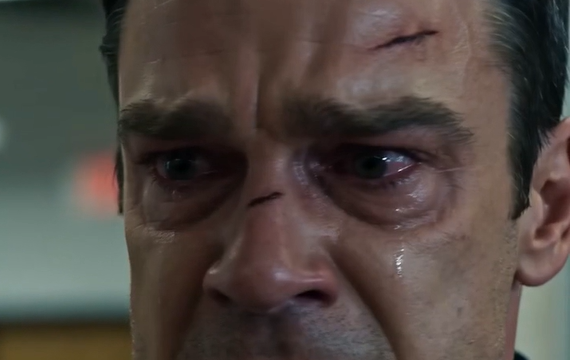
The boy did not smile.

Most children would have looked proud after helping someone stand again, but this boy looked terrified. His small shoulders were stiff, and his pale face carried the kind of fear no child should ever know. Around him, the café had fallen completely silent. Conversations stopped in mid-sentence. Forks hovered in the air. Chairs remained half-pulled away from tables as every person in the room stared at the unbelievable scene unfolding before them.
The woman stood trembling beside her wheelchair.
For years, she had been unable to move her legs. Doctors had given her little hope of ever walking again. She had spent countless nights grieving the life she once had, learning to hide her frustration behind polite smiles and quiet acceptance. Her husband had stayed by her side through it all, always appearing patient, attentive, and supportive. To everyone around them, they looked like a couple who had survived hardship together.
But in that moment, nothing made sense anymore.
The strange little boy stood near her table, breathing hard, his eyes fixed on the wheelchair. Only seconds earlier, he had crouched beside it and touched something underneath the seat. Then, without warning, the woman felt a sudden surge move through her legs like electricity waking muscles that had been asleep for years.
At first, she thought she was imagining it.
Then her toes twitched.
A sharp gasp escaped her mouth as feeling rushed upward through her calves and thighs. The sensation was overwhelming, painful, and wonderful all at once. Her hands gripped the edge of the table so tightly her knuckles turned white. Tears flooded her eyes.
People nearby noticed immediately.
“Did she just move?” someone whispered.
Another diner stood up so quickly his chair scraped loudly across the floor.
The woman slowly pushed herself upward. Her knees shook violently, but they held. For the first time in years, she was standing.
Shock swept through the café like a wave.
One waitress covered her mouth with both hands. An older man near the window crossed himself quietly. Even the staff behind the counter froze in disbelief.
But while everyone else stared in amazement, the boy looked frightened.
Not proud.
Not excited.
Afraid.
The woman looked down at him, tears running freely down her face.
“How did you do that?” she whispered.
The boy swallowed hard before pointing beneath the wheelchair.
“It wasn’t your body,” he said softly. “It was the chair.”
His words cut through the room like ice.
The woman’s expression changed instantly. Confusion replaced joy as she slowly lowered herself back into the seat. Her breathing became uneven.
“What do you mean?” she asked.
The boy knelt carefully beside the wheelchair again. His small hands trembled as he reached underneath the seat. Everyone leaned forward, watching every movement.
Then he pulled out a small black device.
A red light blinked slowly on its surface.
The café became silent again, but this silence felt different. Heavy. Dangerous.
The woman stared at the object in horror.
“What is that?” she whispered.
The boy held it carefully, like something fragile and terrifying at the same time.
“My dad used to repair medical chairs,” he said quietly. “He showed me devices like this once. That thing can interfere with nerve signals.”
Several people exchanged uneasy glances.
The woman looked completely frozen.
“You’re saying…” Her voice cracked before she could finish.
The boy nodded slowly.
“It can stop messages from reaching the legs,” he said. “It doesn’t hurt the body itself. It blocks the signals.”
The room erupted into murmurs.
“That can’t be real.”
“Who would do something like that?”
“Is this some kind of joke?”
But the fear in the boy’s eyes made it impossible to dismiss.
The woman’s breathing grew shallow as memories flooded her mind. Years of appointments. Endless medications. Specialists who seemed confused by her condition. Tests that never fully explained why her paralysis appeared suddenly and progressed so strangely.
And through all of it, her husband had always been there.
Always nearby.
Always managing her appointments, her medications, her transportation, her finances.
Always in control.
The boy slowly lifted his head and looked across the café.
Everyone followed his gaze.
At a table near the far corner sat a man in an expensive gray coat. Until now, he had remained completely still, almost invisible among the crowd. But the moment the boy looked toward him, the man abruptly stood.
His face had gone pale.
The woman turned slowly in her chair.
The moment she saw him, her expression shattered.
“That’s my husband,” she whispered.
The café fell deadly quiet.
The man forced a weak smile, but panic flickered across his face. His hands moved nervously as he looked around the room, clearly aware that every eye was now fixed on him.
“Honey,” he said carefully, attempting to sound calm. “You’re upset. Let’s go home and talk about this privately.”
But the woman did not move.
For years, she had trusted him completely. She remembered the promises he made when her condition first appeared. He had sworn he would never leave her side. Friends praised him constantly for his loyalty and sacrifice. People called him devoted.
Now, for the first time, she noticed things she had ignored before.
How quickly he answered questions during doctor visits.
How often he discouraged her from seeking additional opinions.
How he insisted on handling every adjustment made to her wheelchair.
How strangely defensive he became whenever she spoke about moments of temporary sensation returning to her legs.
The memories came rushing back like pieces of a puzzle finally falling into place.
The husband took a step forward.
“This is ridiculous,” he said sharply, glancing at the boy. “He’s a child. He doesn’t know what he’s talking about.”
But his voice lacked confidence.
The boy lowered his eyes and gripped the black device tighter.
“My dad warned me these things are illegal,” he whispered. “He said they should never be used on people.”
A woman near the counter quietly pulled out her phone.
Another customer began recording.
The husband noticed immediately.
“Stop filming,” he snapped.
That reaction only made the tension worse.
The woman in the wheelchair stared at him with tears streaming down her cheeks, but now those tears were no longer from joy alone. They carried betrayal, confusion, and heartbreak.
“Tell me the truth,” she whispered.
The man opened his mouth but said nothing.
For a long moment, nobody in the café moved.
Then the woman slowly placed both feet firmly on the floor again.
Her legs trembled, but they held her weight.
A collective gasp filled the room as she pushed herself upright once more. This time, she stood taller. Stronger. Not fully stable yet, but standing on her own.
The husband looked terrified.
The woman’s eyes never left his face.
Years of dependence, pain, and uncertainty suddenly felt different now. Questions she never dared ask rose to the surface all at once.
Who had she really trusted all these years?
And how much of her suffering had been carefully controlled by the person closest to her?
The little boy stepped backward quietly, still clutching the blinking device. He looked overwhelmed by the chaos around him, yet there was also sadness in his expression—as if he understood that some truths change lives forever once they are revealed.
Outside, distant sirens could already be heard approaching the café.
Inside, nobody spoke.
Because everyone understood they had just witnessed something far bigger than a miracle.