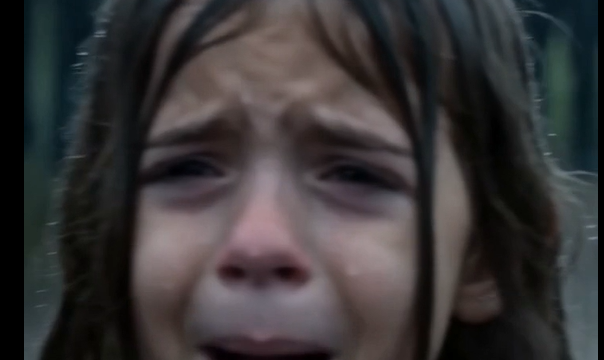
For one long, breathless moment, the entire restaurant froze.
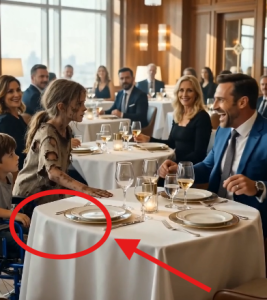
No one moved.
Not the father standing beside the table with his hand still lifted in shock. Not the diners quietly watching from nearby booths. Not even the servers carrying silver trays through the narrow aisle. Every sound in the room seemed to disappear beneath the weight of the girl’s final words.
“He knows me.”
Those three words didn’t sound childish or impossible.
They sounded real.
The boy sitting in the wheelchair still held tightly to the girl’s hand. His breathing had changed now, coming faster and deeper, almost uneven, as though something buried deep inside him had suddenly started waking up before his mind could catch up.
The father stared at the girl carefully.
“What does that mean?” he asked in a quieter voice.
For the first time since approaching the table, the girl looked directly at him.
She didn’t appear frightened by his wealth or his authority. She wasn’t impressed by the expensive suit, the polished restaurant, or the whispers surrounding him.
She simply looked exhausted.
“My mother used to bring me to your house,” she said softly.
The father instantly went still.
Years earlier, before tragedy transformed their lives, there had been a woman who worked around his estate. She wasn’t one of the permanent staff. She filled in where help was needed—sometimes cooking in the kitchen, sometimes helping with laundry, sometimes cleaning rooms when others failed to show up.
And because she had no one to care for her daughter, she often brought along a tiny little girl.
That little girl had once become a regular part of the house.
Especially for his son.
Back then, his son had laughed easily. He smiled often. He ran through the hallways without fear, without pain, without silence hanging over him like a storm cloud.
The father remembered hearing the sound of children laughing together from distant rooms in the house.
He remembered how naturally the two children had connected.
Then came the accident.
Everything changed after that night.
The laughter vanished first.
Then the movement.
Then the joy.
Doctors filled their lives with cautious language and measured expressions. Terms like “permanent neurological damage” and “limited emotional response” became part of daily conversation. Specialists arrived from expensive clinics. Therapists came and went. Treatments were attempted. Hope slowly became something fragile.
The girl tightened her hold on the boy’s hand and looked back at him gently.
“You used to hold my hand whenever you got scared,” she whispered.
That sentence struck harder than anything else.
Because the boy’s fingers immediately tightened around hers.
Not slowly.
Not intentionally.
Instinctively.
Like his body remembered something his mind could no longer fully reach.
The father felt something cold move through him.
Until now, he had assumed this was simply a hungry street child making impossible promises in exchange for leftover food.
But this girl was not a stranger.
She belonged to a forgotten part of his son’s life.
A part from before the pain.
Before the wheelchair.
Before the endless silence inside their home.
The girl slowly moved a little closer to the boy while remaining beside him on her knees.
“Your father stopped letting me come after you got hurt,” she said quietly.
The words carried no anger.
Only truth.
And that truth landed heavily.
Because the father remembered exactly what he had done.
At the time, he convinced himself he was protecting his son. He believed his child needed calm surroundings, structure, medical supervision, and carefully controlled routines. He wanted quiet rooms, trained professionals, and expensive care.
He thought reminders of the old life would only make the suffering worse.
So he pushed away anything that no longer fit the world he was desperately trying to hold together.
Including the little girl from the staff entrance.
Looking back now, he realized something painful.
Children do not care about money or social status when they choose who matters to them.
Adults do.
And perhaps that had been his mistake all along.
The restaurant remained completely silent as the scene unfolded.
The boy leaned farther forward from the wheelchair now, gripping the edge of the table with his free hand while refusing to let go of hers.
The father could barely breathe.
“No…” he whispered under his breath.
Not because he rejected what he was seeing.
But because part of him wanted it to be true so badly that it terrified him.
The girl carefully placed her second hand over the boy’s wrist.
“You once told me you were going to dance when you got older,” she said softly.
A small pause filled the air between them.
“You remember.”
Maybe he did.
Not perfectly.
Not completely.
But enough.
Because for the first time in what felt like years, something changed in the boy’s face.
His lips parted slightly.
Then a tiny sound escaped him.
Not pain.
Not frustration.
Not effort.
Recognition.
It was small and broken, but it was real.
And that single sound shattered the father’s composure completely.
Right there beside the polished silverware and white tablecloths, his carefully controlled world cracked open.
Because suddenly he understood something unbearable.
For years, he had spent enormous amounts of money trying to repair his son’s body. Doctors focused on muscles, nerves, reflexes, and rehabilitation. Specialists measured progress in tiny physical responses.
But nobody had considered the possibility that healing might begin somewhere deeper.
Somewhere emotional.
Somewhere human.
Maybe his son had not only lost movement after the accident.
Maybe he had lost connection.
Comfort.
Trust.
Love.
And maybe the one thing his spirit still recognized was the hand of someone who had once stayed beside him before the world became cold and complicated.
The girl had entered the restaurant because she was hungry.
That much was true.
Her clothes were worn. Her face showed exhaustion. Her voice carried the weight of hardship no child should have to carry.
But food was not the only reason she came.
She came because she remembered him.
And somewhere beneath years of silence and pain, he remembered her too.
The father looked at the two children holding hands and felt guilt settle heavily in his chest.
He had spent years building walls around his son in the name of protection. He surrounded him with specialists, routines, and expensive care while unknowingly pushing away the simple human connection his child may have needed most.
Money had given them treatment.
But it had not restored joy.
Love, however, had just awakened something the doctors could not reach.
The diners around them remained silent, watching something far more powerful than a miracle unfold before their eyes.
It was recognition.
It was memory.
It was hope returning quietly through the smallest gesture imaginable.
A hand once trusted.
A friendship once lost.
And the reminder that sometimes the impossible is not impossible at all.
Sometimes, it is simply what the heart remembers long after everyone else has given up.