Rain poured across the cemetery in cold silver sheets, soaking black umbrellas and turning the narrow dirt paths into rivers of mud. Mourners stood shoulder to shoulder around the open grave, their faces pale beneath the gray morning sky. No one spoke above a whisper. The funeral had already felt strange from the beginning. The coffin remained sealed. The family lawyer avoided eye contact. And the younger brother of the deceased stood too stiffly near the back, watching everyone with nervous eyes instead of grief.
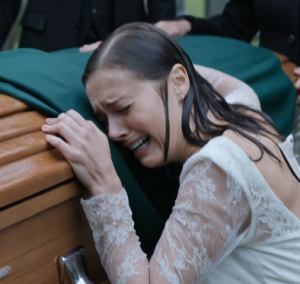
Then the woman in white appeared through the fog.
Her dress clung to her skin from the rain, streaked with mud at the hem as she stumbled toward the grave. In one shaking hand, she carried a folded document protected beneath her coat. Her breathing sounded ragged, almost panicked, as though she had run the entire way there.
At first, nobody recognized her.
Then she dropped to her knees beside the coffin.
Gasps spread through the crowd.
The old woman standing closest to the grave tightened her grip on her umbrella. Her expression shifted from confusion to horror as the younger woman unfolded the soaked papers with trembling fingers.
The document was official.
A marriage certificate.
Signed less than twenty-four hours earlier.
Stamped properly by the county clerk.
Legal in every possible way.
And under the groom’s name was the exact same name engraved into the polished coffin resting above the grave.
The dead man.
The old woman stared at the paper for several long seconds before lifting her eyes toward the bride kneeling in the mud.
“That’s my son,” she whispered weakly.
The bride’s face crumbled with emotion.
“I know,” she said through tears. “He came to me last night. He was hurt… bleeding… terrified. He told me if anything happened to him before sunrise, I had to come here and stop the burial.”
A wave of unease swept through the mourners.
People exchanged nervous looks. A few stepped backward. Even the priest looked uncertain now.
Because if the woman was telling the truth, then the question nobody wanted to ask suddenly became impossible to ignore.
Who exactly was inside the coffin?
The bride turned slowly, searching the crowd.
“The man in the dark suit,” she whispered urgently. “Where did he go?”
Heads turned.
But he was gone.
The younger brother had vanished into the heavy fog surrounding the cemetery.
Not fleeing from heartbreak.
Fleeing from fear.
Rainwater dripped from the bride’s hair as she forced herself to continue speaking. Her voice trembled, but every word carried through the silence.
“He said someone in the family was trying to bury evidence,” she explained. “He told me the body inside the coffin wasn’t his. He said if they buried it, nobody would ever learn who they really killed.”
The old woman staggered backward as though the ground itself had shifted beneath her feet.
Her oldest son had disappeared two days earlier. Police claimed they identified the body through personal belongings: his watch, his wedding ring, and the expensive tailored suit he always wore to business events. Authorities insisted the coffin remain closed because the injuries were supposedly too severe for viewing.
At the time, the explanation sounded tragic.
Now it sounded practiced.
Carefully rehearsed.
The old woman suddenly remembered how quickly the funeral had been arranged. How urgently her younger son insisted on immediate burial. How often he interrupted questions from relatives.
And for the first time, she felt genuine fear.
The bride swallowed hard before reaching into the soaked sleeve of her dress.
From inside, she pulled out a small brass key stained with dried blood.
“He gave me this,” she whispered. “He said it opens the boathouse behind your estate. He told me if your younger son tried to run, it meant he already knew what was hidden there.”
The old woman’s face lost all color.
Because the man who disappeared through the fog moments earlier was not some stranger connected to the funeral.
He was her younger son.
The dead man’s own brother.
Murmurs exploded through the cemetery. Several mourners stepped farther away from the grave, while others stared at the coffin with growing panic. The priest quietly backed away from the burial site entirely.
Then one of the pallbearers shouted.
“Wait!”
Everyone froze.
The man stood beside the lowering device, staring at the coffin with wide eyes.
The metal latch had moved.
At first, nobody understood what they were seeing. Rain hammered against the polished wood while the crowd remained completely silent.
Then it happened again.
A slow metallic twitch.
The bride stopped breathing.
The old woman clutched her chest.
And from deep inside the coffin came three desperate knocks.
The sound was muffled but unmistakable.
Knock.
Knock.
Knock.
Several people screamed.
One mourner dropped an umbrella and ran. Another crossed himself repeatedly while stumbling backward through the mud. The pallbearers nearly lost their grip on the lowering straps.
The old woman rushed toward the coffin with sudden strength.
“Open it!” she cried. “Open it now!”
But nobody moved.
Fear rooted everyone in place.
Finally, one of the younger pallbearers stepped forward with shaking hands. Together with another man, he struggled against the heavy latch until it snapped loose with a sharp metallic crack.
The lid opened only a few inches at first.
Then wider.
Rain spilled into the coffin.
And inside was not the old woman’s eldest son.
It was another man entirely.
Bruised. Unconscious. Barely breathing.
A stranger.
The crowd erupted into chaos.
Someone called emergency services while others shouted questions over one another. The priest stood frozen beside the grave, unable to speak.
The bride covered her mouth in shock.
“He told the truth,” she whispered.
The unconscious man inside the coffin suddenly coughed violently, sucking in air as if waking from a nightmare. Muddy rainwater splashed across his face while paramedics rushed through the cemetery gates.
The old woman could barely stand.
“If that isn’t my son…” she whispered, “then where is he?”
The bride looked toward the distant fog beyond the gravestones.
“He’s alive,” she said quietly. “He wanted us to find the truth before they found him first.”
Police arrived within minutes, sealing off the cemetery while officers searched for the younger brother. But he had disappeared completely into the storm.
Then another discovery changed everything.
Inside the stranger’s jacket pocket, investigators found documents connected to the family’s shipping company. Hidden among the papers were financial records, offshore account numbers, and signed statements pointing toward a massive fraud operation worth millions of dollars.
The missing older brother had apparently uncovered everything.
And someone inside his own family wanted him silenced before he could expose it.
The bride later explained how she met him only hours earlier at a roadside motel outside town. He arrived injured and terrified, convinced people were following him. He begged her to marry him immediately—not for romance, but for protection. If anything happened to him, his legal rights, property access, and personal records would automatically pass to her.
He believed she would be the only person willing to question the official story.
Before dawn, he vanished.
By sunrise, the funeral had already begun.
But whoever planned the burial never expected one thing:
The man inside the coffin survived long enough to knock.