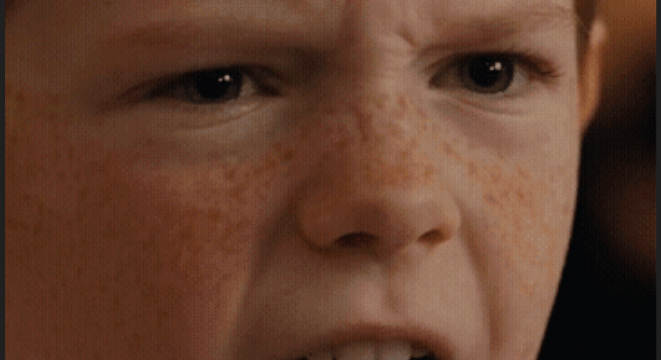
The little boy had stopped crying loudly several minutes earlier, but the quiet sounds coming from him somehow felt even worse. His shoulders shook under the oversized torn hoodie hanging from his thin frame, and every breath sounded exhausted, like fear had worn him down for far too long. He looked no older than eight or nine, dirty sneakers soaked from the rain outside, pale fingers clutching the edge of the diner booth as though letting go might pull him back into whatever nightmare he had escaped.
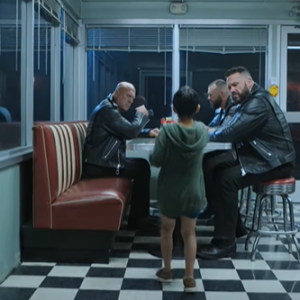
The old roadside diner had gone completely silent.
Even the truckers sitting near the windows had stopped eating.
The jukebox kept playing some soft country song in the background, but nobody paid attention to it anymore.
“She isn’t dead,” the boy whispered weakly. “He keeps her somewhere. She told me to run when he fell asleep.”
Rooster froze where he stood beside the counter.
The large biker had seen plenty of hard things in his life. Fights. Prison time. Broken families. Men who drank themselves into the grave. But something about the trembling child standing under the flickering diner lights made every instinct in his body sharpen at once.
Especially after seeing the photograph.
The old picture sat in Rooster’s rough hands, slightly bent at the corners from years of being hidden away. The moment he looked at it, the air left his lungs.
The woman smiling back at him was Mae.
His younger sister.
Seven years earlier, the entire town had been told the same story. Mae had supposedly overdosed somewhere near the highway outside town and disappeared before anyone found her. The police searched for a while, but eventually the case faded away like so many others.
No body was ever recovered.
No funeral ever happened.
Only whispers spread through town diners, bars, and gas stations until people stopped talking about her altogether.
But Rooster never believed she was dead.
Mae had struggled in life, sure. She trusted the wrong people and carried too much pain after their parents died. Still, something about the official story never made sense to him. Deep down, he always believed somebody had hidden the truth.
Now that truth was standing right in front of him.
The boy had Mae’s eyes.
Not similar eyes.
Not close.
The exact same pale green eyes Rooster remembered from childhood.
Outside the diner windows, headlights glowed through the rain.
A black sedan had been parked there for several minutes.
Then the driver stepped out.
The man wore a long dark coat buttoned neatly to the collar. His shoes were spotless despite the wet pavement, and his expression remained calm as he walked toward the diner entrance.
No panic.
No rush.
That frightened Rooster more than anger would have.
Men who panic usually know they can lose.
Men who move slowly often believe they already control the ending.
One of the bikers standing near the coffee machine instinctively stepped toward the door, but Rooster lifted a hand without taking his eyes off the man outside.
“Not yet,” he said quietly.
The room obeyed him immediately.
Rooster crouched down in front of the boy until they were eye level. His voice softened slightly.
“What’s your name, kid?”
The child swallowed hard before answering.
“Eli.”
Rooster nodded once. “Did your mother ever tell you who that man is?”
Eli’s lips trembled badly.
For a second, it looked like he might not answer at all.
Then he whispered a name so quietly that everyone nearby leaned closer to hear it.
“Judge Harlan Voss.”
A loud crash suddenly echoed from the kitchen.
One of the waitresses had dropped an entire plate onto the floor.
Nobody reacted to the broken dishes.
Because everyone in town knew that name.
Judge Harlan Voss wasn’t just some wealthy official. He had spent years building a reputation as the face of child protection across the county. He appeared on television talking about missing children, foster care reform, and protecting vulnerable families. Churches praised him. Local reporters admired him. Half the town considered him a hero.
Rooster slowly stood up.
The metal stool behind him scraped violently across the floor before tipping over.
Outside, Judge Voss was already approaching the diner door.
Eli grabbed Rooster’s hand tightly with both of his small trembling hands.
“He said nobody would ever believe a dirty kid over him,” the boy whispered.
Those words settled heavily across the room.
Rooster looked down at Eli, then back toward the entrance where the judge’s shadow appeared behind the fogged glass.
Then he looked once more at Mae’s photograph resting on the counter.
The bell above the diner door rang softly as Judge Voss stepped inside with the calm smile of a man completely used to controlling every room he entered.
Rainwater dripped lightly from the shoulders of his coat.
“Well,” the judge said smoothly, scanning the diner. “Looks like there’s been some misunderstanding.”
Nobody answered him.
The silence felt thick enough to choke on.
Voss finally looked toward Eli, and for the briefest moment, something cold flashed across his face before the smile returned again.
“There you are,” he said gently, almost sounding concerned. “You had everyone worried.”
Rooster didn’t throw the first punch.
Most people expected him to.
Instead, he did something far more dangerous.
He picked up Mae’s photograph and placed it flat on the diner counter where everyone could clearly see it. Then he slowly turned toward the customers sitting in every booth and spoke loudly enough for the entire diner to hear.
“You all know this man,” Rooster said. “So before he says another word, look at this boy’s face… and tell me whose eyes he has.”
The entire diner became motionless.
Truckers stared openly now.
An elderly couple near the pie display exchanged nervous looks.
One biker muttered a curse under his breath.
Judge Voss’s confident smile disappeared completely.
For the first time since entering the diner, he looked uncertain.
Then the kitchen door swung open.
The elderly waitress who had dropped the plate stepped forward slowly, one shaking hand pressed against her chest. Tears filled her eyes as she stared directly at Eli.
“Oh my God,” she whispered.
The boy looked back at her nervously.
The waitress moved closer, trembling harder with every step.
“I know that child.”
Nobody breathed.
Her voice cracked as tears rolled down her cheeks.
“I held him the night Mae gave birth.”
The diner erupted into shocked whispers.
Judge Voss immediately stepped forward. “Now listen here—”
But the waitress pointed directly at him before he could finish.
Her voice suddenly became stronger.
“You told us the baby died.”
Silence crashed over the diner once again.
Judge Voss’s face drained of color.
For years, he had controlled the story. He had controlled the police reports, the rumors, and the fear that kept people quiet. In a small town, powerful men often survived because nobody wanted to challenge them.
But that control was beginning to crack.
Eli still clung tightly to Rooster’s hand, trembling but no longer completely alone.
Rooster stared directly at the judge with a coldness that made several people nearby step backward.
Outside, thunder rolled across the dark highway.
Inside the diner, the truth had finally walked through the door.