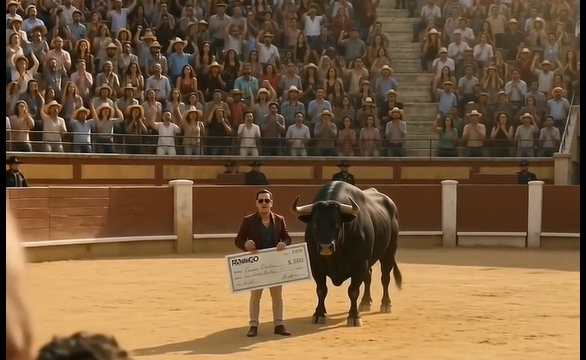
Everyone laughed when a poor old man spent his last ten dollars on a dying horse, but what happened next left the entire auction yard in silence.
When the auctioneer announced that the opening bid for the sick white horse was only ten dollars, a poor old man lifted his hand from the back row, and the wealthy farmers laughed. None of them imagined they were about to witness something they would remember forever.
By early morning, the country auction yard was alive with noise. Dust drifted through sunlight as trucks rolled in, trailers backed toward the pens, and men gathered near the rails. Farmers discussed feed prices, ranchers compared bloodlines, and traders watched every animal, hoping to spot value first.
Some people had come looking for a workhorse. Others wanted a cow, calves, or a Saturday morning among neighbors. At the front of the ring, behind a wooden table, sat the auctioneer, Roberto Martinez, a heavyset man with a powerful voice and polished gavel.
All morning, Roberto had raised prices, teased bidders, and slammed the gavel. Steers sold quickly, a chestnut mare drew a bidding war, and the yard buzzed with business.
Then Roberto glanced at his list and cleared his throat.
“Final lot of the morning,” he called. “Bring him in.”
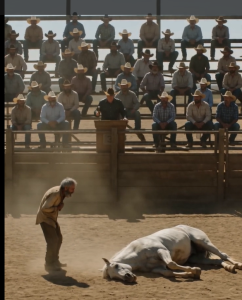
Two workers opened the side gate and led out an old white horse. Or at least, they tried. The animal stumbled on trembling legs, took three unsteady steps, and folded to the ground as if years had settled on his back.
Laughter rolled across the yard.
The horse was heartbreaking. His coat, once white, was gray with dirt and dried mud. Scars marked his sides. His mane hung tangled. His ribs showed, and his breathing came shallow and tired.
Someone near the front shouted, “That thing belongs at the end of a shovel!” Another called, “He’ll be gone before next Sunday.” A third laughed, “I wouldn’t take him with a free saddle.”
Roberto smirked, though he seemed uncomfortable. He tapped his gavel against the table and forced a grin.
“Starting bid,” he announced, “ten dollars. Do I hear ten?”
Silence answered him.
Men shifted in their seats. One farmer folded his arms and muttered, “That’s not livestock. That’s a problem. You’d spend more hauling him away than he’s worth.”
Roberto looked across the crowd. “Ten dollars. Anybody?”
Still no one moved.
The workers stood beside him, holding the rope loosely while he lay in the dirt, eyes half closed, chest rising with effort.
The crowd began to lose interest. Some men turned toward the parking area. Others checked their phones or gathered their papers. The auction was practically over.
Then, from the last row, a thin old man slowly stood up.
He was easy to overlook. Gray hair stuck out beneath his faded cap. His shirt was nearly colorless, his boots cracked, one sole tied with twine. He looked like someone who had spent a lifetime working hard and had little left to show.
Carefully, almost shyly, he raised his hand.
“I’ll buy him,” the old man said.
For a heartbeat, no one reacted.
Then the entire yard erupted.
Men slapped their knees. One wealthy farmer in a spotless denim jacket stood and pointed at him.
“Old man, have you lost your senses?” he shouted. “That isn’t a horse. That’s a pile of bones with ears.”
Another farmer added, “You’re about to throw away your last dime. In a few days, that poor creature will be gone, and you’ll still be hungry.”
Someone else yelled, “Buy bread instead!”
The laughter grew crueler, bouncing off the boards and barns.
Roberto raised one hand, trying to settle the crowd, but even he looked doubtful.
“Sir,” he said, “are you certain? Once the gavel falls, there are no refunds.”
The old man stepped slowly down the aisle. Every eye followed him. He moved with the stiffness of age, but there was no shame in his face.
When he reached the table, he took out a small cloth bundle. He untied it with trembling fingers and placed several worn bills and a handful of coins on the wood.
“This is all I have left,” he said.
The murmuring started again.
“Now he’ll starve too.”
“Poor fool.”
“Some people can’t be helped.”
Roberto looked from the money to the old man. “Why would you want him?”
The old man turned toward the horse lying in the dirt. His eyes softened.
“Because,” he said quietly, “he is my last hope.”
For a few seconds, the yard grew still.
Then a man snorted. “Hope? In that half-dead wreck?”
“He won’t even make it home,” another said.
The old man did not answer. He walked to the horse and knelt beside him in the dust. With surprising tenderness, he placed one hand on the animal’s neck.
The horse opened one cloudy eye.
“Easy, boy,” the old man whispered. “You remember me, don’t you?”
The laughter faded.
The old man stroked the horse’s mane, then leaned close to his ear. No one heard what he said, but the horse’s ear twitched. His nostrils flared. His head lifted slightly from the ground.
A woman near the fence stopped smiling.
The old man slid his hand beneath the tangled mane and found a narrow leather strap hidden against the horse’s neck. Attached to it was a small brass tag, dark with age. He rubbed it with his sleeve until the engraved letters caught the sun.
Roberto stepped closer. “What is that?”
The old man held it up.
On the tag was a name: Silver Star.
An older rancher in the second row straightened. “Silver Star?” he said. “That can’t be.”
Whispers moved through the crowd.
The old man looked at them, his voice stronger now. “Twenty years ago, this horse belonged to my daughter. She raised him from a foal. He won county races, pulled our wagon through floods, and once carried my grandson three miles to town when the boy was sick and the road was washed out.”
The crowd grew quiet.
“After my daughter passed,” he continued, “debts took the farm. Silver Star was sold without my knowing where he went. I searched for years. Yesterday I heard an old white horse with this scar might be brought here.” He touched the mark on the horse’s side. “I came with everything I had because I promised my daughter I would never stop looking.”
No one laughed now.
The old man bent again and whispered, “Come home, Silver.”
The horse trembled. Then, slowly, painfully, he pushed one front leg beneath himself. The workers stepped back. The crowd held its breath. With the old man’s hand steady on his neck, Silver Star struggled, stumbled, and finally stood.
A sound passed through the yard, not laughter this time, but astonishment.
Roberto removed his hat.
The wealthy farmer who had mocked him looked down at his expensive boots.
The old man rested his forehead against the horse’s face. “I found you,” he whispered.
And in that dusty auction yard, everyone learned that value is not always measured in muscle, money, or appearance. Sometimes the weakest-looking soul carries the strongest memory. Sometimes what others discard is exactly what someone else has prayed to find. And sometimes ten dollars can buy back a promise, a piece of the past, and the only hope an old heart has left.