He promised to marry the woman with the most beautiful voice, not the prettiest face. But when the final singer removed her mask, the whole palace learned a lesson no one would ever forget.
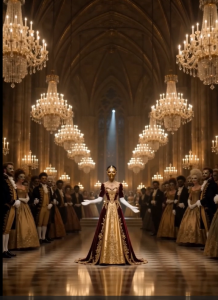
The prince gathered ninety-nine masked young women from every corner of the kingdom and swore before nobles, servants, soldiers, and guests that he would marry the one whose voice reached his heart. No one expected the final singer to change everything forever.
For years, the prince had been famous for wealth, title, a future crown, and a stubbornness that exhausted everyone around him. By twenty-five, he had met daughters of kings, dukes, counts, and powerful neighboring families. Some were praised for beauty. Some were admired for grace. Others carried ancient noble names. Yet after every meeting, the prince gave the same polite smile, bowed his head, and answered quietly, “No. She is not the woman I am looking for.”
At first, people called his refusals youthful pride. Then they whispered he was impossible to please. The courtiers worried in private corners. The aging king understood that a kingdom without a settled heir could become unstable. Ministers spoke carefully. Advisors offered lists of eligible brides. Relatives tried to persuade him. Still, the prince remained unmoved.
One evening, during a grand ball of music, candlelight, and silk gowns, the prince stood before the court. The musicians lowered their instruments. Conversation faded. Every eye turned toward him.
“I love music more than anything else in this world,” he announced. “If I am to marry, my future wife must have a voice capable of touching the soul. Therefore, one month from today, I will hold a special competition. Young women from across the kingdom may come to the palace. I swear before all of you that I will marry the one whose voice is more beautiful than all the others.”
Astonished murmurs traveled through the hall. Some smiled at the romance; others exchanged doubtful looks. The prince raised one hand, and silence returned.
“To make the choice fair,” he continued, “every participant will sing while wearing a mask. I do not want to be influenced by a face, a gown, a family name, or jewels. I will listen only to the voice.”
The announcement spread faster than any decree in years. Messengers carried it across villages, estates, towns, and mountain roads. Within days, every household seemed to be talking about the prince’s challenge. Daughters of merchants practiced before mirrors. Noble families hired the best music teachers they could find. Mothers imagined their daughters wearing a crown. Fathers prepared carriages and gifts. Each young woman dreamed that her song might open the palace gates to a new life.
When the day arrived, the throne room became a concert hall. Banners hung from the walls, lamps glowed above the polished floor, and guests filled every seat. The king sat with a tired but hopeful expression, while the prince took his place on an elevated platform facing a stage built just for the competition.
Then the first masked young woman stepped forward.
She wore the same mask every contestant would wear, plain enough to hide her identity. She sang beautifully, and a few guests nodded in approval. But when she finished, the prince sat silently for a moment and shook his head.
“Next,” he said.
The second singer had a stronger voice. The third brought several guests to tears. The fourth sang with such skill that even the musicians looked impressed. Still, the prince did not rise. He listened carefully, always respectful, but always gave the same answer.
“Next.”
Hours passed. The room grew warmer. The morning excitement slowly turned into nervous tension. One young woman, rejected after months of preparation, burst into tears on the stage and had to be led away by her family. Another ran from the hall with her hands pressed over her face. A third bowed stiffly, but tears slipped down beneath her mask before she disappeared through the side doors.
By the ninety-eighth contestant, the audience was restless and disappointed. Many believed the prince had created the contest only to reject everyone again. The king’s face had gone pale with frustration. The courtiers whispered behind their sleeves. The musicians looked exhausted.
Then the far doors opened one last time.
The final young woman entered. Unlike many before her, she wore no jewels, embroidered cloak, or expensive ribbons. Her dress was simple, her mask dark velvet. Nothing about her entrance demanded attention. Some guests barely looked up.
“She has no chance,” someone whispered.
“All the best voices have already been heard,” another replied.
“Poor girl,” a woman murmured. “She came too late.”
The young woman walked to center stage. She did not tremble under hundreds of eyes. She lowered her head for a moment, breathed in, and waited for the music to begin.
The first notes floated through the hall.
Then she sang.
After a few words, the room changed. The whispers vanished. Fans stopped moving. A glass paused halfway to a man’s lips. Her voice was unlike anything heard that day. It was clear, gentle, powerful, carrying sadness, hope, and warmth in every note. It did not sound like performance alone. It sounded like a heart speaking through music.
People who had been tired suddenly sat upright. The musicians, stunned by her timing and feeling, nearly forgot their own parts. Even the guards beside the doors stood motionless, listening as if the song had reached places in them they had forgotten. Women in the audience wiped their eyes. Older men lowered their heads. The king, who had been sitting heavily in his chair, slowly straightened.
And the prince leaned forward.
For the first time that day, his expression changed. The careful calm left his face. His eyes brightened. He looked at the singer as though he had been searching through noise all his life and had finally heard the one sound meant for him.
The song rose, softened, and finally ended.
No one clapped at first. The silence was too deep, too full. Then, all at once, applause thundered through the throne room. People rose from their seats. Some shouted praise. Others wept openly. The young woman stood quietly beneath the dark mask, her hands folded before her.
The prince rose from his throne. He did not ask the judges for an opinion. He did not look to the king for permission. His voice rang through the hall.
“I have made my choice.”
The applause stopped instantly.
“I will marry you,” he said, looking directly at the final singer. “Remove your mask.”
A tremor of excitement moved through the palace. Everyone leaned forward. Who was she? A hidden noblewoman? A merchant’s daughter? A princess from some distant land? The girl slowly lifted both hands to the velvet mask.
For a moment, even the candles seemed still.
Then she removed it.
A gasp swept across the throne room. Beneath the mask was not the flawless face many had imagined, but a young woman whose skin bore deep scars from an old fire, marks that covered one side of her face and pulled at the corner of her mouth. The palace froze in horror, not because she had done anything wrong, but because everyone realized how quickly they had expected beauty instead of truth. Even the prince stood shocked, staring at the face behind the voice that had already captured his heart.