They thought the old man would be crushed in one week. Instead, he exposed the truth that shook the entire prison.
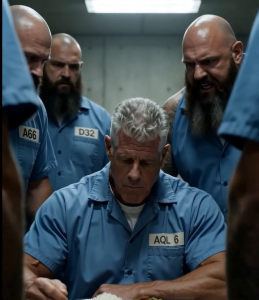
When sixty-eight-year-old Viktor was transferred to a maximum-security prison, almost everyone who saw him believed the same thing: he would not last long. He was thin, gray-haired, and quiet, with tired eyes and a slow way of moving that made him look more like someone’s grandfather than a man who belonged behind steel doors.
He did not stare people down, raise his voice, or try to prove anything. During his first days there, Viktor kept mostly to himself. He ate in silence, read old books in the library, and walked the yard with his hands folded behind his back. To younger inmates, that calm looked like weakness.
But Viktor’s silence was not fear.
Most people did not know that Viktor had already made a powerful enemy before he ever stepped into the cafeteria.
A few weeks earlier, while housed in another unit, he had filed a formal complaint against members of the prison staff. In careful handwriting, he described what he had witnessed: a young prisoner dragged into a hallway, struck, threatened, and later returned to his cell shaking. Viktor had not added drama. He simply wrote what he saw, named the time, named the officers, and demanded an investigation.
The complaint should have disappeared like many before it. But this one did not.
Somehow, it reached an outside oversight commission. A woman on the committee read it twice, then requested records. Soon, questions came from outside the prison, the kind that made administrators nervous.
The warden, Marcus Hale, was furious.
Hale liked order, obedience, and silence. He believed every man in his prison should understand one rule: nothing left those walls unless he allowed it. Viktor’s letter had broken that rule.
Still, the warden could not punish him openly while the commission was watching. So Hale chose a different method.
There was one place where punishment could look like routine: the cafeteria.
In the center of that long, echoing room stood a table most inmates avoided. It belonged to the most feared group in the prison: gang leaders, violent offenders, and men whose names carried weight. Even the guards watched that table carefully.
That was where the warden ordered Viktor to sit for one week.
“Put the old man with them,” Hale said. “After seven days, he’ll forget all about complaints.”
The next afternoon, conversation dropped as Viktor entered carrying his tray. He found the number painted on the table’s edge, then walked toward the dangerous group as if he had been invited.
Dozens of inmates turned to watch.
At the head of the table sat Roman, a massive bald man with tattoos climbing up his neck. He had the relaxed confidence of someone used to being obeyed.
Roman looked Viktor up and down and smiled.
“You’re at the wrong table, Grandpa.”
Viktor did not answer. He sat down carefully, placed his tray in front of him, unfolded his napkin, and picked up his spoon.
A younger inmate reached across and took Viktor’s bread.
Another pulled his drink away.
Someone laughed. Then another. Within seconds, the whole table joined in.
“Maybe they moved him here from a nursing home.”
“Careful. He might write you a letter.”
The joke spread through the cafeteria. Even a few guards smirked. Viktor simply ate what was left.
The next day, they hid his spoon. The day after that, they bumped his shoulder hard enough to spill half his soup. On the fourth day, someone placed a hand on his tray and whispered a warning about men who ignored prison rules.
Viktor listened without blinking.
He never insulted them. He never begged to move. He never complained to the guards. Each day, he returned to the same table, sat in the same place, and ate what he could.
His calm began to irritate Roman more than any argument would have.
By the sixth day, the cafeteria was no longer laughing as loudly. Some inmates watched Viktor with curiosity. Others wondered why the old man did not break. A man who refused to react was harder to control than a man who shouted.
On the seventh day, Roman decided to end it.
Lunch had just been served. The room smelled of boiled potatoes and weak coffee. Viktor sat down with his tray. Before he could lift his spoon, Roman stood.
The cafeteria grew quiet before he even moved.
Roman walked around the table, grabbed Viktor’s tray, and slammed it onto the concrete floor. Potatoes rolled under the bench. Soup spread in a pale puddle. Bread landed beside Viktor’s shoes.
No one laughed.
Everyone waited for the old man to finally show fear, anger, or shame.
Viktor looked down at the food on the floor. Then he slowly stood.
A guard reached for his radio. Roman leaned close, smiling as if the victory were already his.
But Viktor did not swing. He did not shout. He bent down, picked up the fallen bread, wiped it with a napkin, and placed it back on the table.
Then he turned, not to Roman, but to the cameras mounted high in the cafeteria corners.
In a clear voice, steady enough for the room to hear, he said, “My name is Viktor Sokolov. For seven days, under the order of Warden Marcus Hale, I have been placed at this table after filing a protected complaint with the oversight commission. During that time, I have been harassed, denied food, threatened, and ignored by staff assigned to keep this room safe.”
The cafeteria froze.
Viktor reached into the lining of his prison jacket and pulled out folded sheets of paper. His hands did not shake.
“These are dates, times, names, and witness statements,” he continued. “Copies were mailed yesterday to the commission, to a federal attorney, and to my daughter, who is a journalist.”
Roman’s smile vanished. The guards looked at one another.
Then Viktor faced Roman. “You were never my enemy,” he said quietly. “You were the warden’s tool. And he counted on you not realizing it.”
A murmur moved through the cafeteria.
Roman’s face hardened. He looked toward the guards, then toward the camera, then back at the old man. For the first time, he understood that he had been used.
At that moment, the cafeteria doors opened.
Two officials in dark suits entered with a woman carrying a folder. Behind them came three officers none of the inmates recognized. They walked straight toward the staff station.
The warden appeared seconds later, pale and furious.
“What is this?” Hale demanded.
The woman opened her folder. “Warden Hale, we are here on behalf of the oversight commission. You are being removed from duty pending investigation.”
The room went silent.
Viktor sat back down and placed the rescued bread beside his empty tray. He looked tired, but peaceful.
Roman lowered himself onto the bench across from him.
After a long moment, the most feared man in the prison pushed his own tray toward Viktor.
“Eat,” Roman said.
No one laughed this time.
From that day forward, Viktor was no longer seen as weak. He became proof that courage does not always look loud or strong. Sometimes the bravest person in the room is the one who speaks the truth calmly, quietly.