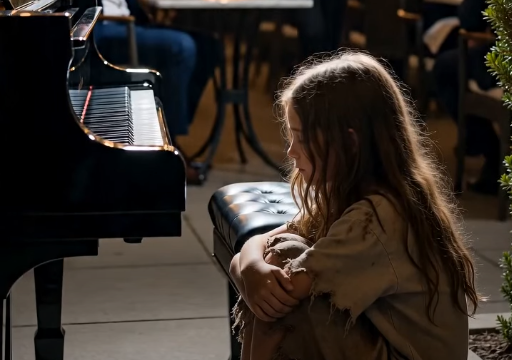
He thought her stutter would make the whole city laugh. Instead, one brave moment turned her shame into a lesson no one in that arena would ever forget.

The cruel leader of a dangerous clan forced a poor young woman into an arena before thousands of spectators, knowing she stuttered and could not sing. He was certain he would shame her before the city, but Sarah’s answer left the stadium stunned.
In that region, no name carried more fear than Victor Hale, ruthless head of the strongest clan for miles. People feared him, officials quietly avoided him, and wealthy farmers sought his favor. Victor had held power so long that he confused obedience with respect.
Sarah lived in another world. She and her sick mother shared a small house on the edge of town, where every coin mattered. Because her mother could no longer work, Sarah took any honest job she could find. She washed clothes, swept floors, carried baskets, and came home tired but grateful. She was beautiful, humble, and quiet.
Victor first noticed her near the market well. She was helping an old woman lift a heavy sack when he rode by. Her calm face caught his eye. Soon, he knew her name and how desperate her family was. To him, poverty meant weakness. He decided Sarah would become his wife, because he wanted to possess what others admired.
At first, he sent gifts and acted as though honoring her. Sarah accepted none of it. That irritated him. During one tense meeting, he demanded an answer about marriage while followers watched. Frightened, Sarah tried to say she needed time, but the words caught in her throat.
“I… I c-can’t answer you,” she whispered.
Victor’s expression changed. He asked her to repeat herself, pretending not to understand. As she grew nervous, she stumbled. A cruel smile appeared. In his mind, his woman had to be flawless. He did not see Sarah’s kindness or sacrifice. He saw only something he could use.
From that day on, he no longer wanted to marry her. But that was not enough. He wanted revenge for being refused by a poor girl. He wanted the region to laugh at her until no one remembered her courage.
Several weeks later, the city held its largest annual festival. Thousands poured into the huge arena. Families climbed stone steps, musicians played, and vendors shouted. People came for races, riding contests, and the bull exhibition. Victor had paid for everything, so his banners hung everywhere.
Sarah came because her mother wanted one afternoon away from sickness. They sat high in the stands. Sarah planned to watch quietly, then go home before dark. She had no idea Victor had seen her.
From his box, Victor leaned forward. The sight pleased him. He whispered to the announcer, and minutes later the drums stopped.
“By special request of our generous organizer,” the announcer called, “one honored spectator is invited to the center of the arena.”
The crowd cheered, expecting a harmless surprise. Then Sarah’s name rang out, cutting through the noise like a warning.
For a moment, she could not move. Her mother clutched her hand. Hundreds of faces turned toward them. Victor’s guards were already coming up the steps. They did not threaten her, but refusal was not an option. Sarah kissed her mother’s fingers, stood, and walked into the bright dust.
The arena felt impossibly wide. Murmurs followed her. Victor left his box holding a microphone, He smiled as if giving her an honor.
“Sarah,” he said, his voice echoing through the stadium, “I have heard you are a very talented young woman.”
The spectators applauded. Fear moved through Sarah like cold water. She understood the trap before he finished.
“Sing for everyone here,” Victor continued.
Her lips parted, yet no sound came. She had never been able to sing in public. Even speech failed when panic tightened her chest. Victor knew that. He had chosen the arena, crowd, and microphone for one reason.
Then he made the threat clear.
“Sing,” he declared, “and I will announce our wedding today. But if you cannot, you will be the next person to enter the ring during the bull exhibition.”
Shock swept the stands. Some gasped. Some laughed nervously. Others looked away, ashamed and afraid. Sarah’s mother struggled to rise, but neighbors held her back.
Sarah stood alone in the center. Her heart pounded so hard each beat seemed to shake the air. Victor watched with satisfaction. He expected tears, broken syllables, and panic. He expected her to crumble, proving she had been foolish to resist him.
The microphone was pushed toward her.
Sarah looked at it, then at the crowd, then at her mother. Something changed in her eyes. She remembered her mother smiling through pain and every insult swallowed because they needed work. She remembered Victor’s smile when he discovered her stutter, and realized his power depended on everyone believing fear was stronger than truth.
Slowly, she took the microphone.
The stadium became silent. Sarah breathed once, then twice. When she spoke, the first word trembled.
“I…”
Victor’s cruel smile widened.
But Sarah did not stop.
“I stutter when I am afraid,” she said, her voice uneven but clear enough to carry. “I do not sing well. Everyone here may know that now.”
The entire crowd fell silent. She turned toward Victor.
“But a decent man does not invite a poor girl into an arena to mock her. A decent man does not threaten someone because she refused to belong to him. A decent man does not call cruelty entertainment.”
Victor’s smile vanished. His followers shifted behind him. Sarah’s voice grew stronger, imperfect but honest.
“If I must stand here in front of all of you, then let the city hear the truth. He asked me to marry him. I said I needed time. When fear made me stutter, he decided I was no longer worthy of respect. Today he wanted you to laugh at me.”
No one laughed now.
An old farmer stood first. Then a woman. Soon, people across the arena were rising in quiet support. Sarah’s mother wept openly.
Victor tried to take the microphone back, but the announcer stepped away. Even his guards hesitated. For the first time in years, he looked small.
Sarah lifted her chin, steadying herself beneath the merciless sun.
“You can put me in front of a bull,” she said, “but you cannot make me ashamed of something I did not choose. The shame belongs to the person who uses power to hurt the helpless.”
Then applause began, scattered at first, then thunderous. The sound rolled over Victor until his orders disappeared beneath it. Officials who had avoided him for years found courage in the crowd. The bull exhibition was canceled. Victor was escorted out before the city he had tried to impress.
Sarah walked back to her mother, shaking. She had not sung a note, and her voice had trembled. Yet she had done something greater. She had told the truth where fear was meant to silence her.
By sunset, the region was talking. But no one was laughing at Sarah. They were repeating her words and remembering her courage. They understood that dignity does not come from wealth, status, or a perfect voice. It comes from standing upright when someone powerful tries to make you bow.