She thought her husband was comforting his grieving mother. But one rainy night, she followed him—and uncovered a family secret that destroyed everything she believed about her marriage.
Every night, Daniel left our bed and slipped into his mother’s room. By morning, he always had a calm explanation ready, a gentle lie that made me feel guilty for asking. For months, I tried to believe him. Then one night I followed him down the hallway, and what I saw behind that half-open door shattered the life I thought we were building.
When I married Daniel, I believed I had found the kind of man a woman could grow old beside without fear. He was not loud or careless with promises. He was steady, soft-spoken, and patient.
After the wedding, we moved into his childhood home, an old house near town. His mother, Margaret, already lived there. She had stayed after Daniel’s father died, and Daniel said she should not be alone. I understood. Family, I believed, was not something you loved only when convenient.
For weeks, everything seemed peaceful. Margaret was quiet, but I thought grief had made her that way. She thanked me when I cooked and spoke kindly. She spent most evenings in her bedroom, saying she tired easily. Daniel checked on her often.
Then one night, I woke up and reached across the bed, only to find his side empty.
At first, I was not alarmed. People wake up. People get water, use the bathroom, or walk around when sleep refuses to come. I turned over and waited. Ten minutes passed. Then twenty. Finally, I entered the hallway.
A thin line of light glowed beneath Margaret’s bedroom door.
I stood there, listening. I heard no voices, only the quiet hum of the old house. I told myself Daniel was comforting her. Maybe she had woken from a nightmare. Maybe grief still came for her in the dark. I went back to bed and forced myself to close my eyes.
The next night, it happened again.
And the night after that.
Soon I knew the exact sound of Daniel leaving our bed. He moved carefully, as if every breath might wake me. Sometimes he stayed for an hour. Sometimes he did not return before dawn.
I tried to be understanding. Margaret had lost her husband. Daniel was being a good son. But understanding does not erase loneliness. It does not quiet the ache of lying alone night after night while the person you married chooses another room.
After several weeks, I finally asked him. We were having breakfast, though neither of us was eating much. Margaret had already gone back to her bedroom. Daniel was stirring his coffee, watching the spoon turn in slow circles.
“Where do you go every night?” I asked.
His hand stopped.
For a long moment, he said nothing. Then he looked at me with tired eyes and answered, “Mom is afraid to be alone at night since Dad died. I sit with her until she falls asleep.”
“So every night?” I asked.
“She needs me,” he said.
Those three words ended the conversation. What could I say? That I needed him too? That a wife should not have to compete with sorrow? I swallowed my hurt and nodded.
But months passed, and nothing changed.
Daniel kept leaving. Margaret kept retreating. I began to feel less like a wife and more like a guest in a house where everyone understood the rules except me.
Small things began to trouble me. Margaret rarely looked me in the eye. Once, I passed her door and heard her whisper, “Not tonight.” Daniel answered too softly for me to understand.
When I asked if she was unwell, Daniel said she was still grieving. When I suggested counseling, he looked at me as if I had crossed an invisible line.
I began to wonder whether I was imagining things. Loneliness can twist a person’s thoughts. Silence can make ordinary shadows look like secrets. Still, my heart would not rest.
One rainy Thursday night, I woke to the familiar dip of the mattress as Daniel slipped out of bed.
Something inside me broke.
I did not call his name. I did not ask another question that would only earn another answer. I waited until his footsteps faded. Then I got out of bed, barefoot, and followed.
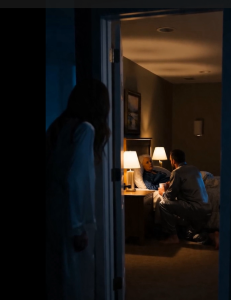
The floorboards were cold. Rain tapped against the windows. My heart beat so loudly I was sure he would hear it. Margaret’s door was not fully closed. Warm yellow light spilled through the narrow opening.
I stepped closer and looked inside.
Daniel was sitting on the edge of Margaret’s bed, but Margaret was not crying. She was awake, upright against the pillows, holding a small wooden box in her lap. Daniel’s hands were trembling. On the blanket between them were envelopes, photographs, and a silver baby bracelet.
Then I saw my name.
It was written on one envelope in blue ink.
Margaret looked toward the door before Daniel did. Her face went pale.
Daniel turned, and the expression on his face told me the truth before he spoke. Not all of it, but enough to know my life had been built on something hidden.
“What is that?” I asked.
Neither answered.
I walked into the room and picked up the envelope. Daniel reached for it, but Margaret stopped him with one sharp whisper.
“She deserves to know.”
My hands shook as I opened it. Inside was an old hospital record, a photograph of a newborn, and a letter written by Daniel’s father before he died.
Years before I met Daniel, my mother had given birth to twins. One child went home with her. The other was quietly placed for adoption after a family crisis no one discussed. Daniel’s father had helped arrange it. Margaret had known. Daniel had discovered the truth after his father’s death.
The adopted baby was Daniel.
I felt the room tilt.
Daniel was not my husband in the way I believed. He was the brother I had never known existed.
Margaret began sobbing, saying they had tried to find a way to tell me. Daniel repeated that he had not known before the wedding, and once he learned the truth, he was terrified of destroying me.
But the destruction had already happened.
Every night, he had gone to Margaret’s room not because she feared loneliness, but because they were searching through his father’s records, trying to confirm what they already suspected. Every quiet step, every apology, every gentle lie had been part of a secret too heavy for any marriage to survive.
By sunrise, I had packed one suitcase.
Daniel cried in the doorway, but I could not comfort him. Margaret stood behind him, smaller than I had ever seen her, whispering that she was sorry.
I left that old house while the rain was still falling.
For a long time, I thought betrayal always looked like cruelty. I learned it can also look like silence, hesitation, and people who believe they are protecting you while taking away your right to know the truth.
The life I lost that night was not only my marriage. It was the story I had told myself about who I was. Rebuilding meant facing one painful lesson: love cannot survive where truth is treated like a danger instead of a promise.