He thought she was just a tired housewife and tried to humiliate her in front of everyone. But one arm-wrestling match revealed a truth no one in that bar was ready for.
The soldiers’ bar was loud when I walked in. Laughter bounced off the walls, boots scraped the floor, and country music rattled through speakers. Men in faded military shirts filled the tables, telling stories that grew bigger with every drink.
I was not there to impress anyone. My brother had texted that he needed to see me after his shift, so I drove across town without changing clothes. I still wore a plain gray sweatshirt and loose pants from cleaning the garage. My hair was tied back, my face bare. To anyone watching, I looked like a tired suburban wife who had wandered into the wrong room.
I ordered water and stood near the end of the bar.
Then the cold splash hit my chest.
Water ran down my clothes, soaking the fabric and leaving dark stains across the gray cotton. I did not gasp or shout. I only watched the liquid spread and listened as the table burst into loud laughter.
“Watch where you’re standing, sweetheart,” a deep voice muttered.
I looked up.
The man in front of me was built like a wall. Broad shoulders, thick arms, close-cropped hair, square jaw. Across his black T-shirt, the word SEAL was printed in white letters. Behind him stood three other men with the same arrogance. One had his phone raised.
The big man held an empty plastic cup and smiled. To them, I was harmless: a woman alone, middle-aged, quiet, ordinary.
I reached for a napkin, hoping to wipe myself off and let it pass. I had no interest in turning a childish insult into a scene.
“Hey,” he snapped.
His hand closed around my wrist before I could step away.
“I’m talking to you,” he said. “Because of you, I just lost.”
His fingers tightened. He wanted me to panic. He wanted me to flinch. Men like him often mistake restraint for weakness.
But inside me, everything went calm. The music faded. The laughter dimmed. My breathing slowed into a rhythm learned in places far less forgiving than any bar.
I looked at his hand, then at his eyes.
“Let go,” I said.
He laughed. “Or what?”
I turned my wrist, broke his grip, slid free, and shoved him backward. He stumbled into his friends. A chair scraped across the floor. The laughter changed from amusement to surprise.
“Oh, look at that,” he said, straightening with a darker smile. “A strong woman.”
“Housewife strength, huh? Carrying all those grocery bags?” he said. “Come on. Show us what you can do.”
“I don’t need to show you anything,” I replied. “Leave me alone.”
That should have ended it. But he stepped closer.
“No,” he said. “You’re not walking out until we settle this.”
“I said leave me alone.”
“One round,” he said, pointing to the table. “Arm wrestling. You lose, you do whatever I say. You win…” He looked at his friends. “I’ll get on my knees and apologize.”
The men behind him pounded the table. Others turned to watch. Phones came up. The bartender froze.
I studied him. I did not owe him a lesson. I did not need applause, revenge, or proof. Real strength rarely announces itself. Still, sometimes people choose the lesson they are about to learn.
“Fine,” I said.
The bar quieted.
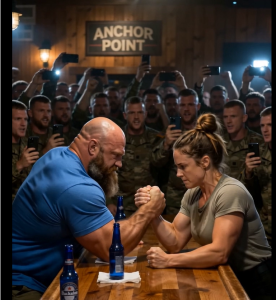
We sat at the center table. He rolled his shoulders. I placed my elbow on the scarred wood. My wet sleeve clung to my arm.
“Careful, ma’am,” one man called. “Don’t hurt yourself.”
I ignored him.
The big man wrapped his hand around mine. His palm was rough. He squeezed hard before the match began, trying to intimidate me.
I let him.
“Ready?” someone asked.
“Go!”
He attacked instantly, driving with everything he had. For one second, our hands dipped toward my side, enough to make the crowd roar.
Then I stopped him.
Not with drama. Not with a shout. I locked my shoulder, centered my wrist, and let his force meet something he could not move.
His smile disappeared. Confusion crossed his face. He pushed harder. His arm trembled. His jaw clenched.
I breathed in.
Then I brought his hand back to center.
The cheering faded. His friends stopped laughing.
“Come on, man,” one said, but his voice no longer sounded amused.
The man grunted and leaned his body into it, but no one called it. I did not complain. I kept my elbow planted and posture still.
Then, slowly, inch by inch, I turned his wrist.
His eyes widened. The table groaned under his weight. His boots slid against the floor. His face reddened.
I leaned closer, my voice low enough that only he could hear.
“Strength without discipline is just noise.”
Then I pressed his hand down until his knuckles hit the table.
The sound was not loud, but it ended everything.
Silence swallowed the bar. For a moment, no one moved. The man stared at his pinned hand as if it belonged to someone else. His friends lowered their phones. The bartender’s mouth hung open.
Then my brother’s voice came from the doorway.
“Emily?”
I turned. He stood there in uniform, eyes moving from my soaked sweatshirt to the man.
“What happened?” he asked.
Before I could answer, an older man near the bar stood up.
“Wait,” he said. “Emily Carter?”
A murmur moved through the room.
The big man looked from him to me. “You know her?”
The older man swallowed. “Everybody who served in Kandahar knows that name.”
The bar went quieter.
People had told the story of a convoy ambush in a desert valley, of a communications specialist who dragged two wounded soldiers behind cover after the lead vehicle was hit. They called her fearless. They called her impossible.
They never imagined she might walk into a bar wearing gray sweatpants, tired from cleaning a garage.
The older man looked at the one who had challenged me.
“She carried men twice your size under fire,” he said softly. “You challenged the wrong woman.”
The big man’s face changed. His arrogance drained away, leaving only embarrassment. He stood slowly.
No one laughed now.
He looked at my wet clothes, then at the cup.
“I didn’t know,” he said.
“That was the problem,” I replied. “You thought you needed to know who I was before deciding whether to treat me with respect.”
His mouth opened, but nothing came out. Then, in front of the bar, he lowered himself to one knee.
“I’m sorry,” he said.
I believed he meant it. But apologies are easy when pride has already been broken. The harder part is becoming different after everyone stops watching.
I took my brother’s jacket and turned toward the door.
Before leaving, I glanced back at the men who had mistaken quiet for weakness.
“Remember this,” I said. “You never know what someone has survived. Be kind before life teaches you humility the hard way.”
No one answered.
Outside, my brother walked beside me.
“You still know how to clear a room,” he said.
I smiled faintly.
“No,” I said. “I just know when a room needs to be reminded.”
Behind us, a lesson remained on the table with a spilled cup of water and one man’s pride.