She thought a maid had no power and no place in our family. But one hidden necklace, one old letter, and one painful truth changed everything.
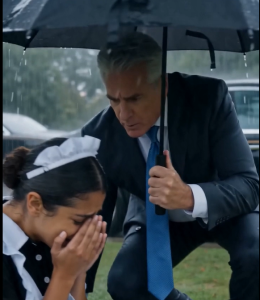
I came home that afternoon under a sky so dark it felt like evening. Rain hammered the windshield and soaked my coat before I reached the gate. Then I stepped into the yard and saw something that made my heart stop.
Under the old oak tree sat Maria.
She was on the wet grass, shivering in her soaked gray uniform, holding a plastic container of rice that had filled with rainwater. A small bag of clothes lay beside her in the mud. Maria had worked in our house for years. A parent can provide a beautiful house, fine schools, and every comfort, yet still fail if he does not teach a child to respect the hands that make that comfort possible. She was quiet, careful, and kind. She had kept my home clean and watched over my daughter Lucia when Lucia was still afraid of thunder.
“Maria,” I said, hurrying toward her. “What happened?”
She tried to stand, then lowered her eyes. “Mr. Alberto, I am sorry. I did not want you to find me here.”
“Why are you sitting in the rain?”
Her lips trembled. “Miss Lucia threw me out.”
“Lucia did what?”
“She said I stole her pearl necklace,” Maria whispered. “The one that belonged to your wife. But I did not steal anything. I swear I did not.”
I felt heat rise in my chest.
“She said calling the police would be too kind,” Maria continued. “She said people like me needed to learn shame. She threw my things into the hallway and told the driver not to help me. Then she gave me this food and said, ‘If you like taking what is not yours, eat outside.’”
I looked at her and felt a fear I had never felt before. I was afraid of what my own daughter had become. That truth struck harder than the storm outside, and I could not ignore it.
I knew Lucia could be proud. I gave gifts when she needed guidance, money when she needed responsibility, and excuses when she needed correction. This was cruelty. I had ignored small signs for years: the way Lucia spoke to staff, the way she rolled her eyes at people who served her, the way she believed an apology could be bought with flowers or money. I had called it grief, then youth, then confidence. Standing in that rain, I finally called it what it was.
“Maria,” I said carefully, “did you take that necklace?”
She lifted her tearful face. “No, sir.”
“Then why would Lucia accuse you?”
Maria hesitated. “Because I saw where she hid it.”
My breath caught.
“This morning,” she continued, “Miss Lucia was angry because you refused to give her more money for her party. She opened the jewelry case, took the necklace, and placed it inside the blue vase in the sitting room. When she saw me watching, she smiled and said, ‘You saw nothing.’ I was afraid to speak.”
I knew that vase. Elena had bought it years ago.
I took Maria’s cold hand. “Come inside.”
She pulled back. “Please, sir. Miss Lucia will be furious.”
“Tonight,” I said, “Lucia should worry about me.”
I brought Maria through the side door, gave her my coat, and asked the cook for hot tea. Then I went straight to the sitting room.
Lucia sat on the sofa in a silk robe, scrolling on her phone. She glanced up and frowned.
“You are dripping on the floor,” she said.
I did not answer. I walked to the blue vase, reached inside, and pulled out my wife’s pearl necklace.
Lucia’s face turned pale.
“Father,” she said quickly, “I can explain.”
“No,” I said. “You can confess.”
She stood, trying to look offended. “Maria has been careless for months. I wanted her gone. She acts too comfortable here.”
“She earned comfort here,” I replied.
Lucia gave a sharp laugh. “She is a maid.”
“Sit down,” I said.
“I am not a child.”
“Tonight, you have behaved worse than one. Sit down.”
She obeyed.
I looked at Elena’s portrait above the fireplace.
“There is something you were never told,” I said. “Maria is not just an employee.”
Lucia stared. “What does that mean?”
“When you were five, you had a terrible fever while I was away. The bridge was flooded, and the doctor could not reach the house. Your mother was terrified. Maria wrapped you in blankets and carried you three miles through the storm to the clinic. She collapsed at the door, but you lived because of her.”
Lucia blinked, shaken. “That does not make her family.”
“No,” I said. “But your mother believed she was.”
I opened my desk drawer and took out an old envelope. I handed it to Lucia.
She read in silence.
My dear Alberto, if I am gone before Lucia understands, protect Maria. She gave us loyalty when others left and courage when fear was all I had. She is the reason our daughter is alive. Treat her as family, because in every way that matters, she is.
I said, “Your mother trusted me to honor that request. I failed today because I allowed you to believe wealth made you better than another person.”
“As of tonight, your allowance is suspended. Your credit cards are canceled. The apartment I bought for you will be sold unless you begin working and paying your own way. Tomorrow morning, you will apologize to Maria in front of everyone in this house.”
“Father, please,” she whispered.
“No. You placed an innocent woman outside in the rain. You accused her of stealing what you hid yourself. You used shame as a weapon. Now you will learn humility.”
Lucia cried then, but punishment was not revenge. It was the last chance to save her character.
The next morning, the rain had stopped. I gathered the cook, gardener, driver, Maria, and Lucia in the kitchen. Lucia came in wearing plain clothes. Her eyes were red.
“I lied,” she said. “I hid the necklace and blamed you. I treated you cruelly when you had only been kind to this family. I am sorry. I do not deserve your forgiveness, but I am asking for it.”
Maria studied her quietly. Then she touched Lucia’s hand.
“I forgive you,” Maria said. “But forgiveness does not mean you should forget what you did.”
Lucia began to cry again. Then, without being told, she knelt in front of Maria. She knelt because shame had finally reached her heart.
In the months that followed, Lucia changed. She got a job at a small office downtown. On weekends, she helped Maria with chores and listened as Maria told stories about Elena.
One evening, I found them together in the garden. Lucia was quiet, but this time her silence was not arrogance. It was respect.
That day taught me something I will carry forever. Love without discipline can grow pride. Comfort without gratitude can grow cruelty. And sometimes the person a family overlooks is the person who has been holding it together all along.
Maria was never just a maid. She was loyalty, sacrifice, and grace under my roof. My daughter had to lose her pride before she could finally see the truth.