The lunch crowd at The Gilded Swan rarely looked at prices. Men in tailored suits leaned back in leather chairs, women lifted crystal glasses, and waiters moved between white tablecloths like shadows. Everything was polished and controlled. That was why every head turned when the old man stepped inside.
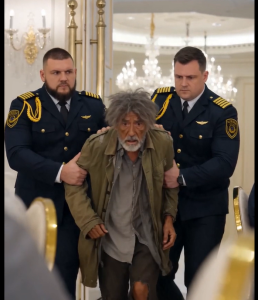
He stood near the entrance in a faded brown coat. His beard was white and uneven, his shoes were cracked, and his hands trembled as he removed a worn cap. He did not shout, beg, or push forward. He looked around with tired eyes, as though he had walked a long way to find one familiar face.
The hostess froze. A waiter stopped with a tray in his hands.
“Sir,” the hostess said sharply, “you cannot be here.”
“I’m not here to cause trouble,” he said. “I just need to see someone.”
A businessman near the window laughed. “Unbelievable,” he muttered.
The words moved through the restaurant like cold air. People stared with disgust, not because he had harmed anyone, but because his hardship made them uncomfortable. To them, he was not a person with a past. He was an interruption.
The hostess signaled to security. Two guards appeared, large men in dark suits trained to remove problems quickly. One placed a firm hand on the old man’s arm.
“You need to leave,” the guard said.
The old man did not resist. He only glanced past the tables, as if searching for a face he had carried in memory for years.
“Please,” he said softly. “Just one minute.”
But his plea only made the room colder. A man shook his head. Another guest whispered that people like him always had some excuse. No one asked who he wanted to see.
The guards guided him toward the exit. His shoes dragged across the marble floor. The piano player stopped, and the silence made every sound larger: the scrape of a chair, the clink of a fork, the old man’s uneven breathing.
Then a child’s scream shattered the room.
“Grandpa!”
A little girl, no more than seven years old, jumped down from a booth. She wore a pale blue dress, and her brown curls bounced as she ran between the tables. Her mother reached for her, startled, but the girl slipped past her hand.
“Lily, stop!” the woman called.
But Lily did not stop. She ran straight toward the old man, her face full of shock and joy, and threw herself into his arms.
The guards stepped back. Guests stared. The hostess covered her mouth.
The old man caught the child as if his body remembered how. His trembling hands rested on her back, and for a moment the whole world seemed to disappear except for that little girl.
“Lily?” he whispered.
The girl pulled back just enough to see his face. “I knew it was you,” she said, tears running down her cheeks. “I saw your picture.”
Her mother hurried across the dining room, pale with confusion. “Lily, come here,” she said, but her voice had lost its certainty.
The old man reached into his coat. From it he pulled an old photograph, its edges bent and yellowed. He held it as though it were fragile and holy.
The restaurant went completely still.
In the photograph was a younger version of the old man beside a smiling young woman. In his arms was a baby wrapped in white. On the back, written in faded ink, were the words: My daughter, Grace, and my granddaughter, Lily.
Lily’s mother stopped as if the floor had vanished beneath her. Her name was Grace. Her eyes moved from the photograph to the old man’s face. The color drained from her cheeks. Her lips parted, but no words came out.
The old man looked at her with a sorrow that had survived too many years. “Grace,” he said. “I have searched for you for so long.”
Grace shook her head. “My father died,” she whispered. “They told me he died.”
The old man closed his eyes. “I was told you had moved away and never wanted to see me again,” he said. “After your mother passed, everything fell apart. I lost the house. I lost my job. I lost the people who knew the truth. But I never stopped looking.”
Grace’s hand rose to her mouth. The guests who had judged him minutes earlier now sat frozen. The man they had treated like a stain on the marble floor was not a nuisance. He was a father. He was a grandfather. He had carried one photograph through hunger, cold nights, and years of rejection because love was the last thing he had left.
Lily clung to him tighter. “Mommy,” she said, “that’s the man in Grandma’s old box. The picture under the letters.”
Grace remembered the box. She remembered finding it after her mother’s death, but she had been young, grieving, and surrounded by relatives who told her not to ask painful questions. Now the truth stood before her in a torn coat, nearly thrown into the street by people who thought fine clothes made them better.
“I didn’t know,” Grace whispered.
The old man gave a sad smile. “Neither did I.”
The manager rushed over, suddenly full of apologies. “Sir, I am deeply sorry. Please, allow us to make this right.”
But the old man looked only at Grace and Lily. “I did not come for a meal,” he said. “I came because I heard your name. Someone told me a woman named Grace came here every Thursday with her little girl. I thought maybe, just maybe, it was you.”
Grace began to cry as years of loss broke open all at once. She stepped forward and touched his face, as if needing proof that he was real.
“Dad,” she said.
That word changed everything.
The old man’s shoulders shook. He pulled Grace and Lily into his arms, and the three of them stood near the entrance, surrounded by people who no longer knew where to look.
Some lowered their eyes in shame. The businessman by the window stared at the table. The woman with the napkin said nothing. The guards stepped away, embarrassed by their part.
Grace led him to her table. The old man seemed overwhelmed by the simple act of being invited to sit. Lily climbed into the chair beside him and refused to let go of his hand.
As food arrived, he barely touched it. Grace listened as he explained how misunderstandings and selfish relatives had kept them apart, how poverty had swallowed him, and how one photograph had given him strength.
By the time they left, no one laughed. No one whispered insults. Several guests stood as the old man walked out, not because he wore a fine suit, but because they finally understood something they should have known from the beginning.
A person’s worth is not measured by the coat on his back, the money in his pocket, or the table where he is allowed to sit. Sometimes the person the world pushes aside is carrying the story that can bring a family back together. And sometimes, the hero everyone rejects has been holding on to love the longest.