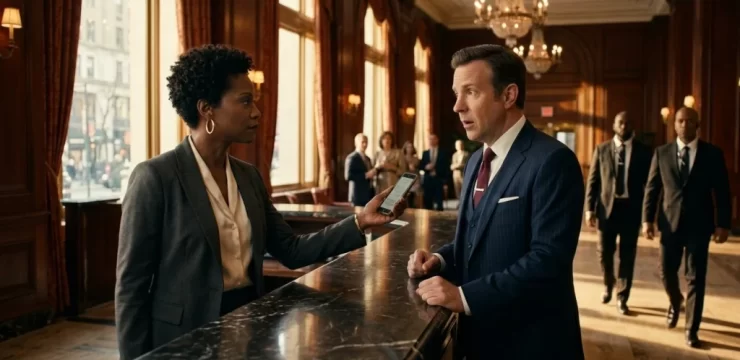
The office looked like the kind of place where important decisions were made before most people had finished their morning coffee. Sunlight poured through the floor-to-ceiling windows, spreading across polished floors, glass walls, and a sleek white reception desk that sat near the entrance like a quiet symbol of order and success. Beyond it, the executive office opened toward a panoramic view of the city. Everything about the space felt modern, expensive, and carefully controlled. It was confident.

That confidence, however, did not seem to impress the man who stepped through the doors.
He was in his thirties, dressed in a sharp navy blue suit, and a watch that he clearly expected people to notice. His hair was neatly cut, his shoes were polished, and his expression carried the impatient pride of someone who believed the room should adjust itself around him. He did not pause to look around with respect. He did not take a moment to understand where he was or whom he might be speaking to. He walked straight toward the white desk as if arriving automatically placed him above everyone else.
Behind the desk sat a young woman in a vibrant green blazer. Her long, highlighted brown hair framed a calm, professional face, and a gold chain necklace added a simple touch of elegance. She did not look rushed. She did not look intimidated. She had the quiet composure of someone who knew exactly where she belonged. When the man approached, she looked up with a polite smile, ready to receive him with the kind of courtesy that serious business demands.
But courtesy was not what he came prepared to offer.
“I would like to meet the owner of the company and do business with him,” he said, his tone already heavy with assumption. “Of course, if he’s interested.”
The words were not openly shouted, yet they carried a clear message. In his mind, the owner had to be a man. The woman at the desk was simply someone standing between him and the person he considered important. He did not ask who she was. He did not introduce himself with respect. He spoke as if access was owed to him.
The woman’s smile remained steady. A less composed person might have corrected him immediately, or matched his arrogance with irritation. She did neither. She simply answered with grace.
“I would be happy to welcome you,” she said.
For a brief second, it seemed as though the situation might continue politely. She had given him an opening to behave like a professional. She had offered him dignity, even though he had not offered much in return. But instead of listening, the man leaned over the desk, invading the space between them with a dismissive confidence that revealed far more about his character than his suit ever could.
“Go and bring me a coffee,” he snapped. “I don’t talk to secretaries. Do you know who I am?”
The office seemed to grow quieter around those words. They were not just rude. They were careless, revealing the dangerous habit of judging people by position, age, gender, or assumption. In a place built on leadership and responsibility, he had mistaken politeness for weakness. He had mistaken professionalism for subordination. Most of all, he had mistaken a woman’s calm presence for permission to disrespect her.
She did not flinch.
That was the most powerful part. She did not raise her voice. She did not scramble to defend herself. She did not need to perform authority, because real authority rarely needs to announce itself loudly. Instead, she rose from her desk with measured confidence, the movement simple but unmistakable. The man’s expression shifted only slightly at first, as if he were confused by her calmness. He expected embarrassment. He expected obedience. He expected her to disappear and return with coffee.
Instead, she stood.
As she turned, the view behind her became impossible to ignore. This was not a small reception area separated from power. This was the executive space itself, elegant and open, with the city stretching behind it like a reminder of what leadership can build. On the desk, a nameplate came into view. It did not need a long explanation. It did not need a speech. One word said everything.
CEO.
The man’s confidence started to crack.
The woman faced him with the same controlled expression she had worn from the beginning. She had given him a chance to show respect. She had allowed him to reveal himself. Now the conversation belonged to her.
“No,” she said firmly, “but I am the owner of this company, and I’m not interested in your business.”
There was no insult. There was no dramatic revenge. That was what made it stronger. She did not lower herself to his behavior. She simply told the truth, and the truth was enough to close the door he had kicked open with arrogance. In one sentence, she corrected every assumption he had made. The secretary he dismissed was not a secretary. The woman he talked down to was not beneath him. The person he came to impress was the very person he had disrespected.
For the arrogant client, the moment was more expensive than any failed meeting on his calendar. A business opportunity had been lost before it even began, not because his proposal was weak, but because his character was. He had walked into a high-end office believing status came from a suit, a watch, and a demanding voice. He left learning that real status often belongs to the person who stays calm when others reveal who they are.
For the woman, the moment confirmed something many professionals already understand. Respect is not a bonus in business. It is the foundation. A person who cannot treat the first face they meet with decency cannot be trusted to build a healthy partnership behind closed doors. How someone speaks to an assistant, receptionist, intern, clerk, driver, or any person they assume has less power often says more than how they speak to executives. Manners are not small. They are evidence.
That is why this scene feels so satisfying. It is not only about a man being embarrassed. It is about a simple truth that never gets old: never underestimate the person in front of you. The quietest person in the room may be the decision-maker. The youngest professional may be the founder. The person offering kindness may be the one with the authority to say yes or no. And when someone chooses arrogance over respect, they may not just hurt someone’s feelings. They may destroy an opportunity they never deserved.
In the end, the woman did not need to prove her worth to him. His approval was never the prize. Her calm response showed a level of leadership that no title alone can create. She protected her company, her standards, and her dignity in a single sentence. The city view behind her, the polished office, and the CEO nameplate only confirmed what her behavior had already shown.
She was not waiting to be taken seriously. She already was serious. And by the time the arrogant client realized it, the deal was already gone.