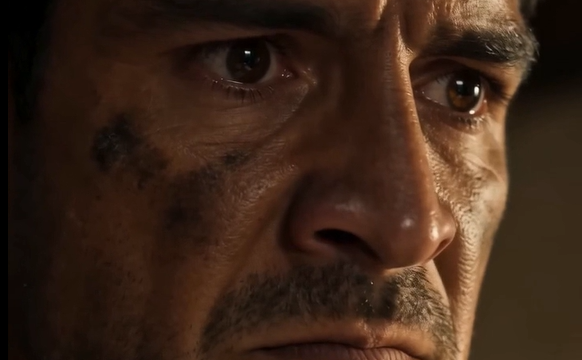
William Harrison was halfway through his second glass of Barolo when the disturbance near the entrance broke his concentration. At first, he did not look up. He disliked disorder and wasted time. In Le Bernardin, interruptions were rare, and when they happened, someone usually solved them before they reached the important tables. Then a young voice cut through the room. “Sir… you have a watch just like my dad’s.”
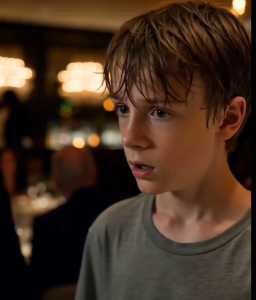
William lifted his eyes, annoyed. Near the entrance, a security guard held a teenage boy by the arm. The boy was barefoot, his shirt torn at the collar, his hair damp with sweat. He looked exhausted, as if he had been running on fear alone. Still, his gaze did not move from William’s left wrist.
William frowned. “Excuse me?”
The boy pulled against the guard. “Your watch,” he said. “It’s the same one. The gold. The face. My dad had one exactly like it.”
Charles leaned close. “William, ignore him. We have the contract to finish.”
Thomas barely glanced up. “Security will handle it.”
William looked down at his gold Rolex, then back at the boy. “Lots of people have gold watches, kid,” William said, controlled but not unkind.
The boy shook his head. “Not with that engraving.”
William’s fork stopped moving. “What engraving?”
The boy swallowed hard. Fear remained on his face, but something deeper rose behind it: grief, memory, recognition.
“W.H. on the back,” he said. “‘William Harrison for Daniel.’ My dad showed it to me a hundred times.”
The piano seemed to fade. The restaurant became distant and thin. William set his fork down carefully. Charles stared at him. “William?”
But William was no longer thinking about contracts. He was remembering a sunlit kitchen, a laughing boy, and a watch too large for an eighteen-year-old wrist. He had given Daniel that Rolex on his birthday, hoping it would say what he rarely said aloud: You are mine. You belong. I am proud of you.
“What was your father’s name?” William asked.
His voice sounded strange, stripped of authority.
“Daniel,” the boy said. “Daniel Harrison.”
William stared. The name struck him so sharply that for a moment he could not breathe. He looked at the watch, then at the boy’s face, and then he looked harder. The crooked nose. The sharp jaw. The faint scar above the left eyebrow.
Daniel had gotten that scar at seven, after flying off a bicycle and trying not to cry because he wanted his father to think he was brave.
William’s chest tightened. “Where is Daniel now?”
The boy’s chin trembled, but he held himself still. “He died three months ago.”
No one at the table spoke.
William pushed his chair back slowly. “What is your name?”
“Eli,” the boy said. “Eli Harrison.”
The guard tightened his hand on Eli’s arm. “Sir, I’m sorry. He came in through the service entrance. We were about to escort him outside.”
William’s eyes turned cold. “Let him go.”
The guard released him. Eli rubbed his arm, but his eyes stayed on the watch, as though it was the last piece of his father left in the world.
William stood. “How did you know to come here?”
Eli reached into his torn shirt and pulled out a folded paper. “My dad had this with his things. It was an old letter. He never mailed it.”
William took it carefully. The handwriting nearly knocked the breath from him. Daniel’s handwriting. Slanted, impatient, painfully familiar.
Dad, if you ever want to know the truth, I have a son. His name is Eli. I wanted to tell you, but I was afraid you would look at him the way you looked at me when I walked away from the company.
William closed his eyes.
The past returned without mercy. Daniel had refused the family business. He wanted to teach music, live simply, and marry a woman William believed did not fit their world. The argument had been ugly and final. William had told his only son that if he left, he should not come back expecting help. Daniel left. William, too proud to apologize, let silence grow into years.
When he opened his eyes, Eli watched him with the guarded hope of a child who had learned not to expect much from adults.
“Did he ever talk about me?” William asked.
Eli nodded. “All the time.”
William almost smiled, but it broke before it formed.
“He said you were stubborn,” Eli continued. “He said you could scare a boardroom quiet without raising your voice. He said you loved old jazz records and hated cheap coffee. And he said…” The boy looked down. “He said you were not a bad man. Just a lonely one who forgot how to say sorry.”
The words carried more weight than any accusation.
Around them, the room had gone quiet. The Midtown contract lay forgotten beside William’s plate.
William turned the Rolex over and saw the engraving. W.H. for Daniel.
“Eli,” William said, voice rough, “where have you been staying?”
The boy hesitated. “Different places. A church sometimes. A shelter when there’s room.”
Charles cleared his throat. “William, this is unfortunate, but you cannot simply accept every claim from a stranger. There should be verification. Lawyers. Documents.”
William turned toward him. “There will be documents. There will be lawyers. But he is not a stranger.”
Thomas blinked. “William, the contract—”
“The contract can wait.”
For decades, William had believed waiting was harmless. He waited to call Daniel. Waited for his son to apologize first. Waited for pride to soften on its own. Waiting had cost him a son. He would not let it cost him a grandson.
William removed the Rolex from his wrist. Eli looked startled as the old man held it out.
“This was your father’s,” William said. “I gave it to him because I wanted him to remember where he came from. I was wrong to think a watch could say what I was too proud to say.”
Eli did not take it at first. “I didn’t come to steal anything.”
“I know,” William said. “That is why I want you to have it.”
The boy accepted the watch with a shaking hand. It looked heavy in his palm, not because of gold, but because of everything it carried.
“Come sit with me,” William said.
Eli glanced at the tables, embarrassed. “I’m not dressed for this place.”
William answered softly. “Neither was my heart.”
No one laughed. Some guests looked away. Others wiped their eyes. The boy followed William to the table, and Charles quietly gathered the contract papers, aware that profit had no place in that moment.
William asked the waiter to bring food, shoes, and privacy. Then he sat beside Eli, not across from him. For the first time in years, he did not care who was watching. He cared only about Daniel’s eyes in the boy’s face, and the second chance he did not deserve but had been given anyway.
That night, the gold watch changed hands, but something greater returned to William Harrison. Not his son. That loss would remain. But a door he thought had closed forever opened just wide enough for grace to enter. And for an old man who had spent a lifetime winning rooms, it was the first time he understood what it meant to come home.