He had not planned to stay long that afternoon. The cemetery was growing colder, and the pale winter light was slipping behind the trees at the far edge of the grounds.
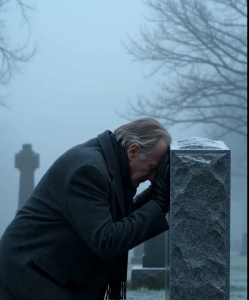
Mist drifted low over the grass, softening the rows of headstones until they looked less like stone and more like memories rising from the earth. The elderly man moved slowly along the narrow path, his dark coat buttoned high against the wind, his black gloves folded around a small bundle of flowers from the same shop he visited every year. Now quiet followed him everywhere
He stopped at a grave near the older section, where the stones had weathered and the letters were losing their sharpness. He lowered himself with effort, one knee sinking into the damp grass, and placed the flowers at the base of the marker. Then his hands moved to the cold stone. He pressed his gloved palms against it, bowed his head, and rested his forehead there as if the marker could somehow answer him. “I came back,” he whispered, though no one was there to hear him. Then he heard something. At first, he thought it was only the wind shifting through the grass. But the sound came again, softer this time, a small movement behind him, too human to ignore. The old man lifted his head slowly and turned. A few graves away, against the side of another headstone, sat a young boy. He could not have been more than eight or nine. Blonde hair stuck out from beneath the hood of his green sweatshirt. His jeans were dirty at the knees, and a dark smudge marked one side of his face. He was curled up on the ground with his arms around himself, leaning his head against the stone behind him. The old man rose unsteadily, his knees aching, and took one careful step toward him. The boy looked cold, too cold to be sitting alone in a cemetery as evening came on. There was no adult nearby, no flowers in his hands, no sign that anyone had brought him there. Only the green hoodie, the dirty jeans, the pale face, and those wide eyes watching the old man through the mist. The boy blinked first. “Are you okay, mister?” he asked. He had come carrying a sorrow too heavy for words, and this child, sitting alone among the graves, was worried about him. He looked at the boy’s smudged cheek, at the way he hugged himself against the cold, and something inside him loosened. He wanted to answer, to say he was fine, that old men sometimes cried in cemeteries and then went home. But the lie would not form. His eyes burned. A tear slipped free and rolled down the lines of his face. He turned slightly, embarrassed, yet the boy kept watching him without judgment. “I was just visiting someone,” the old man said at last, his voice rough. The boy nodded as if he understood more than a child should. “Me too,” he said quietly. The old man looked around again. “Who are you here with?” The boy did not answer immediately. His fingers picked at the sleeve of his sweatshirt. He glanced toward the rows of stones, then back at the old man. “I don’t know,” he said. A deeper chill moved through the man than the weather could explain. He stepped closer but kept enough distance not to frighten him. “What do you mean, son?” The boy’s lower lip trembled. “I woke up near the road. I walked here because I saw the gate. I thought maybe somebody would know where I was.” He swallowed hard. “I’m not supposed to be alone.” “No,” the old man said softly. “You are not.” The child stared at him. There was confusion in his eyes, but also hope, fragile and frightened. Then he asked the question that seemed to stop the whole cemetery around them. “Do you know my parents?” The old man’s breath caught. The words echoed through him with impossible force. He looked down at the boy, and for one blinding instant, memory and reality seemed to cross. The blonde hair. The small face. The vulnerable voice asking for help. His heart beat painfully against his ribs. He did not know why the question struck him so deeply. Perhaps because every grieving person secretly listens for one impossible call from the past. Perhaps because he had once searched for answers with the same desperation now sitting in this child’s eyes. Or perhaps because, in that moment, the boy seemed less like a stranger and more like a door opening onto everything the old man had lost. A tear gathered at the corner of his eye. The world narrowed to the child, the headstone, and the fading gold of sunset behind the trees. The boy waited. “Do you?” he asked again, almost in a whisper. The old man lowered himself slowly until he was at the child’s level. He did not reach for him yet. He only met his eyes, steadying himself against the rush of emotion. He did not know where the boy had come from, why he was alone, or what trouble had brought him to this lonely place. But he knew one thing with a certainty stronger than fear. No child should have to ask that question in a cemetery and receive silence. “Yes,” the old man said. The boy’s eyes widened. The old man took a careful breath. “I may not know everything yet,” he continued, his voice breaking, “but I know enough to help you find them. And until we do, you are not going to be alone.” The boy stared at him, as if trying to decide whether hope was safe. Then, slowly, he nodded. The old man removed one glove and offered his bare hand. It shook slightly in the cold. The boy looked at it, then placed his small fingers in the old man’s palm. His hand was icy. The contact nearly broke the man’s heart all over again. Together, they stood among the stones as the mist deepened and the last light faded. The old man looked once more toward the grave he had come to visit. He had arrived carrying only grief, believing the day belonged to the dead. But as the boy leaned closer beside him, trembling and alive, he understood something he had almost forgotten. Love was not finished just because loss had visited. Sometimes it returned in the form of a voice in the cold, a child asking a question, a hand reaching back. The old man squeezed the boy’s fingers gently and led him toward the cemetery gate. Behind them, the headstones stood silent in the gray light. Ahead of them, a road waited, along with answers, help, and whatever truth the evening would bring. He did not know whether the story would end in reunion, rescue, or another kind of healing. But he knew this much: the boy had found him at the exact moment his own heart had nearly given up. And for the first time in a long while, the old man did not walk out of the cemetery alone.