For nine months, my baby boy knew me without ever truly seeing me. He knew my voice before he knew the shape of my smile. He knew the scent of my skin, the rhythm of my breathing, and the warmth of my chest when I held him through sleepless nights. Every morning, before I opened the curtains, I leaned over his crib and whispered his name. Noah. His tiny hands would move, and sometimes he turned toward me as if searching for the woman who loved him more than life itself.
But he had never seen my face clearly. Not once.
When Noah was born, I thought motherhood would test me in the ordinary ways people talk about. I expected exhaustion, diapers, late-night feedings, and the anxious guessing game of learning what each cry meant. I was prepared to be tired. I was not prepared to watch my son reach for a world his eyes could not find.
At first, everyone tried to comfort me. They told me babies developed at their own pace. They said I was nervous because I was a new mother. Some smiled gently and told me not to worry before there was something to worry about. I wanted to believe them. I wanted to be calm and patient. But mothers notice what other people explain away. I saw how Noah’s eyes drifted past me when I smiled above his crib. I noticed when I moved a bright toy from side to side and he did not follow it. I felt my heart tighten when he cried until I spoke, because my voice reached him long before my face ever could.
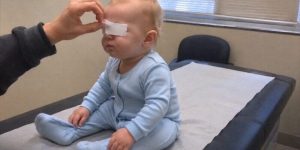
When he was three months old, the doctor confirmed what my heart already feared. Noah had a serious eye condition. It was treatable, he said, but only if we moved quickly. There would be specialists, treatments, surgery, patches, appointments, tests, and follow-ups. There would also be bills, more than I knew how to face.
I remember standing in a hospital bathroom with Noah asleep against my shoulder, his little body warm and trusting. I stared at my reflection, trying not to make a sound while tears ran down my face. I was not crying because I was afraid of work. I was not crying because I hated bills, though I was already drowning in them. I was crying because I was terrified my child might grow up without ever knowing what his mother looked like.
Then his father left.
Noah was not even six months old when the man who had promised to stand beside me said he could not handle it anymore. He said hospitals and bills were too much, and he was not made for this life. I listened quietly, not because his words did not hurt, but because Noah was sleeping in the next room and I did not want anger to fill our home. After he walked out, I stood beside the crib and watched my son breathe. This was not “this kind of life,” I thought. This was my child. And real love does not leave when life becomes heavy.
So I stayed.
I worked mornings at a bakery, while my back ached from standing. At night, I cleaned offices after everyone else had gone home, pushing a vacuum through silent hallways. On weekends, I washed dishes until my hands stung. I sold my wedding ring. I skipped meals and told myself I was not hungry. Some nights, I came home so drained that I had to sit on the bathroom floor before I could step into the shower.
But every night, no matter how late it was, I went to Noah’s crib before I went to my own bed. I touched his tiny hand. Sometimes his fingers curled around mine. I would bend close and whisper, “One day, you’re going to see me, sweetheart.”
Sometimes I said it for him. Sometimes I said it for myself.
Because every parent who has ever fought for a child understands. When your child needs saving, you do not stop to measure your strength. You do not ask whether you have enough left. You become what they need. You become stronger than fear, quieter than pain, and bigger than the loneliness waiting after midnight. I was not rich. I was not fearless. I was not brave in every moment. But I was Noah’s mother, and that meant I would give up anything if it bought my baby one more chance to see the world.
When Noah turned nine months old, the doctor finally said the words I had prayed to hear.
“We’re ready to remove the patch.”
That night, I did not sleep. I sat beside Noah’s crib until sunrise, my hand resting through the bars while his fingers wrapped around mine. In the dim quiet before morning, I thought about everything he had never seen clearly. My smile when he woke up. My tears when I was frightened. The way I looked at him like he was the only reason I was still standing. I wondered whether he would know me when sight finally joined sound.
The next morning, the nurse placed Noah in my lap. The room felt too quiet, as if even the walls were holding their breath. The doctor stood before us and reached toward the patch. My arms tightened around my son. His cheek rested against me, soft and trusting.
“Ready?” the doctor asked.
I was not ready. No mother could be ready for that much hope and fear. But I nodded.
Slowly, the patch came off.
Noah blinked once. Then twice. His little eyes moved around the room, confused by light and shadow. The doctor lifted a small blue toy, hoping to catch his attention. Noah looked past it.
My heart dropped. For one terrible second, I thought every sacrifice had not been enough. I thought of the bakery mornings, the office floors, the dishes, the ring I had sold, the meals I had skipped, and the nights I had whispered promises into the dark.
Then I leaned closer.
My voice broke as I whispered, “Noah.”
His eyes stopped moving.
Slowly, very slowly, he turned toward the sound he had trusted since the day he was born. Toward me.
For the first time in his little life, my son looked directly into my eyes. His face went still. His lips parted. Tears gathered in his small eyes, shining beneath the hospital lights. And then, as if he finally understood that the voice that had loved him all along had a face, Noah smiled.
He lifted both tiny arms toward me.
I pulled him close, trembling so hard I could barely hold him. His fingers reached up and touched my cheek, softly, carefully, as if he were learning me by sight and touch at the same time. Then he patted my face with his little hand, pressed his palm against my tears, and gave the smallest laugh. In that moment, every lonely night finally had a clear purpose.
The doctor turned away and wiped his eyes.
And I held my son, knowing he had not just seen my face for the first time. He had seen love.