Inside the stone walls of San Gabriel Monastery, silence was supposed to mean peace. The sisters rose before sunrise, prayed in the cold chapel, tended the garden, baked bread for the village poor, and locked the great wooden doors every night before the last bell. No man was permitted beyond the outer office. The windows were narrow and barred. The corridors were watched by older nuns who had lived there for decades. Nothing entered that place unnoticed.
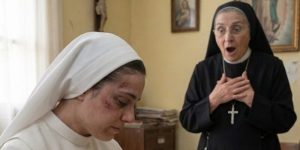
That was why Sister Esperanza’s first pregnancy had shaken everyone.
At first, Mother Caridad tried to protect her. She told the frightened sisters not to whisper, not to judge, and not to turn a confused young woman into a scandal. Esperanza insisted she had never broken her vows. She had no memory of anyone entering her room. She wept through the questions, not with shame, but with helpless bewilderment. Doctor Paloma, the physician who had served the monastery for years, examined her privately and said only that the child was healthy and the situation should be handled quietly.
When the baby was born, Mother Caridad called it a sorrowful mystery and prayed that life would return to normal.
But the next year, it happened again.
Esperanza came to the office with a pale face, one hand resting on her stomach, the other holding her first child. Her voice was barely a breath when she said she was feeling the same sickness, the same weakness, the same dizzy spells. Mother Caridad remembered staring at her for a long time, unable to speak. The monastery had been locked every night. The sisters slept in separate rooms. No visitor had been admitted after sunset. No key was missing. No door had been forced. Again, Doctor Paloma came. Again, she offered calm explanations that explained nothing. Again, she urged privacy.
Now, in the third year, Esperanza stood in front of Mother Caridad once more.
“Mother,” she whispered, “I think I am pregnant again.”
A tiny baby slept against her shoulder, only a few months old. Beside her, a little boy clung to the edge of her white robe, unsteady on his feet and watching the room with wide, innocent eyes.
The book in Mother Caridad’s hands slipped from her fingers and struck the floor.
“Again?” she said. “Esperanza, that cannot be.”
Esperanza lowered her gaze. Her expression was strangely gentle, almost peaceful, and that frightened Mother Caridad more than panic would have.
“It feels the same as before,” Esperanza said. “Nausea. Weakness. The spinning in my head. I know the signs now.”
Mother Caridad felt the blood drain from her face. Three pregnancies in three years. Three impossible stories. Three sets of locked doors. She had wanted to believe in obedience, in miracles, in the protection of holy walls. But belief was beginning to feel like blindness.
“You must tell me the truth,” she said, her voice trembling despite her effort to control it. “Who comes to you at night?”
Esperanza looked up at her with wounded calm.
“No one, Mother. I am pure. You know that.”
The answer sounded honest. That was what made it unbearable.
Mother Caridad sent her to rest and reached for the telephone to call Doctor Paloma. The doctor had monitored the previous pregnancies. She knew more than anyone else. Yet as Mother Caridad crossed the office, something pale on the dark stone floor caught her eye.
She bent down slowly.
It was a small white strip.
Not cloth. Not paper.
Fresh medical tape.
Mother Caridad held it between her fingers, and a sharp, clean smell rose from it, the smell that lingered after Doctor Paloma’s visits. Her heart began to pound. Doctor Paloma had not been in the office that day, at least not officially. No one had announced her. No one had opened the front door.
Mother Caridad turned toward the corridor.
For the first time in all her years at San Gabriel, the silence did not feel sacred. It felt watched. It felt arranged. It felt like something hidden had been moving through the monastery while everyone prayed with their eyes closed.
Before she could dial the doctor, a newborn’s cry rang out from the nursery.
Mother Caridad hurried down the corridor, her veil brushing the walls, her breathing uneven. In the nursery, three cribs stood beneath a small statue of the Virgin. One child was crying hard, his tiny arm moving beneath a loose bandage. Mother Caridad approached, lifted the cloth, and froze.
There was a fresh injection mark on his arm.
A chill moved through her so sharply that she gripped the crib to keep herself standing. Babies in the nursery received no treatment without her permission. The monastery kept records for everything, even aspirin. No sister had called for medicine. No illness had been reported. Yet someone had touched this child in secret.
At that moment, the truth split open inside her.
Esperanza’s pregnancies were not miracles.
They were not proof of sin.
They were the result of something being done to her, quietly, repeatedly, under the cover of trust.
Mother Caridad locked the nursery door and gathered every medical record she could find. In Doctor Paloma’s neat handwriting, she saw strange gaps: visits listed at odd hours, injections described only as “routine support,” sedatives noted without explanation, and signatures that looked almost like Esperanza’s but not quite. The more she read, the colder she became. The doctor had been treating Esperanza late at night, when the youngest sisters slept and the elders were at prayer. She had used the monastery’s fear of scandal as a shield.
Mother Caridad remembered every time Paloma had urged silence. Every time she had said outsiders would misunderstand. Every time she had promised that the Church, the village, and the children would be safer if no questions were asked.
Now those words sounded less like concern and more like a lock turning.
That evening, Mother Caridad did not call Doctor Paloma. She called the regional inspector and a lawyer who had once helped the monastery with property records. She ordered the sisters to stay together in the chapel and keep the children in sight. When Doctor Paloma arrived after dark through the small rear gate, carrying her black medical bag, Mother Caridad was waiting.
The doctor stopped when she saw the tape in the Mother’s hand.
“You should not have searched,” Paloma said softly.
Mother Caridad felt no triumph, only grief.
“You should not have betrayed us.”
Paloma’s calm mask changed then. Mother Caridad saw fear. Not fear of God. Fear of being exposed.
The investigation that followed uncovered hidden records, unauthorized procedures, and forged consent forms. Esperanza had not understood what had been done to her. She had trusted a doctor, a woman everyone believed was protecting her. The children were innocent. Esperanza was innocent. The monastery had been guarding the wrong entrance.
Mother Caridad never forgot the detail that revealed the secret: not a confession, not a witness, not a broken door, but a tiny mark beneath a child’s bandage.
Sometimes evil does not arrive loudly. Sometimes it wears a familiar face, speaks in a soothing voice, and asks everyone to remain quiet for their own good.