The first thing everyone heard was not Wren crying. It was the scissors.
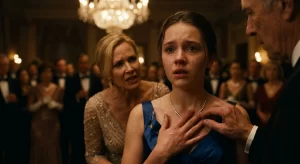
One clean snip sliced through the warm ballroom air, and the blue satin strap of Wren’s dress fell loose beneath Vivian Sterling’s gold scissors. Wren gasped and clutched the front of her gown as the guests drew closer, pretending shock while watching everything.
Vivian’s beaded beige gown glittered beneath the chandelier as she leaned close and spoke to humiliate.
“Girls like you don’t belong in dresses like this.”
Wren’s face burned. Tears blurred the room as she held the torn fabric to her chest. No one helped. They only whispered, stared, and made the circle feel smaller.
“Please,” Wren whispered. “I didn’t do anything.”
“You showed up,” Vivian replied. “That was enough.”
Then the ballroom doors slammed open.
Warrick Sterling entered quickly, carrying a silver tray. His tuxedo was crisp, but his eyes fixed on the frightened girl. He stopped before Wren, lifted a diamond necklace from the tray, and placed it gently around her neck.
“Please don’t cry, my dear,” he said. “It’s yours.”
The room froze.
“Warrick, what is this?”
The necklace rested against the torn blue satin, and a tiny engraved crest flashed behind the stones. Warrick’s hand began to tremble.
“Wait,” he whispered. “This mark.”
Vivian stepped forward. “Take it off her. Now.”
Warrick did not move. “This crest was made for one child. My daughter Grace’s child.”
Wren looked up through tears. “I don’t understand.”
He opened a hidden clasp. Inside was a miniature portrait of a young woman holding a baby wrapped in blue satin.
“That is your mother,” Warrick said quietly.
Vivian went pale. “Don’t do this here.”
Warrick turned toward her, grief and anger rising together. “You told me the baby died.”
The ballroom fell silent.
“She was supposed to disappear,” Vivian said, then stopped, realizing what she had admitted.
Warrick took Wren’s hand and faced the guests.
“Then everyone here has witnessed the return of my granddaughter.”
No one applauded. Two hundred phones glowed under the chandelier.
By midnight, the video was everywhere: the scissors, the necklace, Vivian’s words. By sunrise, “The Ballroom Confession” was on morning shows. Reporters, business partners, and long-silent relatives called.
Warrick refused a statement. “There is no misunderstanding,” he told Preston and Delia. “There is a sixteen-year lie.”
In a side room, Vivian denied everything. “A necklace is not a birth certificate.”
“I had that crest made myself,” Warrick said. “There is only one.”
“Coincidences happen.”
“Grace disappeared after telling me she was pregnant. You said the baby did not survive. You let me believe my granddaughter was dead for sixteen years.”
Vivian snapped, “I protected this family. Grace’s pregnancy would have cost us control of the trust. I fixed it.”
Warrick stared at her. “You call that fixing it?”
The next morning, Warrick went to Wren’s apartment, a worn building with a broken stairwell light. Her guardian, Marisol Vega, stood behind Wren silent. When Wren showed her the necklace the night before, Marisol had recognized it and begged her to take it off. Sixteen years of evasions suddenly looked larger.
“I am asking for one DNA test,” Warrick said through the cracked door. “If I am wrong, I will leave forever. If I am right, I have spent sixteen years mourning a girl who lived four miles away, and I would like to know her.”
Marisol would not let Wren go alone. Warrick agreed.
At the Sterling estate, Preston greeted them coldly. “You are letting a stranger near a four-hundred-million-dollar trust because of a necklace and a feeling?”
“This is your niece,” Warrick said.
Delia studied Wren more carefully. “If this is real, Mom ran the trust on a lie.”
“We will know soon,” Warrick said. “DNA has no agenda.”
That evening, Delia found Wren outside. “You did not embarrass yourself,” she said. “My mother did. She cut a child’s dress in front of a room because she was scared of what you represented.”
For the first time all day, Wren almost smiled.
The test was arranged at an independent lab Vivian chose herself. She also attacked Marisol’s lack of paperwork. “Why has Wren’s aunt been hiding without a legal trail?”
Marisol met her eyes. “Ask yourself that. You know the answer.”
Later, Warrick learned the truth from Marisol. Sixteen years earlier, Grace had given birth two hours away. Vivian told Warrick the baby died. She told Grace that if she did not disappear and let Wren be raised under another name, the Sterling lawyers would take the child through the courts. Young, poor, unmarried, and terrified, Grace believed her.
Marisol was not Wren’s aunt. She was Grace Sterling, Wren’s mother, living under a different name to keep her daughter safe.
Before the results came, someone tried to tamper with Wren’s sample at the lab using the exact case number. Then a car clipped Wren’s cab after she left the lab. That night, a disguised voice called the estate and warned Warrick to drop the test.
Someone was scared.
Warrick’s investigator soon found old hospital discharge records signed by Vivian, along with an estate security tape. On it, a younger Vivian stood over a crying Grace and said, “You disappear, or I make sure you lose her in front of a judge instead. Your choice.”
Warrick called an emergency board meeting.
Vivian arrived with lawyers and tried to question Warrick’s competence. But the records, the attempted lab tampering, and the tape changed the room. Her final defense was a statement from a retired nurse claiming Grace had chosen the private placement freely. When the investigator called the nurse on speaker, the truth cracked open: Vivian had brought the statement already typed, along with a check and a quiet threat about the woman’s pension.
Then the tape played. Vivian’s own voice filled the boardroom.
The DNA envelope still sat unopened. Warrick tore it open and read the result.
99.99% probability of a grandparent-grandchild relationship.
“She is a Sterling,” he said. “She always was.”
Preston looked at his mother as if she had become a stranger. Delia said what everyone understood: Vivian had not protected the family. She had protected her own power as trustee successor.
Police entered with charges tied to falsified medical records, witness intimidation, obstruction, fraud, and misdirected trust money. Vivian backed toward the window, calling it a family disagreement.
“Sixteen years of fraud,” an officer said.
The cuffs clicked in the boardroom.
One month later, Wren returned to the ballroom in a deep green dress chosen with her mother. The necklace rested openly at her throat, crest facing out, nothing hidden anymore. Grace began the legal process to restore her true name, though Wren knew Marisol mattered too. That name had raised her.
Vivian was later sentenced to six years, ordered to pay restitution, and permanently removed from any Sterling fiduciary role. Grace told Wren over dinner that she felt lighter.
At the next family gathering, Grace stood with her daughter beneath the chandelier, sixteen years of silence finally gone.
“No more disappearing,” Grace said.
“No more,” Wren answered.
The crest caught the light again. This time, people looked not with pity, but because it was finally beautiful.