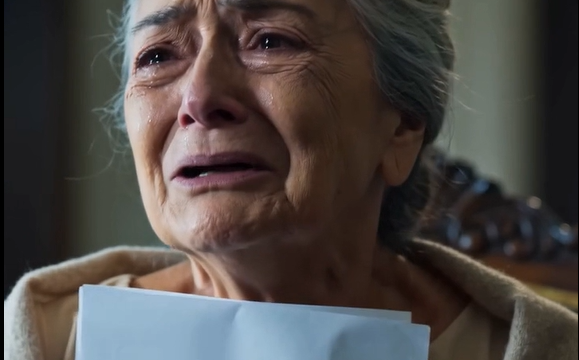
Margaret Collins spent forty years turning a weathered country house into the kind of mansion people slowed down to admire. It had white columns, a rose garden, and portraits lining the staircase. To her husband, Daniel, it was more than property. It was where he had carried his baby daughter through the front door, where Christmas dinners had filled every room with laughter, and where Margaret had whispered, near the end of her illness, “Promise me this home will always hold kindness.” Daniel kept that promise long after she was gone.

Their only child, Vanessa, grew up with every comfort but little patience. At fifty-two, she believed the world owed her a softer landing than it had given her. Her marriage had failed, her business ventures had collapsed, and her habits had drained every account. Still, she arrived at the mansion with a polished smile, speaking to her father as if he were an obstacle instead of the man who had loved her.
At first, she asked for help. Daniel helped. Then she asked again. He helped again. But when she demanded the deed to the mansion, he finally said no.
“This house is not just mine,” he told her from his chair beside the window. “It belongs to your mother’s memory, too.”
Vanessa’s face hardened. “Memories don’t pay bills, Dad.”
Over the next few weeks, she worked on him with cold determination. She complained about medical costs, taxes, repairs, and how unfair it was that he lived alone in “all that space” while she struggled. She told relatives he was becoming forgetful. She told neighbors she was only trying to protect him. Then she brought in an attorney and placed papers in front of him at the dining room table.
Daniel’s hands trembled as he picked up the pen.
Vanessa leaned close. “Just sign, Dad. This is best for everyone.”
The old man looked at Margaret’s portrait above the fireplace. For a moment, his eyes filled. Then, exhausted and heartbroken, he signed.
Vanessa exhaled like a woman who had just won a war. Within days, she moved into the master suite, began calling contractors, and discussed selling the estate to a developer. Daniel was moved into a small guest room at the back of the house. His old bedroom was repainted before he had even packed the framed photo of Margaret from the nightstand.
To everyone else, Vanessa acted generous. She said she had taken control for her father’s safety. But inside the mansion, Daniel ate alone, spoke little, and stared out at the garden his wife had planted.
One Tuesday morning, Vanessa drove him to a clinic for what she called a routine evaluation. She wanted a doctor’s letter confirming that Daniel could no longer manage his own affairs. With that, she could silence any relative who questioned the transfer and move forward without interference.
Daniel sat quietly in the passenger seat, holding a worn envelope on his lap.
“What is that?” Vanessa asked.
“Just something your mother left,” he said.
She rolled her eyes. “Dad, please. Not today.”
At the clinic, a kind nurse named Ruth recognized Daniel immediately. Years earlier, Margaret had volunteered there during cancer treatments, bringing homemade soup to patients who had no visitors. Ruth greeted Daniel warmly, but her smile faded when she saw how Vanessa answered every question for him.
The doctor, Dr. Harris, invited Daniel into the exam room alone. Vanessa objected.
“I handle his affairs,” she said.
“For this portion, I need to speak with him privately,” the doctor replied.
Behind the closed door, Daniel handed Dr. Harris the envelope. Inside was Margaret’s handwritten note and an older legal document Daniel had nearly forgotten. Years before her death, Margaret created a protected family trust. The mansion could not be sold, transferred, or used as collateral unless Daniel appeared before an independent physician and confirmed, of sound mind and free will, that the change honored the trust’s purpose. There was one more clause: if anyone pressured Daniel to surrender the property for personal gain, control of the mansion would pass to a charitable foundation Margaret had named, supporting elderly abandoned patients.
Dr. Harris listened as Daniel quietly explained everything. He was not confused. He knew what he had signed. He also knew why he had signed it.
“I wanted to see whether my daughter would stop herself,” he said, tears slipping down his cheeks. “I hoped love would matter before paper did.”
The examination was careful. Daniel answered every question clearly. He knew the date, the president, his medications, his finances, and the precise terms of Margaret’s trust. Dr. Harris documented that Daniel was mentally competent and that the deed transfer appeared to have been obtained under emotional pressure.
When Vanessa was called in, she sat with a victorious smile.
Dr. Harris placed the documents on the desk. “Mrs. Blake, your father is fully competent. And because this clinic visit triggered the trust review, the deed transfer you arranged is now invalid.”
Vanessa blinked. “That’s impossible.”
Daniel looked at his daughter with deep grief. “Your mother protected the house from greed, even mine if it ever came to that.”
The doctor continued, calm. “The trust’s enforcement clause has been activated. The estate is no longer yours to sell.”
Vanessa grabbed the papers, scanning them as color drained from her face. The mansion, the developer’s deal, the profit she had imagined—it vanished line by line.
“No,” she whispered. “You set me up.”
Daniel shook his head. “I gave you every chance to choose family.”
By sunset, the foundation’s attorneys contacted all parties. The developer withdrew. The mansion was placed under trust management, preserved as Margaret had intended. Vanessa was ordered to leave the master suite, return personal items taken from Daniel’s room, and provide records of every financial decision she had made since forcing the signature. Relatives she had misled learned the truth. Neighbors she had charmed stopped waving.
But the hardest moment came that evening in the hallway, when Daniel passed Margaret’s portrait and Vanessa stood beneath it tearful.
“For what it’s worth,” she said, her voice breaking, “I thought I was saving myself.”
Daniel answered, “At the cost of losing yourself.”
Vanessa left the mansion with two suitcases and no applause, no victory, and no claim to the home. She had won only the truth she could not escape. Daniel returned to the front bedroom, placed Margaret’s photo back on the nightstand, and opened the windows to the garden.
Months later, the mansion became a quiet retreat for older patients recovering from treatment, especially those alone. The rose garden was restored. The dining room filled again with warm meals and soft conversation. Daniel spent his mornings on the porch, greeting guests who arrived tired and frightened, then left feeling remembered.
As for Vanessa, the clinic visit became the day she lost the house but finally saw the truth. A mansion can be signed away with ink, but family can be lost before papers are filed. Her father had not destroyed her victory. Her own choices had. And the home she tried to steal became the place that taught everyone Margaret’s final lesson: kindness is the only inheritance worth protecting.