The rain had turned the cemetery into a field of gray puddles and sinking mud by the time the mourners gathered around the open grave. Black umbrellas leaned together, and every face beneath them seemed washed pale by grief. At the center rested a white casket, polished and impossibly still, surrounded by white roses bending under the storm. No one spoke above a whisper. Even the thunder seemed to roll softly, a father was about to say goodbye to his son.
Don Rafael stood closest to the casket, his black suit soaked through, his gray hair flattened by the rain. His hands trembled, and his eyes never left the glossy lid that separated him from the young man he had raised and loved. People kept telling him to be strong, but strength felt useless now. Strength could not turn back time. Strength could not explain why a healthy man had collapsed at a family gathering, leaving questions no doctor seemed willing to answer.
Beside the mourners stood Isabel, the blonde woman who knew Rafael’s son. She wore a fitted black dress and a veil clinging to her wet hair. She looked like another devastated guest. But her eyes kept moving. First to the casket. Then to the grave. Then to the road beyond the cemetery gate, as if she were waiting for something to end.
The priest lifted his prayer book. The workers shifted near the ropes. The casket was moments from being lowered.
Then a child’s voice tore through the rain.
“¡No lo entierren!”
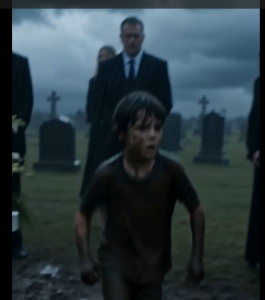
A young boy came running across the cemetery, splashing through puddles, stumbling over the muddy ground, refusing to slow down even when one rubber boot nearly stuck in the earth. His hair was wet, his cheeks were streaked with dirt, and his clothes were stained as if he had crawled through half the storm to reach them. He looked no older than ten, but there was nothing childish in his expression. He ran with the desperate certainty of someone carrying a truth too heavy for his small body.
“Do not bury him!” one mourner whispered, translating the boy’s cry.
The workers let go of the ropes. The priest lowered his book. Don Rafael turned slowly, his face twisted with pain and confusion. Mateo was the quiet child who lived near the old service road and sometimes helped the groundskeeper carry flowers. He was often invisible to adults who believed important things happened only in important rooms.
But that day, in that storm, he was the only person moving.
Mateo stopped in front of Don Rafael, breathing hard, rainwater running from his chin.
Don Rafael stepped forward, his voice breaking. “¿Qué dices? Mi hijo murió…”
What are you saying? My son died.
The words came out like a plea, not a question. Rafael wanted the interruption to be nonsense. He wanted the boy to be confused, frightened, mistaken. Anything would be easier than hope. Hope at a graveside was cruel. Hope beside a sealed casket was unbearable.
Mateo shook his head. His hands clenched, and his lips trembled, but his eyes stayed fixed on the grieving father.
“No,” the boy said in Spanish. “I saw what happened.”
A murmur passed through the crowd. Several mourners glanced at Isabel. She stood still, but the color drained from her face.
Mateo reached into the pocket of his muddy jacket.
When his hand came out, he was holding a small glass vial.
It caught the cemetery’s gray light like a shard of ice. Raindrops collected on its surface. Inside, a thin line of liquid moved as his hand shook. Mud stained his fingers, but he held the vial high, not like a child showing something he had found, but like a witness presenting evidence.
“I saw her,” he said. “Yo la vi… Ella puso esto. Solo lo durmió.”
He had seen her put it in. It only made him sleep.
The words rippled through the funeral like lightning. A woman gasped. Someone dropped an umbrella. The priest crossed himself. Don Rafael stared at the vial, then at the casket, and the grief in his face began to change. Terror mixed with a hope he was afraid to touch.
Isabel’s eyes flicked to the vial.
Then her gaze darted to the white casket.
That was when the cemetery changed. It was no longer a funeral. It was a scene filled with suspicion, fear, and the possibility that the man inside had not been lost at all. Rain hammered the flowers. Mud splashed against polished shoes. The mourners stepped back from Isabel as if guilt could spread through the air.
She tried to lift her chin. She tried to look offended. But her mouth opened without sound, and her careful stillness failed her. One hand pressed against her stomach. Her eyes moved again toward the grave.
Don Rafael’s voice came out low. “Isabel?”
She shook her head too fast. “No. That child is lying.”
But Mateo turned on her with a fury that made several adults flinch.
“¡Ella lo hizo!” he screamed, pointing at her. “¡Él está vivo! ¡Ábranlo!”
Before anyone could stop him, Mateo ran to the casket and slammed his muddy fist against the glossy white lid. The sound cracked through the storm. Once. Then again. A desperate thud that seemed to wake the dead and accuse the living.
“Open it!” he cried, now in English. “Please! Open it before it is too late!”
Don Rafael staggered toward the casket. His knees nearly gave way. Two men reached to steady him, but he pushed them off. He was no longer a grieving father waiting for a burial. He was a father hearing the impossible: his son might still be breathing beneath that shining lid.
The cemetery workers looked at one another, uncertain. The priest whispered for someone to call the authorities. A younger mourner pulled out a phone with shaking hands. Another stepped between Isabel and the path, making sure she could not quietly leave.
Isabel’s face collapsed into panic.
Rafael placed both hands on the casket. Rain streamed over his knuckles. His voice, when it came, was raw enough to silence everyone.
“Open it.”
No one moved for half a second. Then the workers rushed forward. The metal latches were wet and slick. One man fumbled. Mateo stood beside Rafael, still holding the vial, his whole body shaking from cold and fear, but he did not step back.
The mourners crowded closer, then stopped, afraid of what they might see. The storm seemed to hold its breath. Even the music from the small speaker near the flowers cut out suddenly, leaving only rain, thunder, and the terrified breathing of everyone gathered around the grave.
Isabel whispered, “You do not understand.”
Rafael did not look at her. He looked only at the casket.
The final latch snapped open.
And in that instant, before anyone lifted the lid, every person in the cemetery understood the same terrible truth: if Mateo was right, they had nearly buried a living man. And if he was right, then the woman standing among them in black had not come to mourn at all. She had come to make sure the silence became permanent.