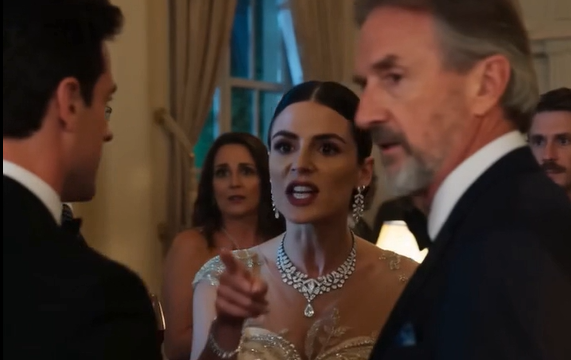
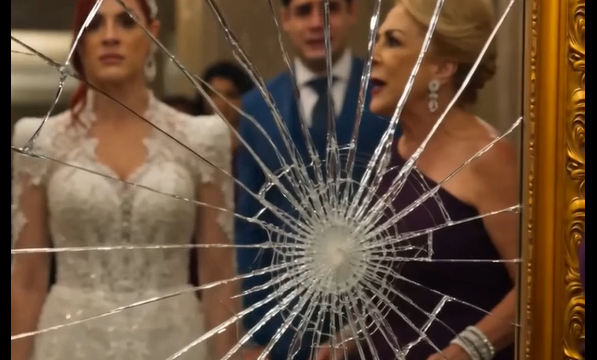
The wedding hall looked like something built for royalty. Crystal chandeliers scattered warm light across the polished floor. Guests in dark suits, satin dresses, and pearls filled every chair. At the front, beneath an arch of roses, the groom stood in a white tuxedo, bearded and proud. Beside him, the bride wore a white lace gown, a veil, and a trembling tiara.
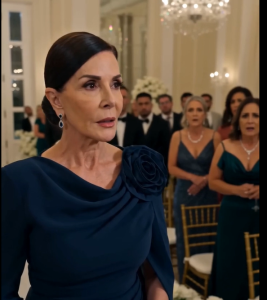
For a few minutes, everyone believed they were watching a perfect celebration. Then the groom turned toward the elegant older woman in the dark blue dress, and the room went cold.
She stood near the first row, calm and dignified, her dark hair pinned in a bun. She did not look weak or out of place. She looked like a woman who recognized storms before they arrived. Still, the groom stared at her as if she were an embarrassment he could erase with one command.
His voice exploded through the hall.
“¡Lárgate de mi boda! ¡Desde hoy dejaste de ser parte de mi familia!”
Several guests gasped. Others looked down, pretending not to hear. The words were cruel enough in any language. Get out of my wedding. From today, you are no longer part of my family.
The bride’s face tightened with shock. Her eyes moved from her groom to the older woman, then back again, as if begging him to stop before he destroyed something that could never be repaired. But he did not stop. He lifted his chin, enjoying the fear spreading through the room. To him, this was not a mistake. It was a performance.
He wanted everyone to see who held power.
The older woman in dark blue did not cry. She did not reach for him, beg, or defend herself in front of the whispering guests. Her stillness made the moment more uncomfortable. A mother humiliated by her own son should have looked broken. Instead, she looked disappointed.
That disappointed look angered him even more.
“You heard me,” he said sharply, switching into English for guests who did not understand Spanish. “Leave. This family does not need you here.”
The bride’s lips parted, but no words came. Her fingers tightened around her bouquet. A close friend covered her mouth. Near the back, a man shifted, the sound loud in the silence.
Then the older woman finally spoke.
Her voice was low, steady, and gentle.
“Está bien, hijo. Solo revisa tu teléfono antes de seguir con esta boda.”
Fine, son. Just check your phone before continuing with this wedding.
The groom gave a harsh little laugh, the kind men use when trying to prove they are not afraid. “My phone?” he said. “This is your grand warning?”
She held his gaze for one final second. There was sadness in her eyes, but no surrender.
Then she turned.
The room watched her walk toward the white double doors. The chandeliers glowed above her. White flowers brushed the edge of her dress as she passed. Guests leaned toward one another, whispering, confused by her calm. No one understood why a woman thrown out of her son’s wedding seemed to be leaving on her own terms.
At the altar, the groom remained rigid and arrogant. He did not pull out his phone. He did not ask himself why she had said those words. He only adjusted his white bow tie and looked at the priest as if ordering the ceremony to continue.
“Go on,” he said.
But before the priest could speak, the white double doors swung open.
The sound rolled like a verdict.
A man in a maroon suit stepped inside. He wore a black shirt and tie, and in one hand he carried a black document folder. Two bodyguards in tuxedos stood behind him. They were not wedding guests. They looked like men sent to enforce a decision already made.
Every head turned.
The groom spun toward the entrance, confusion flashing before anger covered it. “Who are you?” he demanded. “Who allowed you in here?”
The man in the maroon suit did not hurry. He walked forward with calm authority. The folder rested against his chest. With every step, the music faded until only uneasy breathing remained.
When he reached the center aisle, he lifted his voice.
“¡Señores! ¡La ceremonia queda suspendida inmediatamente!”
Ladies and gentlemen, the ceremony is suspended immediately.
The bride went pale. Her veil shook as her head turned from the representative to her groom. The groom’s jaw clenched. A moment earlier, he had controlled the room. Now the room no longer belonged to him.
“This is my wedding,” he snapped. “You cannot suspend anything.”
The representative opened the black folder just enough for the groom to see the official papers inside. “I can,” he said evenly. “And I have been instructed to do so.”
A murmur moved through the guests. Someone whispered, “What is happening?” Someone else lifted a phone to record, then lowered it, sensing this was bigger than gossip.
The bride’s eyes filled with tears. She had expected vows, music, applause, and a beautiful life beginning under crystal light. Instead, she was standing beside a man whose secrets seemed to be arriving one by one through the front doors.
The representative looked directly at the groom.
“La persona a la que usted acaba de echar de este lugar…”
The person you just threw out of this place…
The groom’s expression changed. The rage was still there, but fear had entered beneath it. His eyes darted toward the doors, as if he suddenly wished he could call the older woman back before the sentence was finished.
The representative held the folder higher.
“…fue la mujer a la que usted acaba de echar.”
The line struck the room like a bell.
The guests froze. The bride covered her mouth, tears slipping down her cheeks. The groom stood exposed beneath the chandeliers, surrounded by white flowers, his own cruelty hanging around him like smoke.
For the first time that day, he reached into his jacket and pulled out his phone.
His thumb shook as he unlocked the screen. Then he saw the messages. One after another, they appeared with the cold precision of business law. Board notification. Emergency resolution. Temporary suspension of executive privileges. Review of family shares. Immediate hold on personal authority pending formal action.
His face drained of color.
The woman he had just banished was not simply an unwanted relative. She was the person whose name sat above the signatures, the person whose approval had protected his position, the person whose silence had kept his arrogance alive.
And now her silence was over.
The representative closed the folder. The bodyguards remained behind him like statues. The priest stepped back from the altar. The bride looked at the man she was about to marry and seemed to understand, perhaps for the first time, that power without respect is only borrowed time.
The groom tried to speak, but no confident words came. All he could do was stare at the open doors where his mother had disappeared.
Outside, beyond the flowers and the chandeliers and the stunned guests, she was gone.
Inside, the ceremony remained suspended.
And the fortune he thought he controlled had already begun to turn against him.