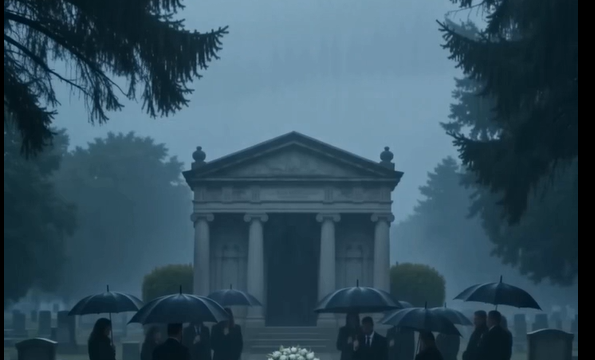
Rain fell steadily over the cemetery, turning the narrow paths between the tombstones into dark ribbons of mud. Beneath a sky the color of ash, mourners dressed in black stood silently around a white casket. Their coats were soaked, their shoes were wet, and their faces carried the exhausted sadness of people who believed they had come to say a final goodbye.
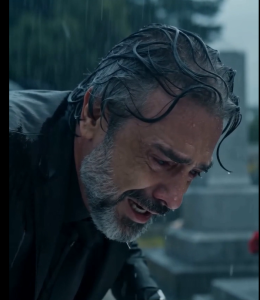
At the center of the gravesite stood an older man with gray-streaked hair and a beard. His black suit, shirt, and tie were drenched, but he seemed unaware of the cold water running down his shoulders. Both hands rested on the white casket as if letting go would make the loss more real.
He bent over it and cried.
The sound was not polished or restrained. It was the broken sobbing of a father who believed his daughter was gone forever. Rain struck the lid beneath his fingers, mixing with his tears as he tried to speak through his grief. Around him, no one interrupted. The only sounds were rainfall, quiet crying, and the solemn music of the funeral.
Then a young boy stepped forward.
He had wet brown hair pressed against his forehead and wore a gray shirt darkened by the rain. He looked small among the adults in formal black clothes, yet there was nothing uncertain about the way he moved toward the grave. His face was emotional, but his expression carried determination.
“¡Paren todo! ¡Ella sí está viva!”
Stop everything. She is alive.
The words seemed to cut through the storm.
Several mourners turned at once. Some stared at the child in disbelief. Others exchanged confused looks, wondering whether grief had overwhelmed him. The father slowly lifted his head from the casket. His tear-filled eyes searched for the boy as if he were afraid to understand what had just been said.
For a moment, hope and pain seemed to collide inside him.
“¿Qué dices, niño? ¡Mi hija ya no está!”
What are you saying, boy? My daughter is gone.
His voice carried disbelief more than anger. Only seconds earlier, he had accepted the terrible finality of the funeral. Now a child was standing in the rain, insisting that everything he believed about his daughter’s death might be wrong.
The father looked back at the white casket.
It was still closed.
Rainwater streamed down the smooth surface. The sight that had represented an ending now seemed suddenly frightening. If the boy was telling the truth, then the father was no longer standing beside a symbol of loss. He was standing beside a question that could not wait.
The mourners fell quiet.
The boy did not retreat.
Instead, he raised a trembling hand and pointed through the crowd.
Everyone followed his finger.
Among the mourners stood a blonde woman wearing a black one-shoulder dress and large gold earrings. Until that moment, she had blended into the gathering like another grieving guest. But when the boy pointed at her, her expression changed.
Her face tightened.
Her eyes widened.
The careful mask of mourning seemed to crack under the pressure of sudden attention.
“¡Sí está viva! ¡Ella le dio algo para dormir, no la quiere!”
She is alive. The blonde woman gave her something to make her sleep, and she does not want her.
A stunned murmur moved through the crowd.
The accusation transformed the atmosphere instantly. What had been a funeral filled with sorrow became a scene of confusion and suspicion. People who had been looking at the casket now turned toward the blonde woman. Some stepped back. Others watched her face, searching for any reaction that might explain the boy’s shocking claim.
She appeared panicked.
The father stared at her, then at the child, then back at the casket.
His grief did not disappear. It changed.
The possibility that his daughter might still be alive created a new kind of terror. If the boy was wrong, the father was being forced to reopen the deepest wound of his life. But if the boy was right, every passing second mattered.
Rain ran through the father’s beard and down his cheeks. His hands returned to the casket, but now they did not rest there in surrender. His fingers tightened against the edge.
The funeral no longer felt final.
It felt urgent.
The boy remained where he stood, soaked and visibly shaken, yet unwilling to withdraw his accusation. He had interrupted adults, challenged the certainty of a burial, and pointed directly at a woman surrounded by grieving witnesses. Whatever had brought him forward, he clearly believed the truth could not wait until later.
The blonde woman stayed frozen nearby.
Her anxiety deepened as more people watched her. No one yet knew exactly what had happened. The boy’s statement had not been proven, and the father had no immediate answers. But the accusation was too serious to ignore.
The older man leaned toward the casket once more.
His face, already devastated by grief, hardened with horror and anger. The possibility that his daughter might be trapped inside, merely sleeping because someone had given her something, was almost impossible to comprehend.
He looked toward the blonde woman.
“¡Es una mala persona!”
She is a bad person.
His shout echoed through the rain.
The mourners stood stunned as the emotional center of the funeral shifted completely. Minutes earlier, they had gathered to support a father saying goodbye to his daughter. Now they were witnesses to a disturbing allegation that challenged the very reason they were standing beside an open grave.
No one could simply continue as though nothing had happened.
No one in the crowd could know yet whether the child’s claim would prove true, but his interruption had changed what had to happen next. The father could no longer treat the burial as an unquestioned ending. The mourners could no longer look away from the accusation. Before another farewell could be spoken, the truth about the daughter, the boy’s warning, and the blonde woman’s actions would have to be confronted with care, urgency, and answers without delay.
The white casket remained before them, covered in rain.
The boy’s accusation hung over the gravesite.
The blonde woman’s fear was impossible to miss.
And the father, caught between despair and a fragile possibility of hope, faced the most urgent question of his life: Was his daughter truly gone, or had everyone arrived at the cemetery before learning the whole truth?
The storm continued without mercy. Water ran across the grass, down polished shoes, and over the names carved into old stones. Yet no one seemed ready to leave.
The father stayed beside the casket.
The boy kept his eyes on the woman he had accused.
Around them, the mourners waited, frightened and uncertain, as the funeral became something none of them had expected.
The music rose sharply beneath the sound of the rain, intensifying the fear, suspicion, and desperate hope surrounding the gravesite.
Then it stopped.
There was no answer yet.
Only the father’s anguished face, the silent white casket, a terrified blonde woman, and one young boy who had risked everything to shout that the daughter was still alive.
In the pouring rain, a farewell had become a race for the truth.